



More than 10 feet (3 meters) of muscle, armor, claws and serrated teeth … Now that’s a lizard! Image via Mikhaël Noury/ Pexels.
Let me introduce you to the Komodo dragon, the largest lizard in the world. It can detect food from miles away, hunt large mammals, swim between islands and even produce offspring without a male. Impressive, right? Looking at its size, claws, teeth and prehistoric appearance, the name “dragon” seems pretty fitting.
Growing to more than 10 feet (3 meters) in length, with serrated teeth and venom glands, this reptile is the top land predator on the handful of Indonesian islands where it lives. Are you ready to venture into its territory and discover more about this extraordinary animal?
King of the lizards
The Komodo dragon (Varanus komodoensis) is the largest living lizard on Earth. The biggest males can exceed 10 feet (3 meters) in length and weigh close to 200 pounds (90 kilograms) in the wild.
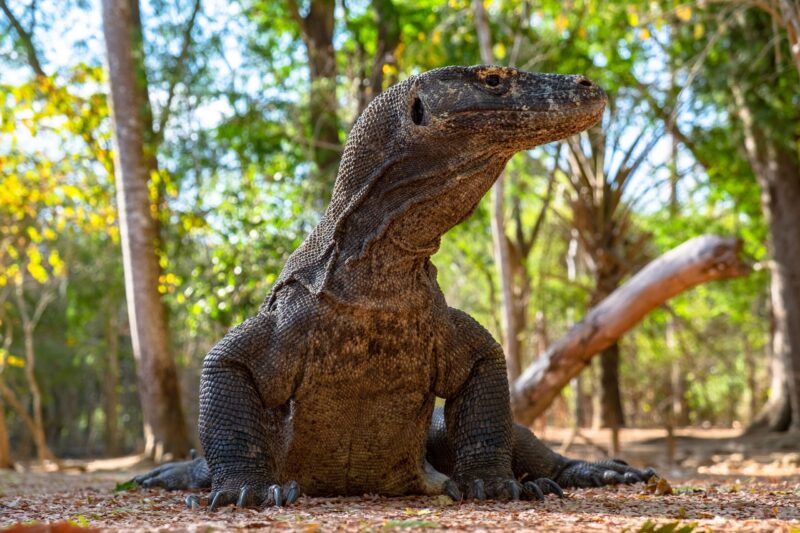
Its body is robust and muscular, supported by powerful legs ending in long, curved claws. It uses them to dig burrows, hold onto prey and defend itself. Its tail, which can be almost as long as the rest of its body, helps it keep its balance, defend itself and propel itself through the water.
Its skin is covered in hardened scales that conceal tiny bones called osteoderms. This natural armor provides particular protection to adult dragons.
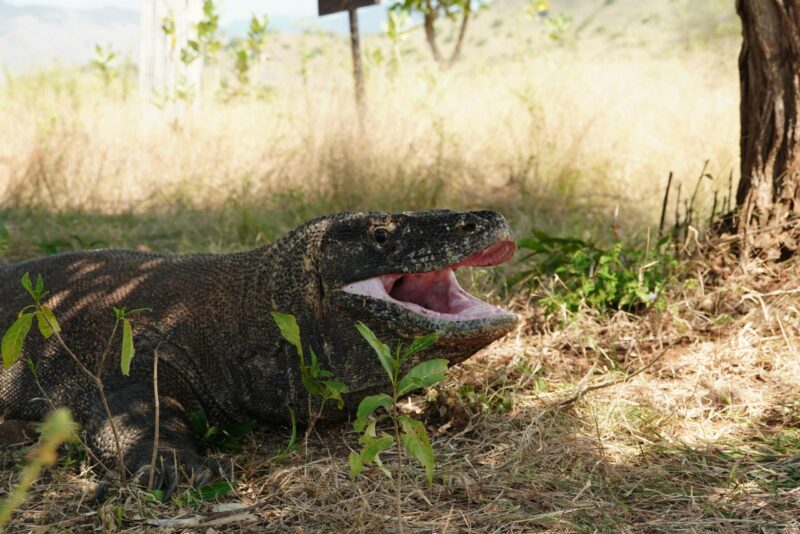
The giant lizard has around 60 teeth with serrated edges that resemble those of sharks. They work like biological knives, capable of cutting and tearing flesh. Its teeth are also continuously replaced throughout its life.
On either side of its head are external ear openings, equivalent to the outer ears of other animals. However, its most important sense is not hearing, but its highly developed chemical sense of smell.
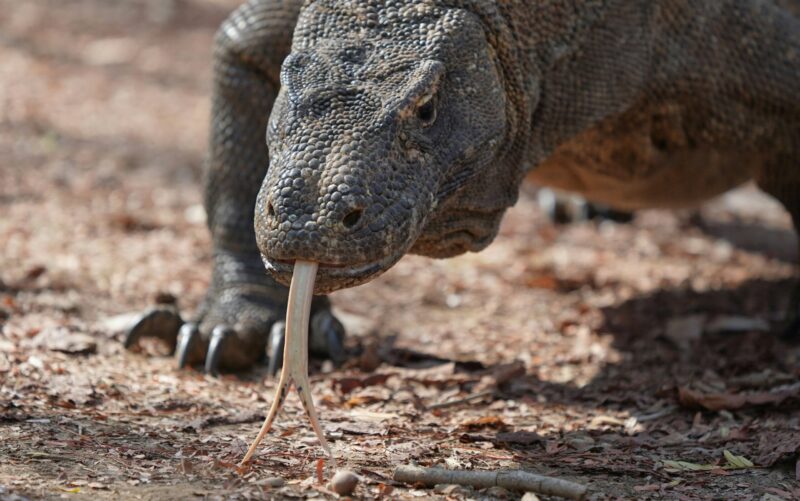
A forked tongue
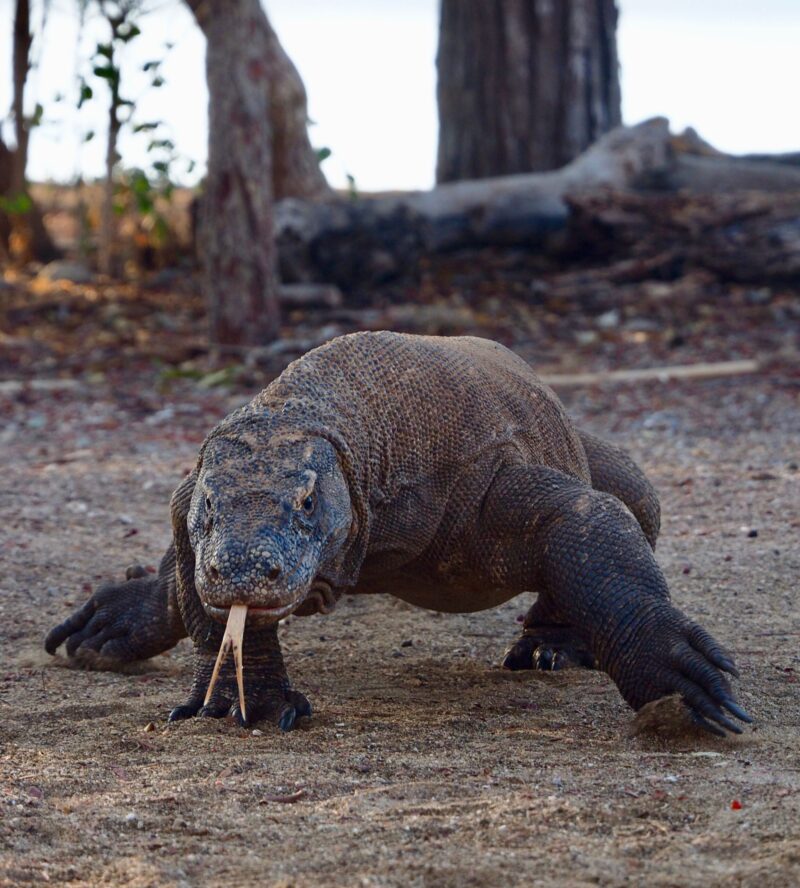
When you see a Komodo dragon constantly flicking its tongue, it isn’t threatening you or showing aggression. It’s “smelling.”
Its forked tongue collects chemical particles from the air and carries them to the Jacobson’s organ, located in the roof of its mouth. The two tips of the tongue can gather information from either side independently, helping the dragon determine where a scent is coming from and follow its trail. Thanks to this system, it can locate food several miles away when conditions are favorable.
In other words, a Komodo dragon doesn’t need to see its prey to find it: it can follow its chemical trail until it reaches it.
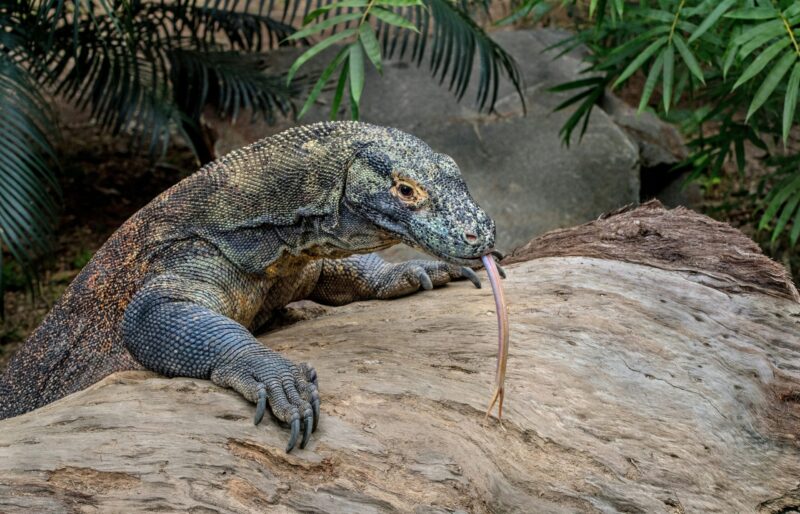
A bite with a twist
Komodo dragons are predators capable of taking down animals much larger than themselves, including deer, wild boar and water buffalo.
Once it gets a bite on its prey, its serrated teeth sink into the flesh. It then pulls backward with its head and neck, using its body weight to make its teeth slice through the tissue and tear away large chunks of flesh. It doesn’t need an exceptionally powerful bite: it is the combination of its teeth, powerful neck and that pulling motion that makes its bite so effective.
And it has another weapon. Komodo dragons have venom glands in their lower jaws. Their venom promotes bleeding and interferes with blood clotting, allowing the prey to lose blood and weaken rapidly.
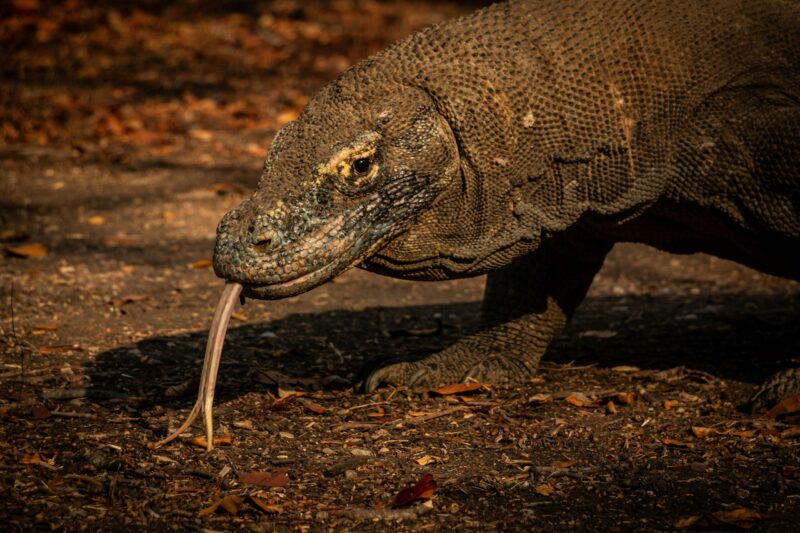
Nothing goes to waste
Although they are formidable hunters, they never pass up an opportunity for a meal. Carrion can make up a significant part of their diet, and when they find a carcass, they make use of almost everything, including bones that other animals would leave behind.
Their diet is remarkably varied. They can eat large mammals, birds, eggs, other reptiles and even other Komodo dragons! Yes, really …
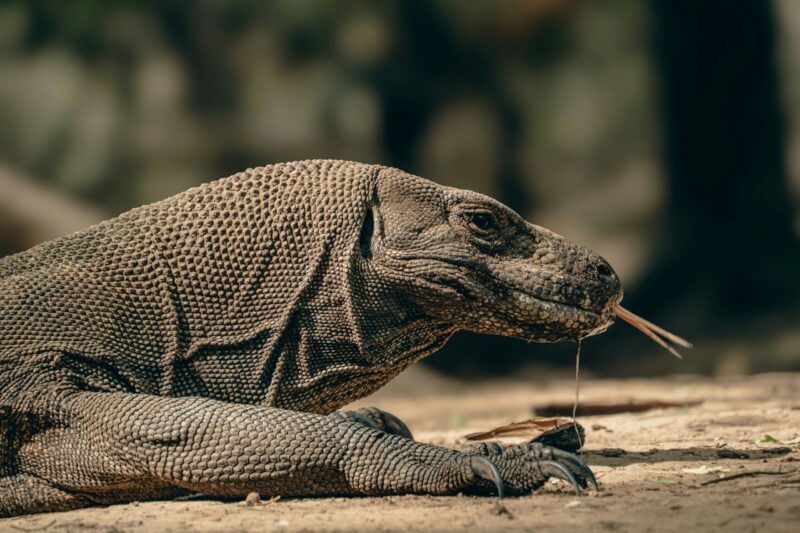
A very different childhood
Being born a Komodo dragon doesn’t guarantee a long life. Although they can live for more than 30 years, the first few years of life are particularly challenging.
Young dragons spend much of their early lives taking refuge in trees. This offers them some protection from adults, which practice cannibalism and will readily eat smaller individuals when the opportunity arises.
This constant threat forces young dragons to live very differently from adults. While adults roam the ground, young dragons remain among the branches, feeding on smaller prey and keeping out of the adults’ reach.
Island navigators
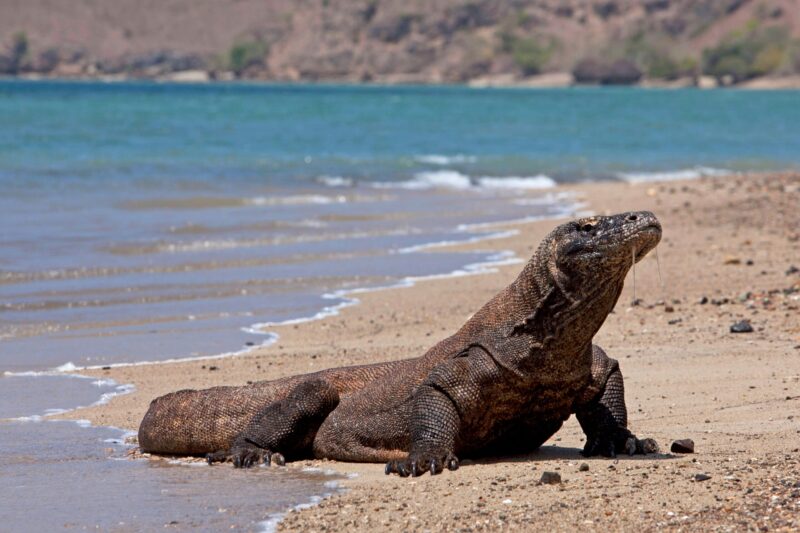
At first glance, an animal this heavy doesn’t exactly look like a great swimmer. Yet Komodo dragons can travel through the sea and cross short stretches of water between islands.
The tail provides much of the propulsion, while the feet, whose toes are partially joined by webbing, help with maneuvering in the water. This ability is particularly important in an archipelago where populations do not always remain completely isolated.
The occasional movement of individuals between islands promotes genetic exchange and reduces some of the risks associated with small, isolated populations.
Watch a Komodo dragon swim.
A reptile full of surprises
Like all reptiles, Komodo dragons are ectothermic: they rely on heat from their surroundings to regulate their body temperature. As a result, they alternate between periods of activity and periods of resting in the sun or shade.
Interestingly, they grow slowly and reach sexual maturity relatively late, usually between eight and ten years of age.
But perhaps the most surprising feature is their ability to reproduce through parthenogenesis. Like most animals, Komodo dragons normally reproduce sexually. However, females can also produce viable eggs without being fertilized by a male.
This ability was discovered in zoos when isolated females produced offspring despite having had no contact with males. For a species spread across several islands, this strategy could be useful if a female reached a new territory on her own and could not find a mate.
But parthenogenesis comes with a trade-off: the offspring produced this way are always male. That means these males would have to mate with their mother to continue the family line, unless they came across other unrelated Komodo dragons.
So while this ability could give a lone female a remarkable advantage in establishing a population in a new territory, it could also limit genetic diversity in that population, which can be harmful.
Busting myths
There are many misconceptions surrounding the Komodo dragon. Let’s bust some myths!
“They kill with the bacteria in their saliva.”
Their saliva does contain bacteria, but the current scientific understanding considers the venom and the wounds caused by the bite to play the main role in their hunting.
“They have the strongest bite of any animal.”
Despite their size and powerful jaws, their hunting success does not depend on exceptional bite force.
“They change color like chameleons.”
There is no solid evidence that Komodo dragons deliberately change color according to the season, their surroundings, or their mood. There is, however, natural variation in coloration between individuals and populations.
“They hunt in packs.”
They are normally solitary animals. When several individuals gather together, it is usually because there is carrion or another abundant food source.
“They became giant because they live on islands.”
The Komodo dragon does live on islands, but its enormous size did not suddenly appear when its ancestors became isolated. Its ancestors already belonged to a group of large lizards. During its evolution, island isolation may have favored the maintenance and even the increase of that size. As it became one of the main terrestrial predators in its ecosystem, a large body allowed it to tackle larger prey and compete more successfully for resources. Today, the Komodo dragon is the largest lizard on Earth.
The dragon of Indonesia
The Komodo dragon is naturally found on only a handful of Indonesian islands, including Komodo, Rinca, Flores and Gili Motang.
Habitat loss, declining prey populations and the effects of climate change pose significant challenges to its future survival.
This impressive animal is one of Indonesia’s greatest natural symbols and an emblem of an archipelago that’s home to some of the most extraordinary species on the planet.
For thousands of years, these islands have provided the Komodo dragon with the conditions it needs to survive. The challenge now is to preserve that balance so it can continue to do so for many years to come.
Bottom line: The Komodo dragon is the world’s largest lizard. It’s a venomous predator that can hunt, swim between islands and reproduce without a mate.
Read more: Colorful iguanas are our lifeform of the week
Read more: The shoebill stork is our fierce lifeform of the week
Like what you read?
Subscribe and receive daily news delivered to your inbox.
More from
Cristina Ortiz


Amazon wildfires hide another threat to the rainforest

Scientists discover a new tiger cat hiding in plain sight
Reef fish survival threatened by motorboat noise
Giant trees break a decades-old science theory



