This brief video describes fossils of the new duck-billed dinosaurs discovered in Wyoming that have preserved scales and hooves. Video via the University of Chicago.
- Scientists discovered two 66-million-year-old Edmontosaurus annectens duck-billed dinosaur fossils with features such as scales, tail spikes and hooves.
- A rare fossilization process preserved these features, when a thin clay layer – formed around the dinosaurs after burial – preserved outer body details.
- The study uncovered the earliest documented hooves in a land vertebrate, marking Edmontosaurus annectens as the first hooved reptile.
Science matters. Wonder matters. You matter.
Join our 2025 Donation Campaign today.
Unusual fossils reveal details of 2 duck-billed dinosaurs
Scientists have reconstructed external features of a 66-million-year-old duck-billed dinosaur species, Edmontosaurus annectens, using newly discovered fossilized remains of two dinosaurs. These fossil mummies, as the researchers called them, had exquisite preservation of scales, tail spikes and hooves. The researchers, led by the University of Chicago, said on October 23, 2025, that the fossils formed in a rare fossilization process where a thin layer of clay formed around the dinosaurs’ bodies soon after burial. As a result, there was a 3D clay mask of large, continuous areas over the outer body. Using these unique fossils, the researchers built realistic views of how the dinosaurs looked like in life.
Paul Sereno of the University of Chicago Biological Sciences Division is the lead author of the new paper. The team published its findings in the peer-reviewed journal Science on October 23, 2025. Sereno said:
It’s the first time we’ve had a complete, fleshed-out view of a large dinosaur that we can really feel confident about. The badlands in Wyoming where the finds were made is a unique ‘mummy zone’ that has more surprises in store from fossils collected over years of visits by teams of university undergrads.
He added:
This may be the single best paper I’ve released. From field to lab to 3D reconstructions along with a suite of useful terms defined, it’s a tour de force, and it tells a coherent story about how these remarkable fossils come to be and what we can learn from them.
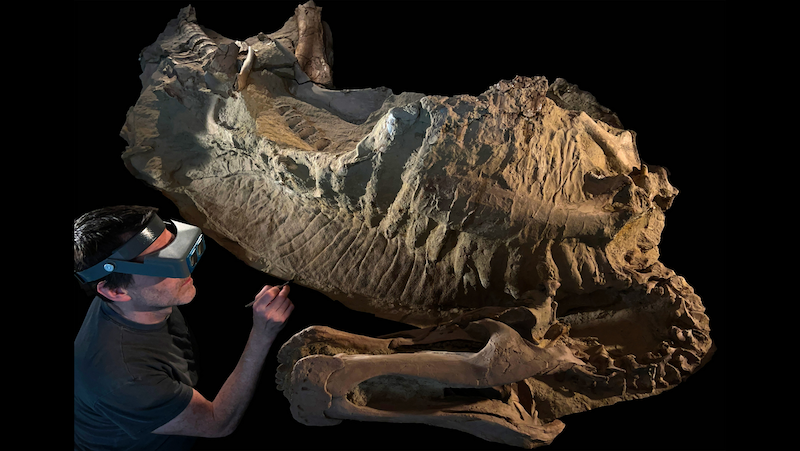
These duck-billed dinosaurs had scales, spikes and crests
The two dinosaurs in this study were a species of duck-billed dinosaur called Edmontosaurus annectens, which lived 66 million years ago at the end of the Cretaceous Period. They were herbivorous dinosaurs, reaching a length of over 40 feet (12 m) at adulthood. Additionally, one was a young adult and the other a juvenile.
Sereno commented:
The two specimens complemented each other beautifully. For the first time, we could see the whole profile rather than scattered patches.
After meticulously cleaning the fossils and doing extensive imaging on them, the scientists were able to identify new features, never seen before, in this species.
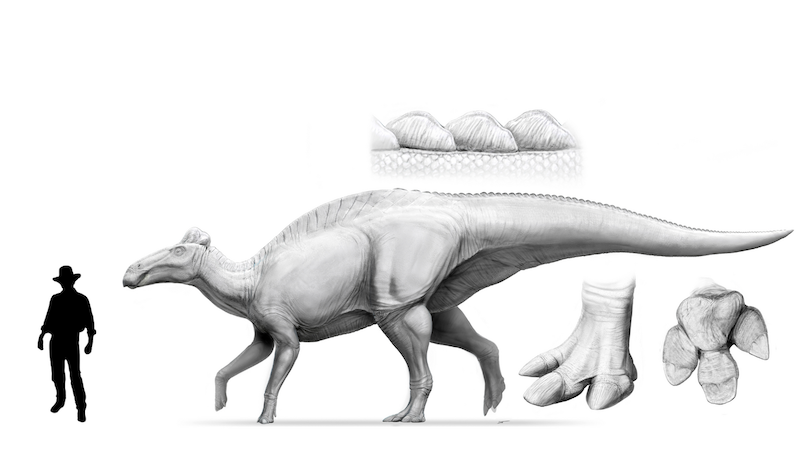
For instance, the dinosaurs had a fleshy crest at the top of the neck that continued like a ridge over the back. However, that ridge morphed into a single row of short spikes that carried down to the tail. In fact, each spike was positioned over a vertebra that connected to each other.
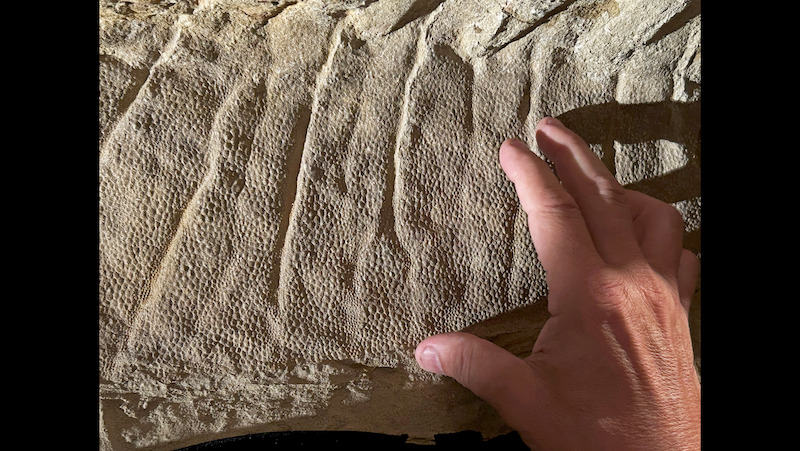
The researchers also reported small pebble-like scales, measuring just 0.04 to 0.16 inches (1 to 4 millimeters) across, as well as some larger polygonal scales on the dinosaurs’ lower body and tail. The small scales were unexpected; they thought an animal that grew to over 40 feet long would have larger scales.
Additionally, they also noted wrinkles over the ribcage, suggesting that this duck-billed dinosaur species had very thin skin in that area. But the skin was a bit thicker over the sides of the tail.
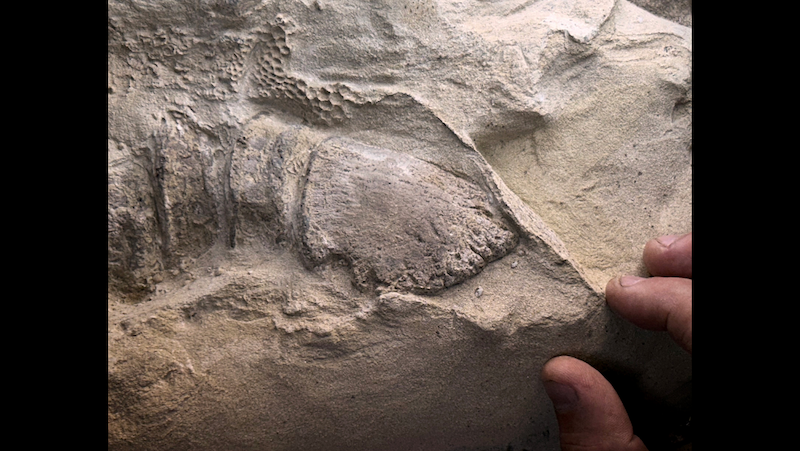
These dinosaurs also had hooves!
Researchers were surprised to discover that the adult duck-billed dinosaur had wedge-shaped hooves encasing the tips of each of its three hind toes. At the bottom, the hooves were flat, just like those of a horse.
In addition, the researchers were able to reconstruct the dinosaur’s hind feet. They did this by taking CT scans of the dinosaur’s feet. They also created 3D images of well-preserved duck-billed dinosaur footprints found in rock dated to the same time period of those dinosaurs. With these two types of data, the scientists were able to show there was a fleshy heel pad behind the hooves.
Sereno remarked:
There are so many amazing ‘firsts’ preserved in these duck-billed mummies: the earliest hooves documented in a land vertebrate, the first confirmed hooved reptile, and the first hooved four-legged animal with different forelimb and hindlimb posture.
The unique preservation process for these duck-billed dinosaurs
Most fossils preserve only the hard parts, such as bones and teeth. That’s because soft tissue decomposes. But in this case, there was a rare twist in the fossil preservation process. Soon after the animals were buried, and before the tissue completely decomposed, a very thin layer of clay, just 1/100th of an inch (0.25 mm) thick, formed around the body surfaces.
Sereno said:
This is a mask, a template, a clay layer so thin you could blow it away. It was attracted to the outside of the carcass in a fluke event of preservation.
That fluke occurred over a sequence of events. First, a flash flood suddenly swept sediment over the dinosaur carcasses, which had been drying under the sun. As a result, a biofilm formed over the carcass’ surface, and it pulled clay out of the surrounding wet sediment. This process formed a very thin clay layer around the animals’ outer bodies, capturing fine surface details in three dimensions. The tissue eventually decayed, and the dinosaur’s bones became fossilized. But, amazingly, that clay layer boundary at the dinosaurs’ outer body surface remained preserved.
Uncovering these unique fossils
It’s not the first time researchers have found so-called “mummified” dinosaurs. Scientists uncovered similarly preserved dinosaurs in the early 20th century in Wyoming. (This, by the way, is not anything like mummies found in ancient Egypt, which were human-created. There is still tissue left in those mummies, but not in 66-million-year-old dinosaur mummies.)
Sereno and his team were able to relocate that original site, in east-central Wyoming, using old photographs and field investigations. There, they uncovered the two duck-billed dinosaurs – a juvenile and young adult – described in their paper.
At their lab, the researchers used an array of sophisticated imaging tools, such as hospital CT scanners, micro-CT scanners and X-ray spectrographs. They also analyzed the clay and studied the excavation site to better understand the fossilization process.
Bottom line: Scientists have reconstructed the features of two 66-million-year-old duck-billed dinosaurs, uncovering exquisite details such as scales and hooves.
Like what you read?
Subscribe and receive daily news delivered to your inbox.
More from
Shireen Gonzaga


Alpha Cephei, or Alderamin, is a fast-spinning star

Delta Cephei helps measure cosmic distances