What are ‘dog days?’
You might have heard the hottest days of summer referred to as the dog days of summer … but where did this term come from? It turns out they come from an ancient belief about a star – the brightest star in the sky – Sirius in the constellation Canis Major. Sirius is also called the Dog Star. And the ancient Egyptians believed that when Sirius rose at the same time as the sun, the double whammy of Sirius and the sun caused the hot weather. Voila. Dog days!
But when does that happen? And, exactly, are the dog days?
Sirius and the hottest days of summer
The name Sirius comes from an ancient Greek word for “scorching” or “glowing.” It’s the brightest star visible from Earth, and skywatchers in both hemispheres can see it.
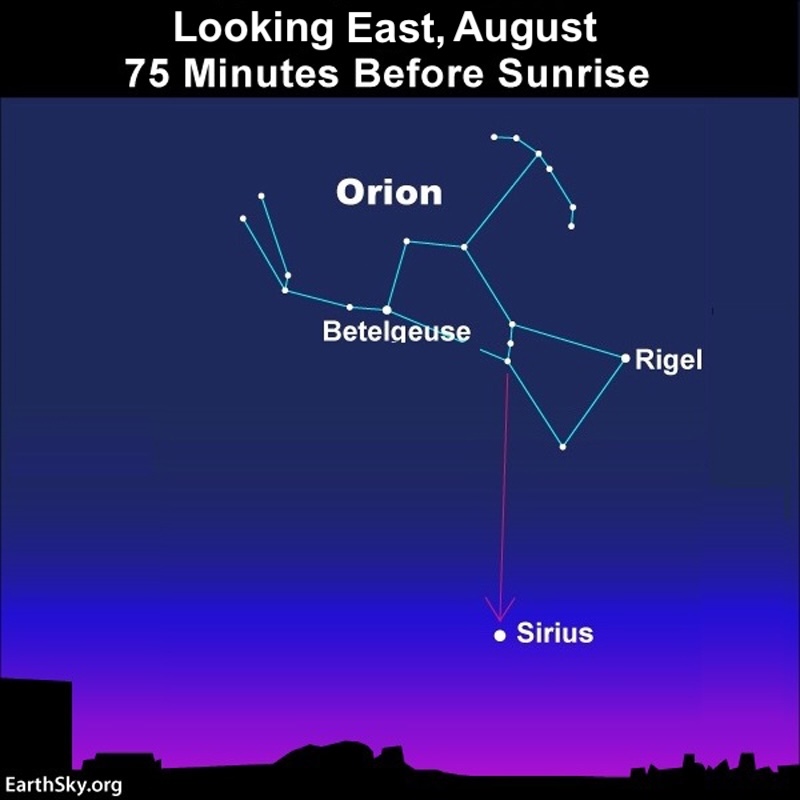
Sirius is a beacon in Northern Hemisphere winter skies. During northern summer, it lies behind the sun from Earth’s perspective. And in late summer it appears in the east before sunrise, near the sun in our sky.
Ancient Egyptians noted that Sirius rose just before the sun each year immediately prior to the annual flooding of the Nile River. Although the floods could bring destruction, they also brought new soil and new life.
Ancient Romans noticed the reappearance of Sirius in the morning sky as well. And they blamed it for the heat in July and August. That’s because Sirius rose each day before sunrise. And then, it traveled across the sky with the sun all day. Thus, early stargazers might have imagined a double-dose of heat from Sirius and the sun caused the hot weather.
What are the dates?
According to the National Weather Service:
The “dog days of summer” is a phrase used to describe the hot and humid days of summer. It can be traced back thousands of years to the days of the Roman Empire. It refers to the dates from July 3 through August 11, which is 20 days prior and 20 days after the star Sirius rises and falls in conjunction [sharing the same spot in our sky] with the sun. Sirius was known as the “Dog Star,” because it is the brightest star in the constellation Canis Major (Large Dog).
So, you can see the term dog days isn’t new. And its origin is based on objects in the sky.
Your latitude makes a difference
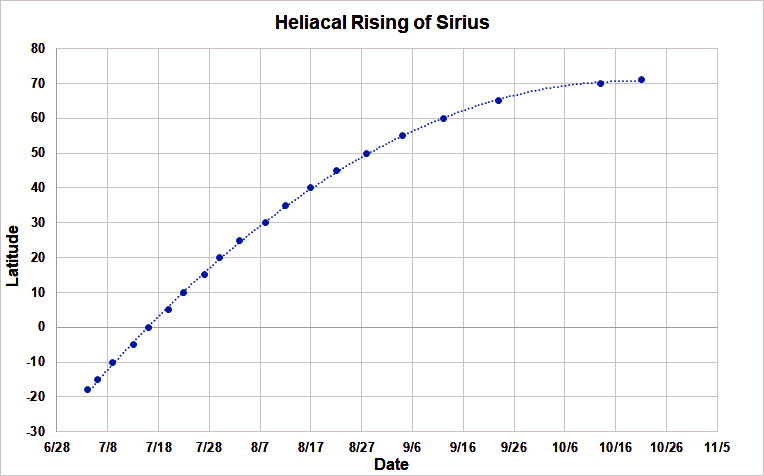
Since the helical rising of Sirius will vary depending on your location on the globe, your warmest days will vary as well. Plus, calendar dates have shifted since ancient times.
Locations closer to the equator can spot Sirius rising around mid-July. At -20 degrees southern latitudes, Sirius can be spotted in early July. While +20 northern latitudes degrees won’t spot it until early August. Then based on the date you can spot Sirius rising for the first time, your warmest days are centered around then.
Read more: The return of Sirius in the morning signals seasonal change
Sirius in conjunction with the sun
Since Sirius is in conjunction with the sun on July 23, the dog days of summer center around then. The dog days of summer fall between July 3 to August 11, and that’s when we have many of our warmest days in the Northern Hemisphere.
So even though we know why this is the hottest time of the year in the Northern Hemisphere, the legend of the dog days has survived.
Bottom line: The dog days of summer are named for the Dog Star, Sirius – the brightest star in the sky – in the constellation Canis Major the Greater Dog. They are associated with the hottest time of the year.
Like what you read?
Subscribe and receive daily news delivered to your inbox.
More from
Marcy Curran


Visible planets and night sky guide for October

Meteor shower guide 2026: Up next … the Orionids
Smart scopes are amazing. Here’s why I love mine
Deep partial lunar eclipse overnight