The ghost of Biela’s Comet
Have you ever heard of the Andromedid meteor shower? Nowadays, this late November meteor shower is so weak that it’s largely too dim to see with the unaided eye. But a couple of hundred years ago it surged in two spectacular meteor storms … before it largely disappeared. And, spookily, this shower comes from the ghost of a comet.
Biela’s Comet was a regular visitor to skies in the late 1700s and early 1800s. French astronomer Jacques Leibax Montaigne first recorded this comet in 1772. It wasn’t until 1826 that Austrian astronomer Wilhelm von Biela recognized that the comet came around every 6.6 years. So Biela’s predictions are what gave the comet its name.
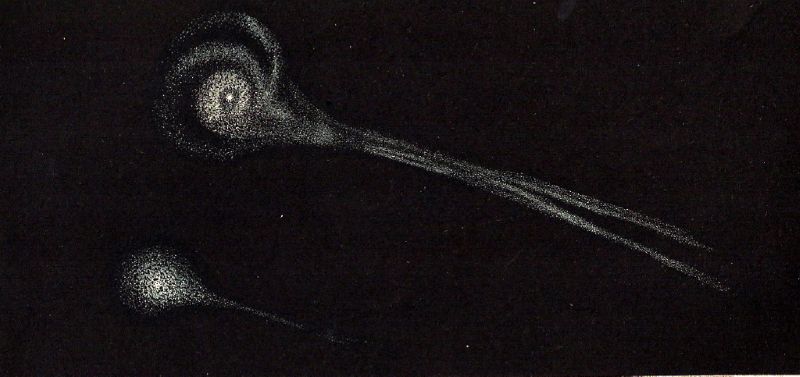
But when Biela’s Comet returned in 1846, it put on a shocking show. At first the comet appeared distinctly pear shaped, according to The Facts on File Dictionary of Astronomy, and then it split in two some 10 days later. The two halves of Biela’s Comet continued traveling in practically the same orbit, with one about 174,000 miles (280,000 km) behind the other. The brightness of each comet half fluctuated wildly. The Dictionary of Astronomy then says:
At the next return in 1852, their separation had increased eightfold, the two periods different by about 15 days.
Neither comet has been seen since.
Meteor showers and meteor storms
While Biela’s Comet (or comets) may be gone, the meteor shower they spawned remains. The Andromedids (sometimes called the Bielids) is an annual meteor shower in late November. The radiant of the shower — the spot the meteors appear to radiate from — is in the constellation Andromeda the Chained Lady.
How do we know this meteor shower is related to the ghost of Biela’s Comet? The meteoroid stream — or the trail of pebbles left behind — has the same orbit as the comet had.
In fact, Biela’s Comet produced two meteor storms. Meteor storms are especially strong showers that produce at least 1,000 meteors per hour. And that’s what happened on November 27 of 1872 and again in 1885. The 1885 meteor storm was incredibly strong, with reports of 75,000 meteors an hour. However, the shower has been much quieter ever since. In general, the few meteors it produces today are so dim that they are not visible to the eye alone.
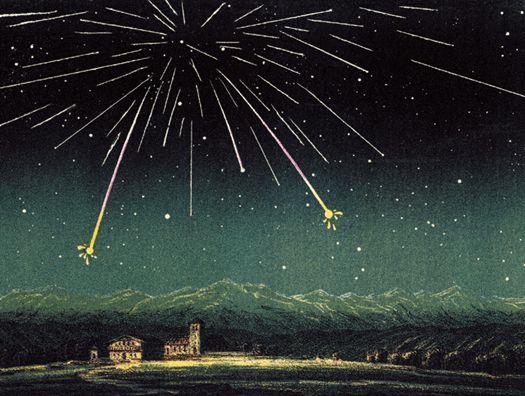
Bottom line: November’s Andromedid meteor shower is the product of the ghost of Biela’s Comet. This comet stunned observers in the 1800s when it broke up and then produced meteor storms.
Like what you read?
Subscribe and receive daily news delivered to your inbox.
More from
Kelly Kizer Whitt


Visible planets and night sky guide for October

Moon and Jupiter pics here! A cosmic hide-and-seek
Solar system’s most bizarre moons! Take the tour