



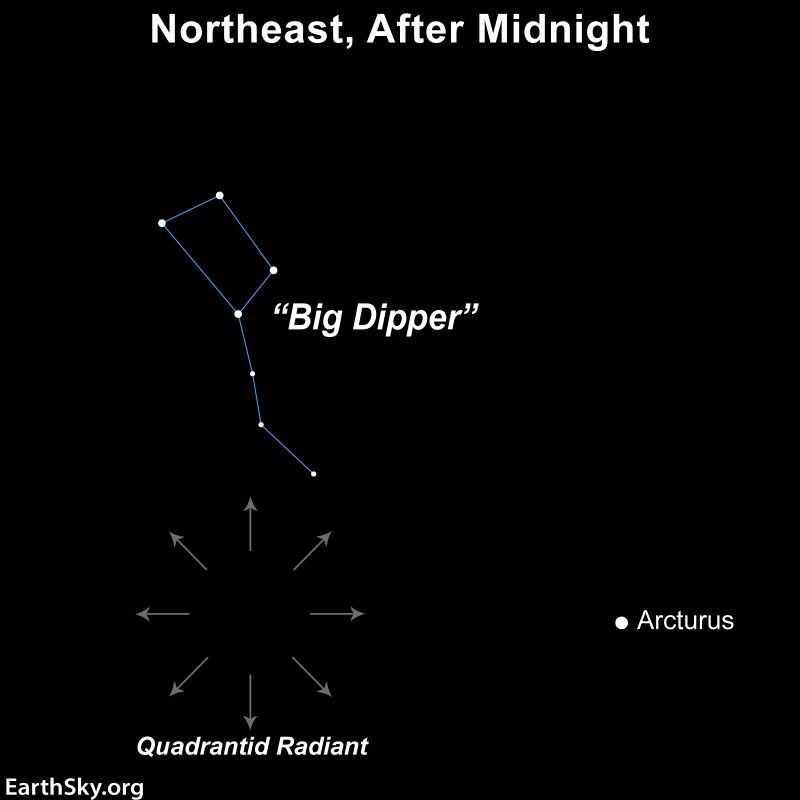
The Quadrantid meteor shower is one of a few each year with an exceedingly narrow peak, in this case lasting only about 6 hours. They are fast, bright meteors, flashing into view for just those few peak hours. In 2027, the Quadrantids won’t be washed out by a waning crescent moon. Catching them is tricky! Read on …
2027 Quadrantid meteor shower
When to watch: The best time to watch for the 2027 Quadrantids is the hours before dawn on January 4. (The predicted peak** is 05:47 UTC on January 4).
Nearest moon phase: A new moon will come at 20:24 UTC on January 7, 2027, so the waning crescent moon shouldn’t interfere with Quadrantid meteors.
Radiant: Rises in the north-northeast after midnight and is highest before dawn. The radiant point for the Quadrantids is in a now-obsolete constellation, Quadrans Muralis the Mural Quadrant. Nowadays, we see the radiant near the famous Big Dipper asterism. Because the Quadrantid radiant is far to the north on the sky’s dome, this is mostly a far-northern shower, not as good for the Southern Hemisphere.
Expected meteors at peak, under ideal conditions: Under a dark sky with no moon, when the radiant is high in the sky, the Quadrantids can (briefly) produce over 100 meteors per hour. In 2027, you’ll have dark skies and the Quadrantids often produce really bright meteors known as fireballs.
Duration of shower: The Quadrantid meteor shower runs from mid-November through mid-January each year, according to this 2017 article in the journal Icarus. You might see a Quadrantid streak by any time during that interval. But most activity is centered on the peak. This time period is when we’re passing through the meteor stream in space!
Note: The Quadrantid shower is one of four major meteor showers each year with a sharp peak (the other three are the Lyrids, Leonids, and Ursids).
Report a fireball (very bright meteor) to the American Meteor Society: it’s fun and easy!
More about the Quadrantid meteor shower radiant point
The radiant point of the Quadrantid shower makes an approximate right angle with the Big Dipper and the bright star Arcturus. If you trace the paths of the Quadrantid meteors backward, they appear to radiate from this point on the starry sky.
Now for our usual caveat. You don’t need to find the meteor shower radiant to see the Quadrantid meteors. The meteors will radiate from the northern sky but appear in all parts of the sky.
But you will see the most meteors (or any meteors) when the radiant is above your horizon (or just below your horizon). Here’s a repeat of what we said above. Best bet: Use Stellarium or another star app to find out what time the Big Dipper asterism and the bright star Arcturus rise into your sky. The radiant point for this shower is near them. You’ll see the most meteors when these stars are above your horizon.
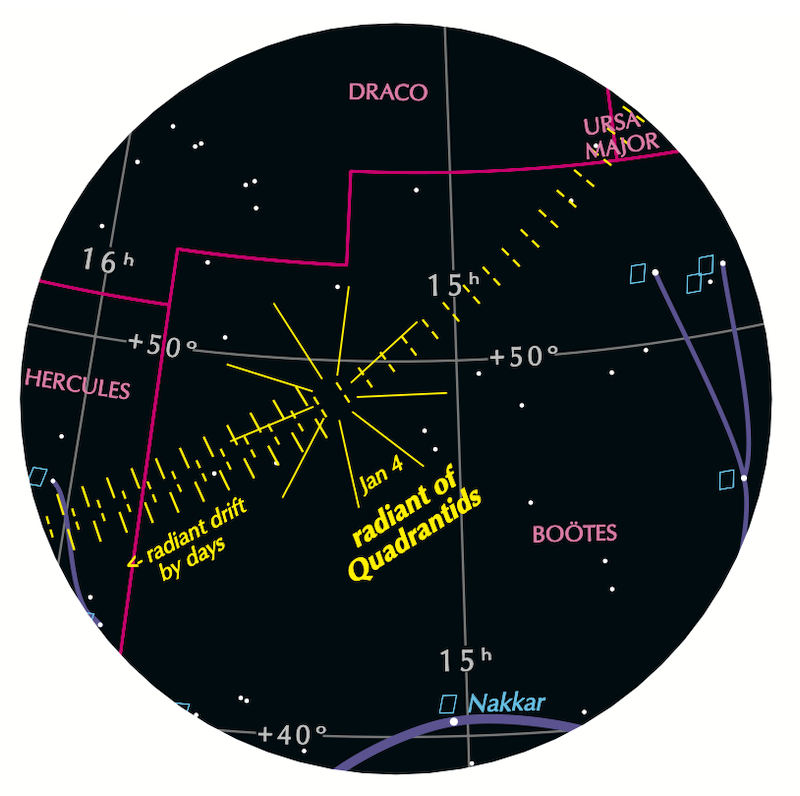
Constellation Quadrans Muralis?
Most meteor showers get their name from the constellations from which they appear to radiate. So it is with the Quadrantids. But the Quadrantids’ constellation no longer exists, except in memory. The name Quadrantid comes from the constellation Quadrans Muralis (Mural Quadrant). French astronomer Jerome Lalande created this constellation in 1795. This now-obsolete constellation was between the constellations of Boötes the Herdsman and Draco the Dragon. What happened to it? Where’d it go?
To understand the history of the Quadrantids’ name, we go back to the earliest observations of this meteor shower. In early January 1825, Antonio Brucalassi in Italy reported that:
… the atmosphere was traversed by a multitude of the luminous bodies known by the name of falling stars.
They appeared to radiate from Quadrans Muralis. In 1839, two men, Adolphe Quetelet of Brussels Observatory in Belgium and Edward C. Herrick in Connecticut, independently suggested the Quadrantids as an annual shower.
Then, in 1922, the International Astronomical Union (IAU) created a list of the 88 modern constellations. And it did not include Quadrans Muralis. Hardly anyone would remember this old constellation, if not for the Quadrantid meteor shower.

Quadrantid shower favors the Northern Hemisphere, but …
The Quadrantids favor the Northern Hemisphere because their radiant is so far north on the sky’s dome. If you’re in the Southern Hemisphere, you might be tempted to resign yourself to the months-long meteor drought that kicks off every year and ends in April with the Lyrids.
But, once in a while, we do hear from Southern Hemisphere dwellers who say they’ve seen a few Quadrantids!
Quadrantids’ parent object(s)
From the late, great Don Machholz (1952-2022), who discovered 12 comets …
For many years, the parent comet for the Quadrantids remained unknown. That’s because astronomers were looking for an object whose orbit matched the orbit of the Quadrantids’ meteor stream. Other meteor showers do have parent objects whose orbits match their meteor streams.
But the Quadrantids’ parent object – or objects – are different. There are currently at least two related objects associated with Quadrantid meteors. Neither presently comes anywhere near Earth’s orbit. But both seem to be responsible for these early January meteors.
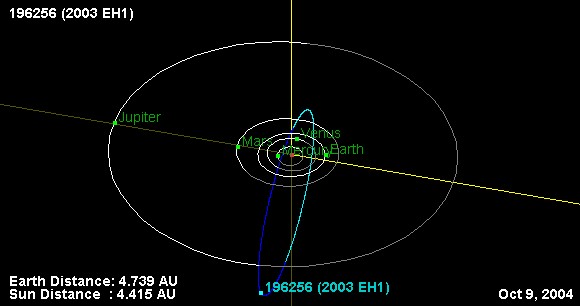
The chief object that spawns the Quadrantids is an asteroid named 2003 EH1. It’s believed to be a dormant or extinct comet. The Lowell Observatory Near-Earth-Object Search (LONEOS) based near Flagstaff, Arizona, found asteroid 2003 EH1 on March 6, 2003. The asteroid takes 5.5 years to orbit the sun. Its closest point to the sun (perihelion) is 1.2 astronomical units (AU). One AU is the distance between the Earth and the sun.
In past centuries, 2003 EH1 must have passed much closer to the Earth’s orbit. Now, though, this asteroid stays well outside Earth’s orbit. Yet particles ejected from this asteroid do intersect Earth’s orbit, to produce the Quadrantids’ narrow peak.
And astronomers now say there is also a second, related object that also contributes to this meteor shower. The second object – Comet 96P/Machholz – produces a less intense and shallower peak. The material we see streaking across the sky left this comet centuries ago. Its perihelion distance is 0.12 AU, and it orbits the sun every 5.3 years. It was back near the Earth in late January 2023.
Captured comet?
What’s the story on these two parent objects for the Quadrantids? The latest theory is that a large comet was captured by our sun and settled into a short-period orbit in about 2,000 BCE. This comet supplied meteors to the inner solar system and then it broke apart sometime between 100 CE and 950 CE. This breakup produced the Machholz Complex. In other words, there are multiple resultant offspring of this great comet. They are Comet 96P/Machholz, the Marsden Comet Group, the Kracht Comet Group, asteroid 2003 EH1 and eight meteor showers. The group is named the Machholz Complex after the main object, 96P/Machholz.
Another object might be involved
A comet that was seen more than 500 years ago, C/1490 Y1, might be involved, too. The orbit calculated for this comet comes from rough positions calculated for the comet’s predicted return, which should be every few years. But we have not seen this comet again. One study suggests it approached too close to the planet Jupiter. So it might have been thrown out of the solar system. That might be why we haven’t seen it since 1490. Or, the comet might have split up prior to its next return, producing the Machholz Complex.
This is not the final word about the parent objects of the Quadrantid meteor shower. Research continues among orbit calculators to better understand the transition of material from the surface of these objects to our Earth’s atmosphere every January. A new paper comes out nearly every year on the subject. That is how science works.
Regardless of their origins, the Quadrantid meteor shower is a fine way to start a new year.
Quadrantid meteor shower photos from the EarthSky community


Bottom line: The best time to watch the Quadrantid meteor shower in 2027 is the hours before dawn on January 4, in a dark sky. This shower has a narrow peak, lasting only hours.
**Peak times for meteor showers provided by Robert Lunsford of the American Meteor Society. Note that meteor shower predicted peaks may vary.
Like what you read?
Subscribe and receive daily news delivered to your inbox.
More from
Editors of EarthSky


Venus brightest in the evening sky this week

See Venus in the daytime: Here are 3 tips
Crepuscular rays are sunrays in twilight skies
What is retrograde motion? And why is the moon moving backwards?


