You deserve a daily dose of good news. For the latest in science and the night sky, subscribe to EarthSky’s free daily newsletter.
Has Rubin just discovered a new dwarf planet?
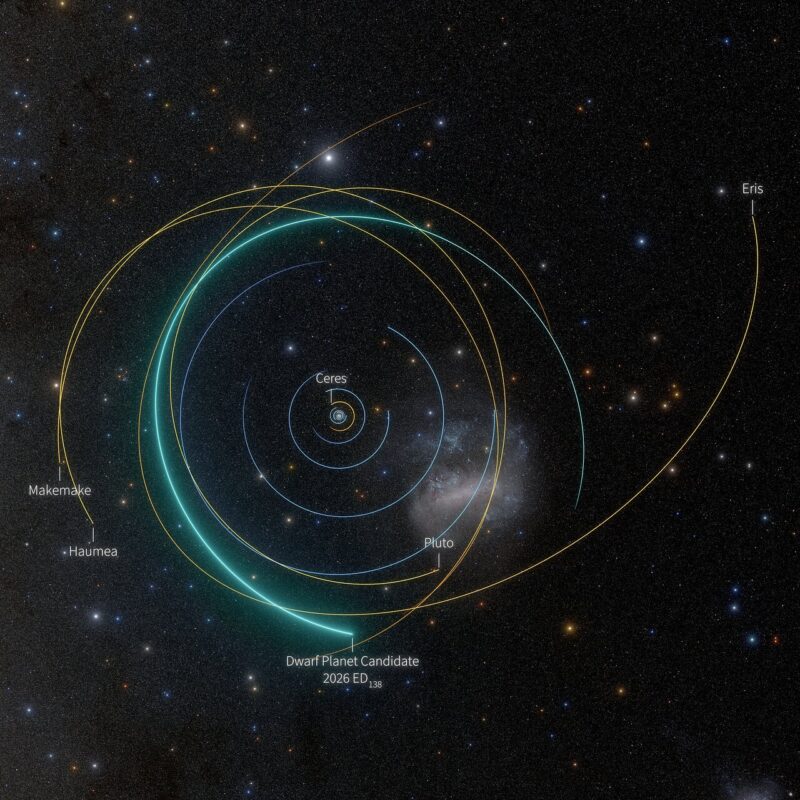
There are only five officially recognized dwarf planets in our solar system. Mini worlds Pluto, Eris, Makemake and Haumea all lie beyond the orbit of Neptune, while Ceres is in the asteroid belt. But on October 27, 2026, astronomers said the Vera C. Rubin Observatory has spotted a candidate that could become the 6th known dwarf planet.
Currently designated as 2026 ED138, the new dwarf planet candidate seems surprisingly large for something that’s remained undetected so long. The current estimates of its size — based on its distance, brightness and reflectivity — suggest ED138 is between 370 and 930 miles (600 and 1,500 km) across. For comparison, Pluto’s diameter is 1,473 miles (2,370 km).
It appears to be the brightest object discovered in the solar system in nearly 20 years.
Excited disbelief
Matthew Holman of the Center for Astrophysics | Harvard & Smithsonian was running data on October 13 when he noticed an object that seemed unusually bright and large for its distance. Holman said:
My first reaction was one of excited disbelief. Objects like this are very rare, so I immediately started checking whether I or the code had done something wrong.
But additional observations helped him confirm that the icy body did exist in an orbit just beyond Pluto.
Mario Juric of the University of Washington said:
Finding an object this big, roughly 1,000 kilometers across, is something that happens maybe once in a generation. It’s the largest trans-Neptunian object found in about 20 years, and Rubin turned it up while we were still commissioning the telescope.
It’s just a little farther out than Pluto
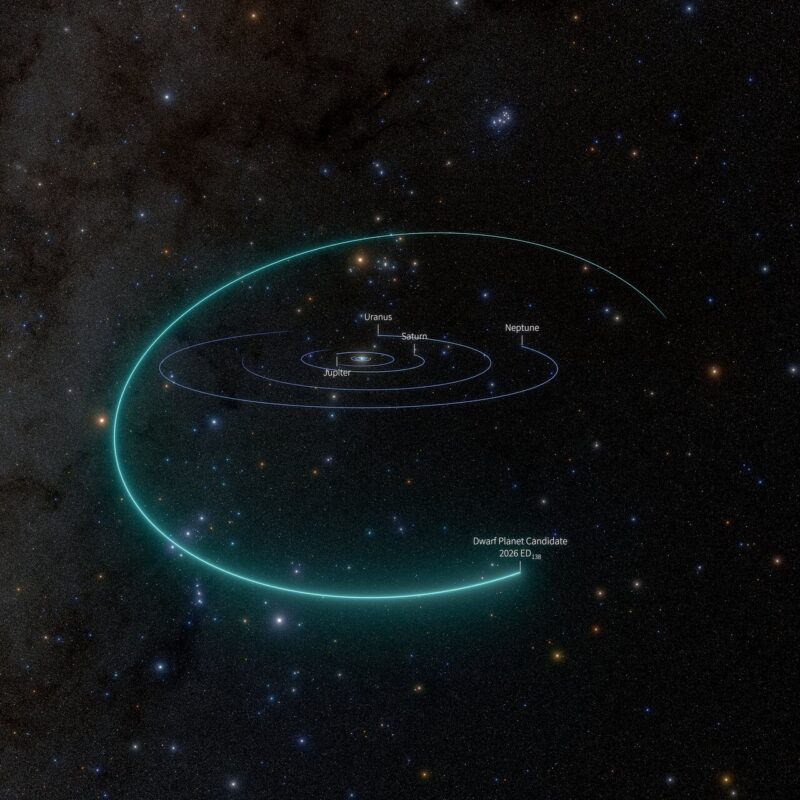
The new dwarf planet candidate orbits the sun at about 46 astronomical units, or AU. 1 AU is the distance from Earth to the sun. And Pluto orbits the sun at an average distance of 40 AU.
This region of the solar system is what astronomers call the Kuiper Belt. This disk of objects extends from beyond Neptune at about 30 AU out to about 50 AU. Scientists have discovered a number of objects in the Kuiper Belt, including Pluto and Haumea and many other smaller, irregular-shaped objects that don’t get the designation of dwarf planet. One example is Arrokoth, the snowman-shaped object that New Horizons flew past.
But due to its size, astronomers think the newly discovered object ED138 is a dwarf planet that is massive enough to pull itself together into a spherical shape.
NSF–DOE Vera C. Rubin Observatory/NOIRLab/SLAC/AURA/R. Proctor.
Why wasn’t it discovered until now?
If ED138 is relatively bright, why wasn’t it discovered before? Well, the new dwarf planet candidate was in a region of sky close to the plane of the Milky Way. So it had to complete with a background packed with little points of light. But it was captured on earlier observations.
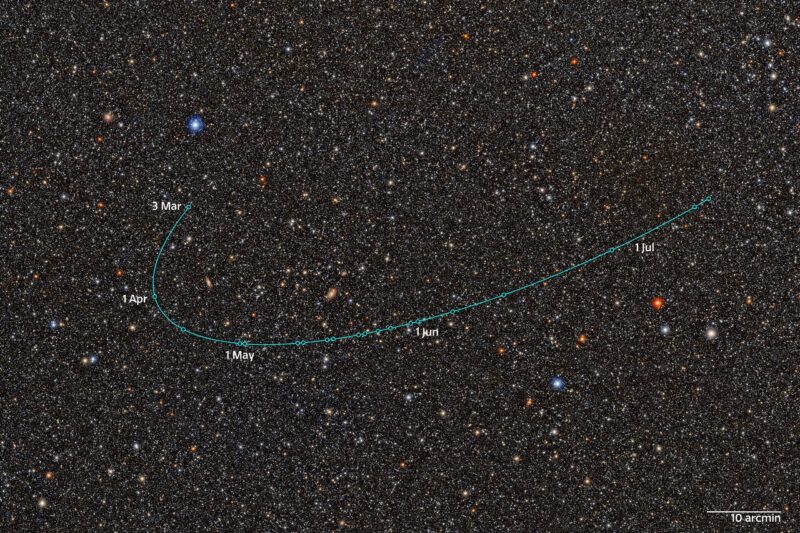
After pinpointing it in the Rubin data and observing it 20 nights earlier this year, researchers also found it in archival data from the Dark Energy Camera all the way back to 2016.
Pinning down ED138’s orbit
So now, with these data points, both professional and amateur astronomers alike can trace the orbit of ED138. And Tony Dunn has done just that with his website Orbit Simulator.
Tony has also shown that the new dwarf planet candidate is in a 7:12 resonance with Neptune. For every 12 orbits of Neptune, ED138 makes 7 orbits of the sun. Pluto has a 2:3 resonance with Neptune. For every 3 orbits Neptune makes, Pluto makes 2 orbits. Haumea is also in a 7:12 resonance with Neptune.
These dwarf planets have a resonance with Neptune because the gas giant planet herded them into their orbits. It’s the objects out in the Kuiper Belt that didn’t attain harmony with Neptune that were likely flung out of our solar system.
Awaiting confirmation
Astronomers are already planning more follow-up observations. If ED138 is confirmed, it will likely be the third largest known dwarf planet after Pluto and Eris. Holman said:
If confirmed as a dwarf planet, ED138 would join a — currently — very small family of worlds. Rubin will image the whole southern sky again and again for 10 years, so any others hiding in the places earlier surveys skipped are now within reach.
Bottom line: Astronomers using the Rubin Observatory have discovered a new dwarf planet candidate. It lies just beyond the orbit of Pluto.
Like what you read?
Subscribe and receive daily news delivered to your inbox.
More from
Kelly Kizer Whitt


Could the Taurid meteors bring a risk of airbursts in 2026?

The Witch Head Nebula rises near Orion on Halloween
Visible planets and night sky guide for October and November