Tropical Storm Isaias became Hurricane Isaias on Wednesday evening. It’s the 1st hurricane of the Atlantic hurricane season. Video via NOAA/ CIRA.
After the longest wait on record in the satellite era, this year’s Atlantic hurricane season has its first hurricane: Hurricane Isaias.
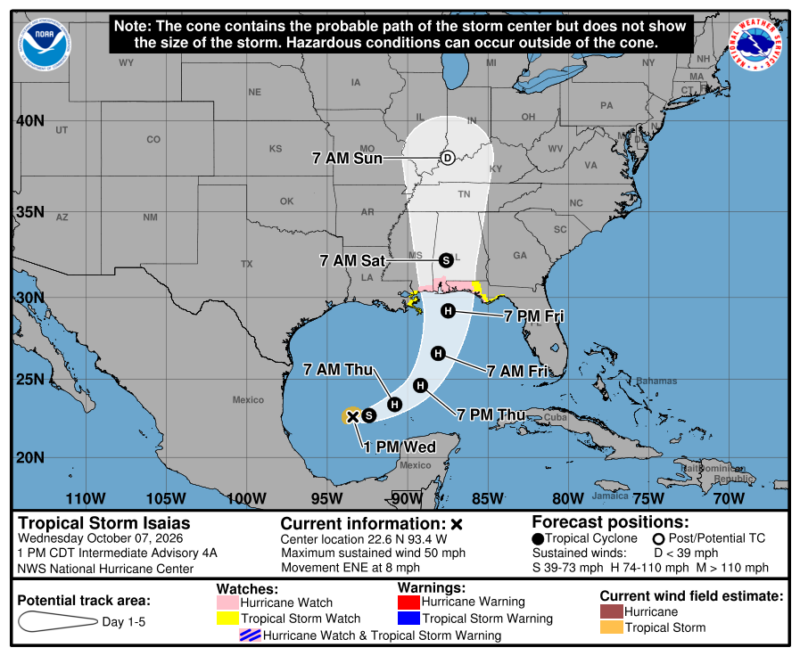
Isaias formed as a tropical storm in the southwestern Gulf on Wednesday morning, October 7. By 10:30 p.m. CDT, it had strengthened into a hurricane, with maximum sustained winds of 75 miles per hour (120 km/h).
As of 4 a.m CDT, October 8, Isaias has strengthened slightly, now with winds of 80 mph (130 km/h). It’s about 170 miles (270 km) northwest of Progreso, Mexico, and 420 miles (676 km) south-southwest of the mouth of the Mississippi River.
The National Hurricane Center (NHC) has warned that Isaias continues to intensify. When it approaches the northern Gulf Coast on Friday, Isaias is forecast to be a strong category 2 hurricane with sustained winds of 110 mph (177 km/h). This is just shy of a category 3, the major hurricane threshold. As it approaches land, strong wind shear will work to weaken the hurricane, but it is still expected to bring significant impacts to communities along the Gulf Coast as well as inland. Landfall along the Gulf Coast somewhere between coastal Mississippi and the Florida Panhandle is forecast for late Friday night or early Saturday morning.
A life-threatening storm surge is expected on portions of the northern Gulf Coast, while dangerous hurricane-force winds are expected over portions of the Florida Panhandle, southern Alabama and southern Mississippi. Find NHC forecast updates here.
Nearly a record-breaking hurricane
Until Isaias, this year’s below-average hurricane season had seen only nine tropical storms and no hurricanes. The last Atlantic hurricane season that had no hurricanes was back in 1914. And this was in the pre-weather satellite era, when data and records were not as reliable. During the weather satellite era there has never been a hurricane season in the Atlantic with no hurricanes, and Isaias has made sure that trend continues.
According to Dr. Philip Klotzbach with Colorado State University, the latest first hurricane on record was October 8, 1905. So it seems Isaias missed out on that record by just a few hours. However, in the era of weather satellite observations, beginning in 1966, Hurricane Isaias is indeed the latest first Atlantic hurricane. On average, the first hurricane of the season forms around August 11th.
Isaias threats
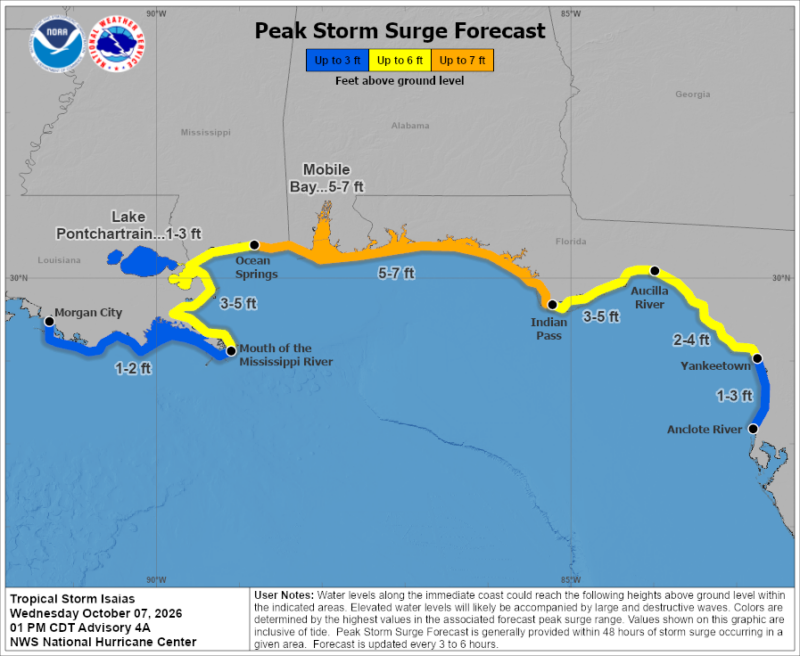
The National Hurricane Center says that life-threatening storm surge is possible for parts of the northern Gulf Coast. Up to 7 feet (2.1 meters) of storm surge — water pushed in from the ocean over dry land due to winds from a hurricane — is forecast from Ocean Springs, Mississippi, through Mobile Bay, Alabama, and out toward Indian Pass, Florida.
Additionally up to 5 feet (1.5 meters) of surge is possible from the mouth of the Mississippi River up toward Ocean Springs, Mississippi. Heavy rain is also possible, with up to 8 inches (20 cm) forecast to fall across Alabama and the Florida Panhandle. Hurricane-force winds are also expected across the Gulf Coast, especially near the point of landfall.
The forecast cone
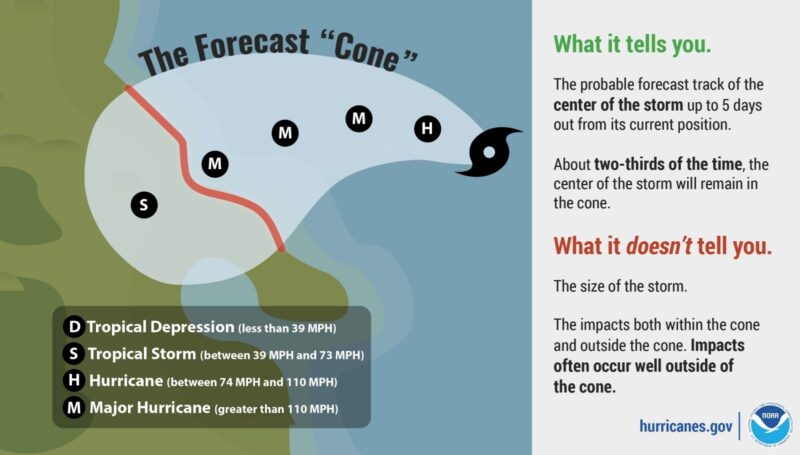
One of the most misunderstood aspects of hurricane forecasts is the forecast cone. The forecast cone, or track, shows where the center of the storm is expected to go. Historically, the center of the storm has remained inside the cone about two-thirds of the time, meaning that in roughly one-third of cases, the center can fall outside the cone.
Plus, the cone only represents the forecast uncertainty for the storm’s center. The hurricane itself is much larger, and its impacts can extend well beyond the cone. This means that dangerous weather can occur outside the forecast cone, even when the storm’s center remains within it.
This makes it important to get your weather information from a trusted source, such as the National Hurricane Center, your local National Weather Service office or a local television meteorologist you trust. Also, if any local emergency agencies call for you to evacuate, do not hesitate: immediately evacuate inland to escape the threat of storm surge flooding.
Bottom Line: Hurricane Isaias has become the first hurricane of the 2026 Atlantic season. It should bring dangerous storm surge to the Gulf Coast Friday and Saturday.
Read more: Atlantic hurricane season sets a record: No hurricanes yet!
Like what you read?
Subscribe and receive daily news delivered to your inbox.
More from
Rachel Duensing


Severe weather threat upgraded today for Midwest