A black hole jet is aimed at us … and it’s in our galaxy
All over the universe, black holes shoot jets out into space. And by coincidence, some of those jets are going to be aimed toward us. On September 22, 2026, astronomers said that — for the first — time they’ve found a black hole jet aimed toward Earth in our own galaxy.
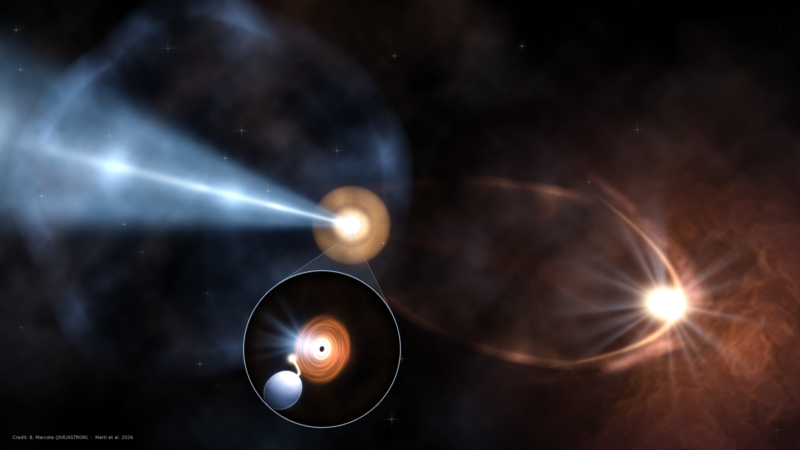
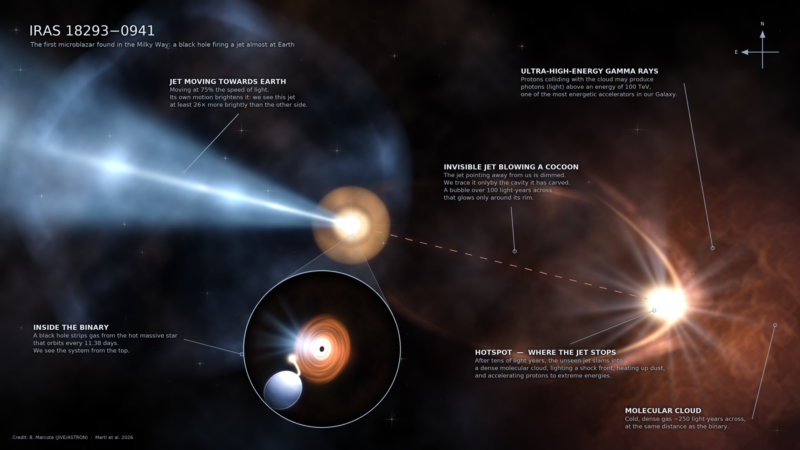
They’re calling this black hole system a microblazar. The black hole has a companion star that’s feeding material into the black hole. The black hole later expels that material in two jets, rushing outward at three quarters of the speed of light. One of those jets is aimed at us. The other we can see only because it’s smashing into a nearby molecular cloud, causing it to light up.
The journal Astronomy & Astrophysics has accepted the astronomers’ study for publication. The researchers pre-published it on arXiv on September 1, 2026.
The discovery of a microblazar
Astronomers believe supermassive black holes lie at the heart of most galaxies. And many of those black holes power jets, some of which are aimed toward Earth. Astronomers call them blazars. But they’ve long suspected microblazars — with jets pointed at us from black holes powered by stellar companions — also exist. They just hadn’t found one before.
And now a team of astronomers from Spain, Netherlands and Argentina says it has spotted a microblazar, just 12,000 light-years away. They’ve named it IRAS 18293-0941. IRAS 18293-0941 is believed to consist of a black hole that a star orbits every 11.38 days. The black hole is sucking in some of the star’s material and then expelling it in the two jets.
Lead author Josep Martí from University of Jaén said:
Everything about IRAS 18293-0941 was hiding in plain sight. It sits behind so much dust that it is essentially invisible in ordinary optical images. It was catalogued decades ago and then more or less forgotten.
A high-speed jet pointed at Earth
The astronomers saw that a star was slightly flickering. Then they used radio telescopes to discover what looked like a jet pointing only toward Earth. But further investigation found the existence of a second jet pointed away from us, thanks to a bubble and a glow. The opposite-facing jet is blasting through a cloud of gas and dust. It has carved out a bubble and on the far wall of the bubble it is heating up the gas and dust, causing it to glow.
How did the astronomers know the jet is from the star’s vicinity and not farther away, like from a distant galaxy? Combining radio and optical observations helped them pinpoint it.
Co-author Benito Marcote from the Joint Institute for VLBI ERIC, JIVE, in The Netherlands said:
This was the moment the result became solid. The resolution achieved by the European VLBI Network position together with the known position of the star from the Gaia satellite confirmed it: the jet belongs to the stellar system.
An impressive black hole jet
The jet is so strong that where it hits the molecular cloud it produces high-energy gamma rays. Co-author Pedro Luque-Escamilla from the University of Jaén said:
The elegance is that the accelerator engine and the target are two different objects, tens of parsecs apart. The jet does the accelerating. The cloud does the shining.
This area where the jet hits a molecular cloud likely accelerates particles to ultra-high energies, say the scientists. It might even accelerate them to petaelectronvolts. A petaelectronvolt (PeV) is equal to 1 quadrillion (1015) electronvolts of energy. So this would make microblazars one of the most powerful particle accelerators in the galaxy.
Confirming a 30-year-old theory
Scientists predicted the existence of microblazars 30 years ago. Now they are happy to finally have some confirmation. They think microblazars could play a part in the evolution of galaxies.
So what’s next? The researchers plan to look deeper in an attempt to see the jet evolve. They’d also like to learn more about how the jet and molecular cloud interact. And, of course, they hope to find more microblazars in our galaxy.
Bottom line: For the first time, scientists have discovered a microblazar, or a black hole jet in our own galaxy pointed at Earth. Don’t worry, there is nothing to fear from it!
Source: A Galactic microblazar as a potential accelerator of ultra-high-energy particles
Like what you read?
Subscribe and receive daily news delivered to your inbox.
More from
Kelly Kizer Whitt


JUICE mission to fly by Earth Monday: Details here

The Artemis Accords are rules for a new moon era
The red planet shows strange swirls of purple and pink
Curiosity rover insights after 5000+ sols on Mars