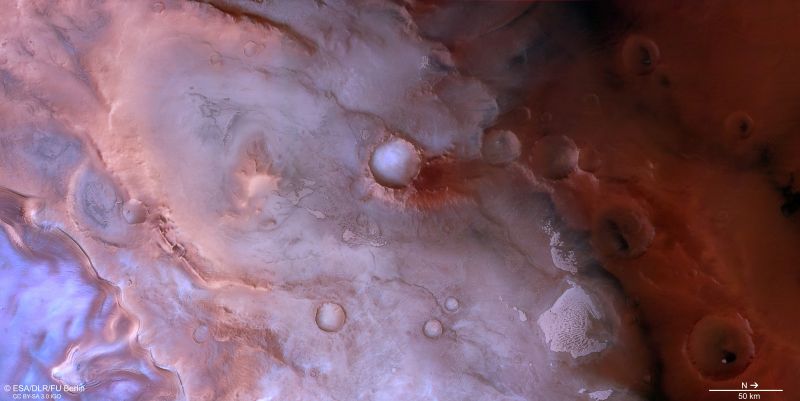
Mars’ south pole region shows swirls of purple
Mars is famous for being the red planet. With your eye alone you can see the red tinge that sets it apart from other points of light in the night sky.
But a new image from the Mars Express orbiter that ESA shared on September 16, 2026, shows the red planet has a much more colorful side.
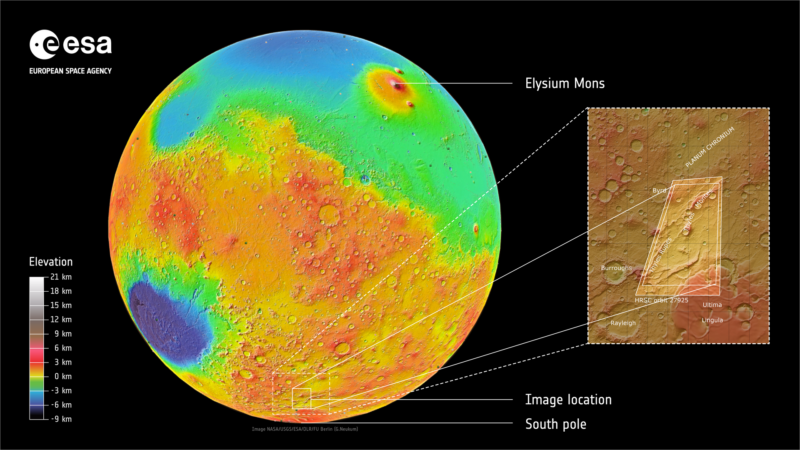
The image features Thyles Rupes, a rugged ice cliff near Mars’ south pole. Instead of just the familiar reds, browns and tans, the landscape is also awash in shades of purple and pink.
So, what makes Mars look purple?
A mix of light, dust and frost on the red planet
The unusual colors come from a combination of light, dust and frost across the Martian landscape.
Mars has a thin atmosphere that varies over time. Thus, it can show Mars in a different light depending on the time of day, In this example, Mars Express captured the landscape in spring under morning light.
This rosy morning filter, along with dust suspended in the atmosphere and patches of ice and frost, all contribute to the berry-purple appearance.
The darkest areas in this image are from volcanic materials such as olivine and pyroxene. You can also find these volcanic rocks in Earth’s mantle. The lighter-colored areas are from frost made of carbon dioxide.
Also, the whitish tones at bottom left are a glacier that is part of the south polar ice cap.
Normally, we think of Mars as the red planet because of the oxidized iron, or rusty soil, on the surface. Just like the rusty red fringe that can accumulate on your car after winter, Mars gets the same reddish tinge thanks to rust. Rust happens when iron, oxygen and water mix.
A closer look at the terrain
This region — Thyles Rupes — lies in the southern highlands of Mars. And some of the cliffs here tower more than 0.6 mile (1 km) high.
Scientists think these cliffs formed through ancient tectonic activity. As the interior of Mars cooled, the planet contracted. That deformation pushed portions of the Martian crust upward, creating steep cliffs.
Mars no longer has active tectonics like Earth. So the processes that created Thyles Rupes happened billions of years ago.
It’s also a heavily cratered region. Sometimes you see craters that cut through the ridges, and other times the ridges cut through the craters. This shows some craters are older and some are younger than the ridge.
At lower right we can also see sand dunes. Winds have left behind rippled patches. Do they remind you at all of satellite images of sand dunes on Earth?
Bottom line: Mars Express captured this view of the red planet showing it in less familiar purple, pink and blue shades. Read why the red planet looks purplish.
Like what you read?
Subscribe and receive daily news delivered to your inbox.
More from
Kelly Kizer Whitt


Curiosity rover insights after 5000+ sols on Mars

Hurricane Polo lurks off Mexico, now Category 4
Visible planets and night sky guide for September
Fat Bear Week 2026: Here’s how to participate!