



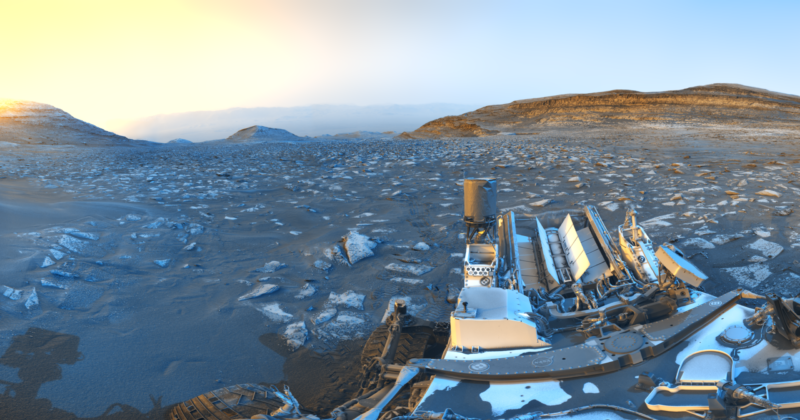
What has the Curiosity rover found on Mars?
NASA’s Curiosity rover launched from Cape Canaveral, Florida, in 2011 on an 8-month journey to Mars. It landed inside Mars’ Gale Crater on August 6, 2012. And it has now been working on Mars for more than 5,000 sols. A sol is a Martian day, about 24 hours 39 minutes long. It reached the 5,000-day milestone on August 29, 2026.
5,000 Mars-days is equivalent to more than 5,137 Earth-days, or more than 14 Earth-years.
As of September 2026, the car-sized rover has traveled roughly 23 miles (37 km) across Mars’ surface, staying entirely within a large crater called Gale Crater. It explored the crater floor, reaching the foothills of Mount Sharp (the enormous mountain in the center of the crater) in 2014.
And since then, it has been climbing Mount Sharp, investigating progressively higher and younger layers of rock. In fact, it has climbed more than a kilometer (0.62 mile) in elevation from the crater floor.
And Curiosity has made many discoveries along the way. Here are three of the many insights about Mars that Curiosity has provided.

1. Ancient Mars had long-lived lakes and streams
Curiosity has found evidence of water throughout its journey across Gale Crater. In fact, it found evidence that Gale Crater was once an ancient, shallow lake. The rover has seen ripple patterns in the crater’s rocks. It has tested the rocks, and found high concentrations of minerals that support the idea a lake once existed here.
Curiosity also found evidence of former mudflats. Cracks in the martian surface point to an ancient lake that repeatedly dried out.
But why did it dry out? Because Mars is small, and its gravity is weaker than Earth’s. Its weak gravity made it difficult for the planet to hold onto a thick atmosphere over billions of years. Plus, its global magnetic field appears to have shut down early.
Without that planetary magnetic shield, the solar wind could more readily erode the upper atmosphere. Less atmosphere meant less greenhouse warming.
As Mars lost atmospheric pressure and greenhouse gases, its surface became increasingly cold and unable to sustain stable bodies of liquid water.

2. Ancient Mars was probably habitable
To be clear, “habitable” doesn’t mean “inhabited.” But it’s still exciting to think that Mars had the right ingredients for life to survive. And Curiosity didn’t just find evidence that water existed. It also found clay minerals, sulfur, nitrogen, phosphorus, carbon and chemical energy sources; conditions that could have supported microbial life.
Much of this evidence comes from Curiosity’s early years exploring the floor of Gale Crater, in what scientists call the Yellowknife Bay area. NASA says Yellowknife Bay is the first habitable environment characterized on another planet.
NASA said recently (April 21, 2026) that Curiosity has identified the most diverse collection of organic molecules yet seen on Mars. Overall, the rover found 21 carbon-bearing molecules in a rock it first sampled in 2020. Seven of those molecules are new discoveries on Mars.
Whether these are truly related to ancient life on Mars is still a matter of research. But Curiosity has shown us that Mars had a rich organic chemistry, and that some of that chemistry survived for billions of years in Martian rocks.
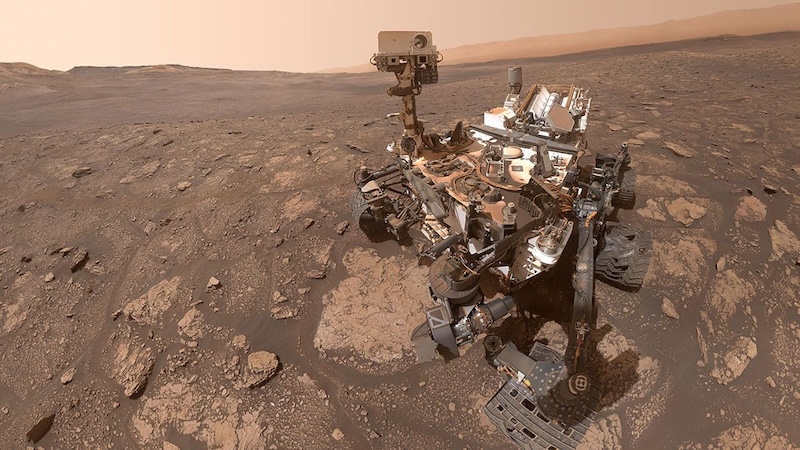
3. After its surface dried, Mars kept water underground
So Mars’ surface rivers and lakes eventually disappeared. But Curiosity has found evidence that groundwater continued moving through rocks beneath the surface.
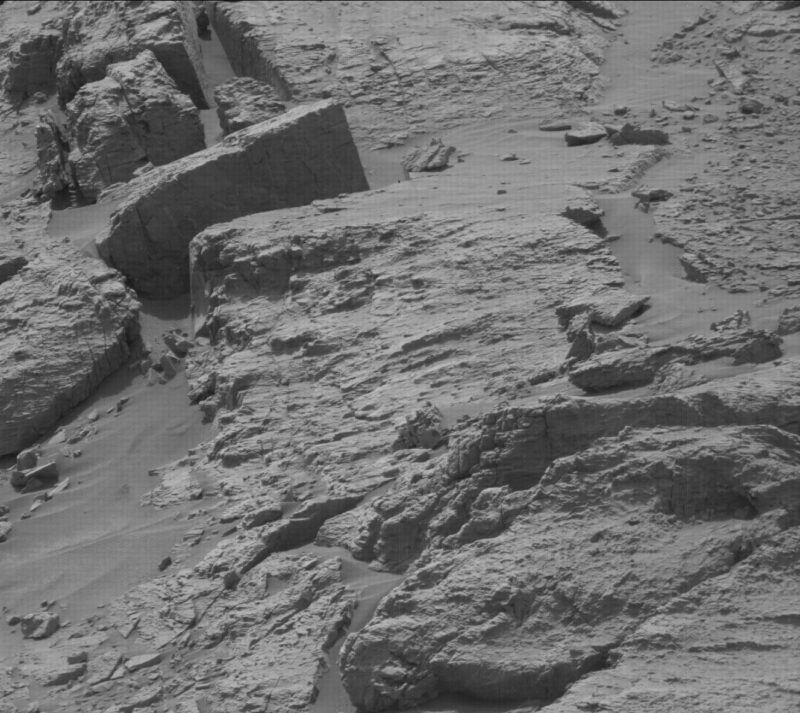
High on Mount Sharp, Curiosity is exploring a spectacular network of ridges called boxwork. The ridges are about 3 to 6 feet (1 to 2 meters) tall with sandy hollows in between them. They extend for miles in the region of Mount Sharp in Gale Crater.
Scientists think groundwater once flowed through cracks in the rock, depositing minerals that hardened the boxwork fractures. Later, wind eroded the softer surrounding rock, leaving the mineral-filled cracks standing as ridges.
The discovery suggests that water remained underground long after Mars’ surface was becoming dry and inhospitable. And that could potentially extend the time and places where microbial life could have survived.
So Curiosity has spent 5,000 sols reading the history of one place on Mars, and that history keeps getting more interesting.

By the way … weird rocks!
Along the way, Curiosity has also given us a closer look at a truly alien world, in part by photographing plenty of weird rocks.
It’s looked at rocks that scientists call dragon bones, along with formations like mini-hoodoos. It’s spied a rock that looks like coral, along with outcroppings that are reminiscent of the U.S. Southwest.
And then there are the weird rock formations that have our eyes seeing things that aren’t there, or what scientists describe as pareidolia. For example, many saw a doorway on Mars. And, more recently, we saw an alien in a hallway.
What will Curiosity see during its next 5,000 sols? We can’t wait to find out!
Bottom line: The Mars Curiosity rover has now spent 5,000 sols — the equivalent to 5,000 Martian days, or more than 14 years — on the Red Planet. Here’s a look at some of the things it’s found.
Read more: Mars calendar year begins September 30: Happy Mars New Year!
Like what you read?
Subscribe and receive daily news delivered to your inbox.
More from
Kelly Kizer Whitt


The red planet shows strange swirls of purple and pink

Hurricane Polo lurks off Mexico, now Category 4
Visible planets and night sky guide for September
Fat Bear Week 2026: Here’s how to participate!



