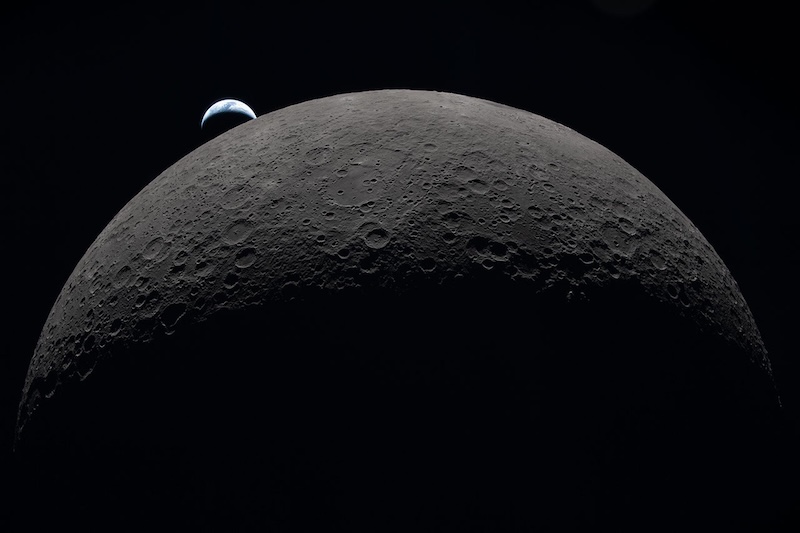
- Could there be evidence of alien technology … on the moon? SETI scientists have proposed a new way to search for it.
- A new mission would collect samples of lunar regolith and then scientists would search for microscopic particles that might have originated from alien technology elsewhere.
- These tiny technosignatures could have drifted through space, shed from alien structures, much as particles shed from human satellites.
Microscopic bits of alien tech on the moon?
As scientists searched for intelligent extraterrestrial life — i.e., aliens — they’ve focused on a short list of standard possibilities. In other words, they’ve searched for radio signals, laser pulses or other technosignatures. Now a team of scientists, led by the SETI Institute, has a new idea. The researchers are proposing we search the moon’s surface for microscopic bits of material shed by alien technology.
The moon would act as a “collection plate,” as it were.
As the SETI Institute noted in a statement on September 8, 2026, the study presents the first quantitative framework for testing whether microscopic technosignatures could accumulate in lunar soil over billions of years.
A preprint version of their new paper was submitted to the arXiv server on August 17, 2026. The paper is currently in peer review for submission to the International Journal of Astrobiology.
Leftover debris from alien civilizations
The proposed scenario is really simple. If an alien civilization ever did have advanced technology in the space near Earth, then space weather — the changing conditions of charged particles, plasma, magnetic fields, and radiation throughout our solar system — might gradually have worn down this alien debris to microscopic bits. As a result, the structures could shed microscopic bits of debris. Those particles would then drift in space, perhaps even spreading across the galaxy.
The idea is similar to that of how microplastics have spread around Earth, contaminating almost everything.
Lewis Pinault, an affiliate scientist at the SETI Institute in Mountain View, California, and a researcher at Birkbeck College, University of London, led the new study. He told The New York Times:
If any other technological civilization has ever existed in our galaxy, it’s not an unreasonable hypothesis to think that particles of them are on the moon in some quantity.
Pinault also said:
The moon has been quietly accumulating material from space for billions of years, much of it likely billions of years older than the moon itself. We’re asking whether that ancient collection might contain microscopic traces of technologies that existed long before humans ever looked up at the sky.
The moon would be an ideal place to look for such material, since it has no atmosphere to speak of, and no flowing water or active geology. The particles could remain preserved for billions of years.
?? The next breakthrough in SETI may come not from a radio telescope, but from a microscope.Researchers propose searching lunar soil for microscopic engineered particles—potential traces of technologies that could have existed billions of years ago. ? ?
— SETI Institute (@setiinstitute.bsky.social) 2026-09-08T19:01:25.607Z
Neat writeup of a recent study about looking for the tiniest physical technosignatures!
— Jason Wright (@astrowright.bsky.social) 2026-09-07T17:16:45.389Z
Tiny particles of alien technology
This concept isn’t far-fetched. Our own satellites shed tiny microscopic particles into space as space weather erodes them on a microscopic scale. For the study, the team modeled how particles from alien space structures could eventually disperse across our galaxy. It’s a new take on the search for alien tecnnosignatures.
As Sofia Sheikh, a scientist at the SETI Institute, noted:
We know on Earth that time and entropy take their toll on everything that humans make, and there’s a lot more to explore in how the breakdown of technological artifacts can be applied to SETI searches.
Co-author Ian Crawford, a professor of planetary science at Birkbeck College, University of London, added:
If you concede that looking for alien intelligences is a legitimate part of science, which clearly it is, then looking for the technological products — aka artifacts of these intelligences — ought to be just as scientifically valid as looking for their radio emissions.
Alien tech on the moon: a fringe idea
It might sound like a long shot, and it probably is. It’s also partly based on a proposal that was considered fringe back in the 1990s. Ukrainian researcher Alexey V. Arkhipov had suggested searching the moon for traces of alien technology; in this case, though, more like actual artifacts of technology.
The new proposal is similar, but looking for that evidence on a microscopic scale. Pinault surmised that aliens:
… may have become starfarers who are developing similar technologies around each star system that they go to, so the potential of there being quite a bit of interesting debris in the galaxy is pretty high.
SETI researcher Jason Wright at Penn State is supportive of the plan. He said:
They’ve revived what is actually a pretty obscure idea and shown that it’s plausible.
Collection Plate: Could Our Moon Be Peppered with Evidence of Extraterrestrial Technology?https://t.co/o6fMUP9TXO pic.twitter.com/7wU6i5wEeL
— marsboy (@marsboy) September 6, 2026
Sifting through the lunar regolith
So how would researchers search for these tiny particles? They propose sending a mission to collect about a cubic meter (35 cubic feet) of regolith. Regolith is the lunar “soil,” the top layer of dust and bits of rock on the surface.
Researchers would then use specialized instruments to comb through the sample. They would look for any types of particles that could have an artificial — and alien — origin. The analysis would use modern microscopy, tomography, spectroscopy and AI-assisted image analysis.
Of course, there would also likely be particles originating from human missions to the moon. Those missions, over decades, could also leave behind microscopic debris. As Crawford acknowledges, finding particles that are actually alien is a long shot:
The chances of finding anything on the moon are so small, this would immediately imply that there must probably be lots and lots of them, at least in the history of the galaxy. It would be a very, very important discovery if made, but it is a needle-in-a-haystack exercise.
But we’ll never know if we don’t look.
As SETI Institute President and CEO Bill Diamond put it:
The concept of searching the lunar regolith for microscopic technosignatures is at once extraordinarily original and eminently reasonable. This is a novel addition to the search methodologies applied to seeking evidence of technology as a proxy for life and intelligence beyond our solar system and we are excited at the prospect of bringing this to fruition.
Microscopic alien probes?
There’s another twist to this idea, too. What about microscopic probes? Physicist Ronald Bracewell came up with the idea of Bracewell probes in the 1960s. A similar concept is the von Neumann probe. These would be small, autonomous alien probes that could self-replicate in order to spread across the galaxy. Could there be microscopic versions of those? We are already using microtechnology that keeps getting smaller and smaller.

Carbon nanotubes on the moon
With all of this in mind, it is worth noting an interesting discovery that was already made. On December 30, 2025, researchers from Jilin University in China published a paper about the discovery of single-walled carbon nanotubes in samples brought back from the far side of the moon.
The assumption of course is that these are naturally occurring. On Earth, though, they are ultra-thin hollow cylinders made artificially from a single layer of carbon atoms. Multi-walled carbon nanotubes do form naturally on Earth, for instance in volcanic eruptions. As the paper notes:
Although CNTs have been predominantly assumed to require artificial preparation, the study findings demonstrate that these materials exist in nature.
Bottom line: Could there be alien tech on the moon? Scientists propose new search for microscopic particles shed by alien technology.
Via:
Like what you read?
Subscribe and receive daily news delivered to your inbox.
More from
Paul Scott Anderson


Peptides in Venus’ clouds could form life-giving shapes

These microbes in Antarctica don’t live anywhere else
Mars’ southern hemisphere is unusually hot deep underground
Giant mega-Earth is 23 times more massive than Earth