Euclid finds the most ancient quasars in the universe so far
ESA said on July 6, 2026, that the Euclid space telescope has discovered 31 of the most ancient quasars yet known. And that includes the two most ancient quasars ever spotted.
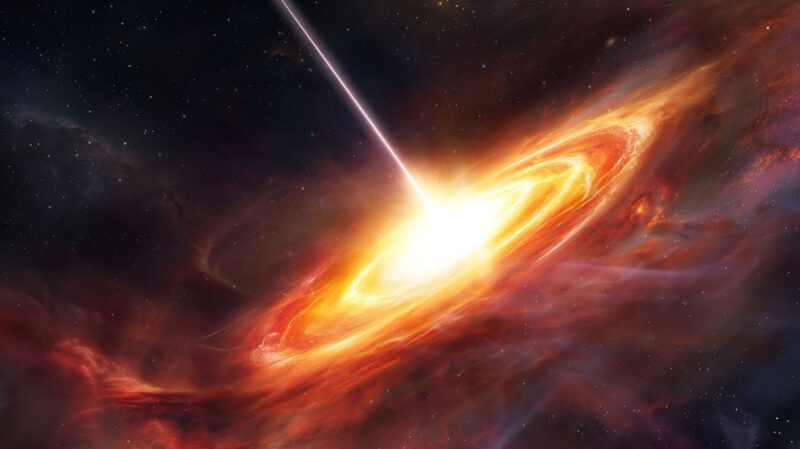
Quasars are the immensely bright cores of some galaxies, powered by actively feeding supermassive black holes.
These newly discovered quasars are the most distant yet spotted. In fact, they’re so distant that their light has taken over 12 billion years to reach us. That means we’re seeing these ancient monsters as they appeared over 12 billion years ago, in the universe’s infancy.
The two most distant of these quasars appear as they were when the universe was just 670 million years old, or 5% of its current age.
Daming Yang of Leiden University in the Netherlands is the lead author of the Euclid discovery paper. The researchers published their peer-reviewed paper on July 6, 2026, in the journal Astronomy & Astrophysics. Yang said:
These early quasars date back to the universe’s infancy. By finding and studying them, we can better understand how these enormous systems formed and grew so quickly … one of the greatest mysteries in astrophysics.
What is a quasar?
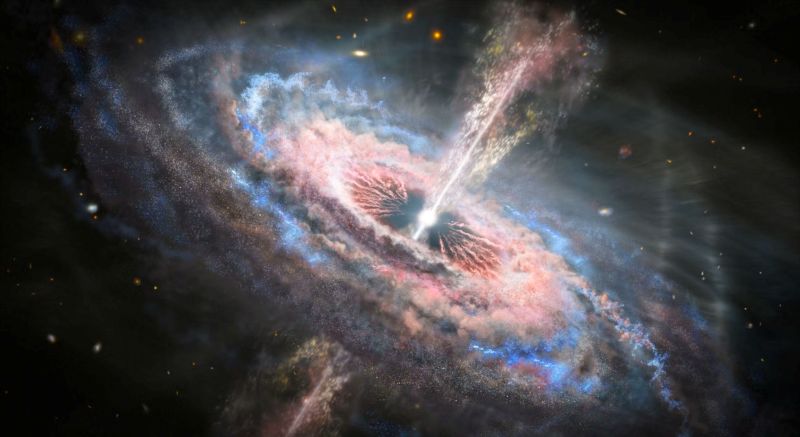
Quasars are extremely bright objects in space, up to 1,000 times brighter than our Milky Way galaxy. And they’re extremely far away. We typically see these objects as they were when our universe was young.
So what exactly are they? Quasars are the extremely luminous centers of galaxies in their infancy. The rapidly growing black holes at the galaxies’ centers feed on the vast supply of available matter in the early universe. As they feed, the accretion disks around the black holes get superheated to millions of degrees. So the light that we call the quasar is a result of intense friction between dust, gas and other matter colliding as it swirls in toward the black hole.
Map of the most distant quasars
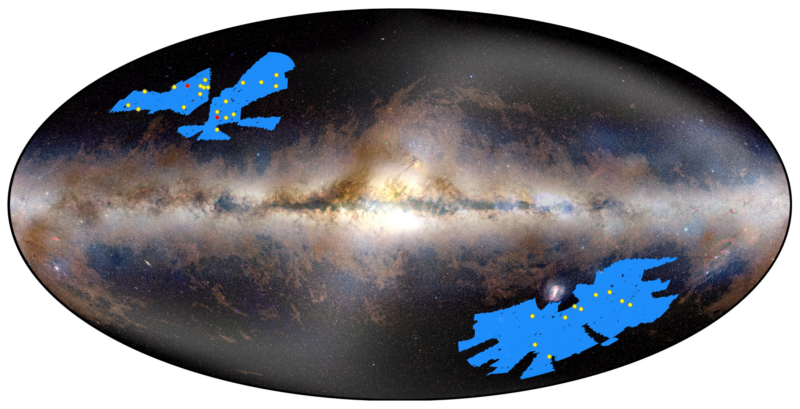
The Euclid space telescope’s mission is to map the large-scale structure of the universe. It does this by observing billions of galaxies across 1/3 of the entire sky. In operation now for three years, Euclid sees in both visible light and near-infrared.
The map below shows the location of the 31 new quasars Euclid discovered in relation to our Milky Way galaxy. The red dots are the two farthest and most ancient quasars yet.
Most distant and most ancient
When we look at distant objects in the universe, we are looking back in time. That’s because it takes a long time for the light to travel from their origin to our telescopes. So when we say that these quasars are the most distant known, that also means they are the earliest known. And that’s why we also describe them as the most ancient, because of how far back in time we see them.
It’s challenging spotting objects at such great distances from us. And the light of quasars can be hard to distinguish from the light of stars. Quasars aren’t numerous in the early universe, because few galaxies had had the time to grow large enough to produce quasars.
The light from those that did exist then had to travel for some 13 billion years to reach us. And by then their light waves have stretched far into the infrared, making them look like cool stars.
But of the 31 new quasars Euclid discovered, the Keck Observatory has already followed up with confirmation observations on 21 of them. NASA said:
The 31 quasars imaged by Euclid include 12 that date to the first 770 million years of the universe. Two others – the oldest ever documented – formed during the universe’s first 670 million years, and their light has taken some 13 billion light-years to reach Earth.
The record-setting most ancient quasars
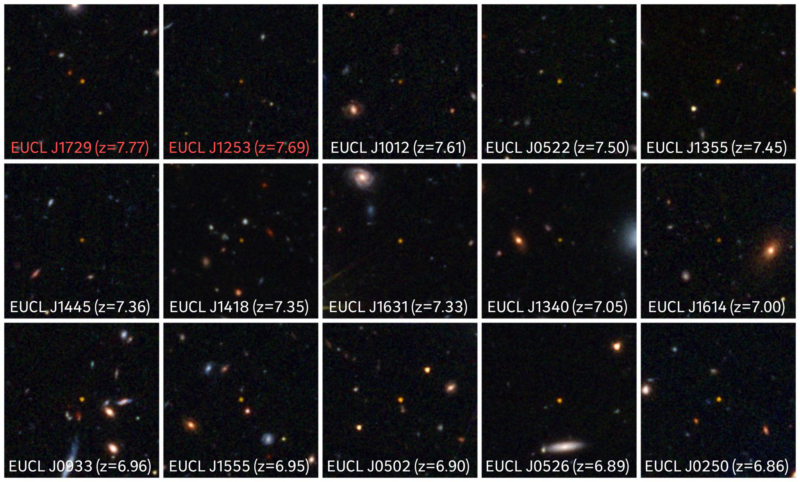
The two quasars that are the most ancient of the new finds are EUCL J172902.75+641018.1 and EUCL J125308.55+705432.3. These quasars have redshifts of 7.77 and 7.69, respectively. A redshift is a way to measure how much the light from an object has stretched as it travels across the universe (and as the universe expands). Astronomers use redshifts to find the distance to an object. The larger the number of the redshift, the farther away the object is … and the farther back in time we see it.
In total, there were 12 quasars out of the 31 that have redshifts greater than 7. A redshift of 7 equals a light travel time of 12.888 billion years. The two most ancient quasars appear as they were more than 13 billion years ago, when the universe was just 670 million years old.
Indeed, it had taken more than a decade for astronomers to find the first 10 quasars with redshifts of more than 7. And now Euclid has found a dozen in a single year.
Will Euclid be able to find a quasar with a redshift of 8 or larger? It’s possible. A redshift that high would mean the object existed when the universe was less than 630 million years old.
Watch the video below to zoom into a quasar in the early universe.
Artist’s animation depicting a wave of ancient quasars discovered from the dawn of the universe. Video via W. M. Keck Observatory/ Adam Makarenko. Image of Keck Observatory by Andrew Hara.
What do the quasars tell us about our universe?
Euclid’s sensitivity allows it to discover “ordinary” quasars, and not just those that are the brightest of the bright. This will help astronomers get a better picture of what a typical quasar is like. Eduardo Bañados of the Max Planck Institute for Astronomy explained the importance of seeing typical quasars and not just the outliers:
We now have a real window onto how the bulk of the first black holes grew, and how they shaped the galaxies around them.
Silvia Belladitta of the Max Planck Institute for Astronomy and colleagues looked closer at the most distant quasar of the bunch. Belladitta said:
We found a galaxy that has all the ingredients to build a giant system: it is as massive as the hosts of the brightest early quasars and contains a huge reservoir of molecular gas to fuel intense star formation. This raises an intriguing possibility. Ultraviolet-faint quasars like EUCL J125308.55+705432.3 may be in a different evolutionary phase than their brighter cousins. Either the black hole is growing more slowly than in the brightest quasars, or else much of its activity is hidden behind thick clouds of dust. Distinguishing between these possibilities will be an exciting challenge for future observations.
Bottom line: The Euclid space telescope has discovered 31 new quasars, including the two most ancient – and most distant – quasars yet known.
Source: Euclid: Discovery of 31 new quasars at 6.6 < z < 7.8
Via:
Like what you read?
Subscribe and receive daily news delivered to your inbox.
More from
Kelly Kizer Whitt


Visible planets and night sky guide for October

Hera mission hits the brakes to arrive at asteroid
The ghost of Biela’s Comet: It created a storm and disappeared