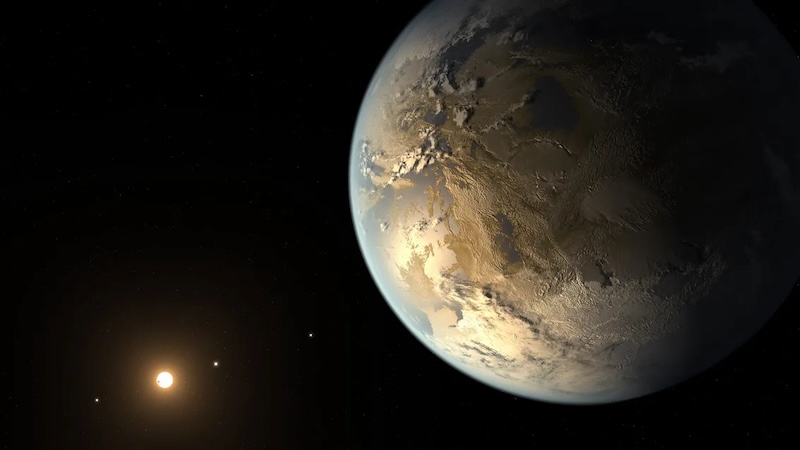
- Scientists have discovered many rocky exoplanets around other stars. But which ones are the most likely to be habitable?
- A new model of habitable exoplanets is narrowing down the search. It focuses on the size and atmosphere of these planets.
- The model predicts which planets could have life-supporting atmospheres.
New habitable exoplanets model
Rocky planets – like Earth – are common in our galaxy. That’s good news in the search for life as we know it. But how can we tell which of these exoplanets are the most likely to be habitable? To answer this question, a team of scientists has developed a new model called Smaller Than Earth Habitability Model (STEHM).
The team, led by Stanford University in California, said on June 4, 2026, that the model aims to find which planets are the most likely to support life by focusing on their size and atmospheric characteristics. The study centers on planets ranging from about half the size of Earth up to Earth-sized.
The only way to determine if a planet could have life, scientists think, is to analyze its atmosphere. Advances in technology are increasingly allowing astronomers to do just that. They look for biosignatures, gases or other chemicals in the atmosphere that could be byproducts of life.
The new peer-reviewed paper was published in The Planetary Science Journal on June 4, 2026.
The Smaller Than Earth Habitability Model
Michelle Hill of the Stanford Doerr School of Sustainability led the new study about habitable exoplanets. She said:
The only way that we’re going to ever find out if there are signatures of life out there is by observing the atmosphere of these planets.
Maybe there’s life on other planets under the ground, but we are never going to be able to see it because we can’t send something to those exoplanets. The best chance we’ve got is looking for signs of life by analyzing atmospheres from afar.
With this in mind, she developed the Smaller Than Earth Habitability Model (STEHM). This model looks at factors that can affect a rocky planet’s ability to create and maintain an atmosphere, within the context of its size.
Size and mass are important. If a planet is too small or low mass, it could lose its atmosphere. This is especially true for low-mass stars like red dwarfs. Intense flare and radiation activity can strip a planet of its atmosphere if it’s too close.
And rocky planets need atmospheres to help protect their surfaces from the harsh conditions of space.
The researchers created six different planetary models. They ranged from half the size of Earth to Earth-sized. The planetary profiles included density and thickness of the mantle and the planet’s overall density. All six modeled planets had carbon dioxide atmospheres. The planets were modeled as what scientists call stagnant lid planets. That is, unlike Earth and its ever-shifting crust, these model planets had rigid, unmoving surfaces.
How long do exoplanets sustain their atmospheres?
STEHM found that planets with a radius at least 80% of Earth’s can maintain their atmospheres for 10 billion years or more. But that’s only if they are comfortably far away from their star, like Earth is.
If a planet is smaller than that, it could lose its atmosphere within 1 billion years. One caveat though; if a planet’s radius is about 0.7 that of Earth, it could maintain its atmosphere, depending on other factors.

Carbon helps maintain atmospheres
How much carbon a planet has when it first forms is also important. Carbon helps to contain and preserve heat. That heat can be essential to keeping a planet habitable. Heat-producing elements such as thorium, uranium and potassium in the mantle also help maintain heat inside the planet.
But if those elements become depleted, the mantle, in turn, will begin to cool off. As a result, volcanic activity ceases. And that means no more carbon dioxide production, leading to loss of the atmosphere.
But if a planet has a thicker mantle, and smaller core, it could hold on to more carbon and elements for a longer time.
Too much heat is bad
As already noted, heat inside a planet is essential for life. But what if there’s too much heat? The model found that if a planet has too much heat too early, that can reduce the lifespan of the atmosphere.
These planets – dubbed ‘hot-start’ planets – are very hot on the inside after formation. In fact, their mantles can melt. This exposes the atmosphere to stellar radiation. This is not good, but the habitable zone also plays a role. That is the region where temperatures could allow a rocky planet to have water on its surface. The planet needs to be far enough from its star to not burn up from stellar radiation. But it also can’t be too far from its star, where temperatures are too frigid.

Inspiration from Mars
Mars was actually the original inspiration for STEHM. The researchers wanted to know if Mars could have ever held onto a thicker atmosphere. The model showed that the odds were always against it, due to the planet’s small size and lack of plate tectonics.
The model also correctly predicted the fate of Venus, with its thick carbon dioxide atmosphere.
Next, the researchers want to create profiles of mobile lid planets, like Earth, that do have tectonic activity. Those ones will then be compared to the stagnant lid planets.
Bottom line: Researchers have developed a new habitable exoplanets model to find out which rocky exoplanets could possibly support life.
Read more: Habitable exoplanets could exist around nearby stars
Like what you read?
Subscribe and receive daily news delivered to your inbox.
More from
Paul Scott Anderson


The rings of Chariklo are unexpectedly dynamic and changing

Did Venus have a moon for nearly 2 billion years?
Alien tech on the moon? Scientists propose search for microscopic debris
Peptides in Venus’ clouds could form life-giving shapes