- Comet 3I/ATLAS is the 3rd known interstellar object to enter our solar system. We are still learning about its composition.
- New analysis of data from the James Webb Space Telescope reveals that it contains abundant methane.
- It’s the first time that methane has been found on an interstellar object. The findings suggest that the environment the comet formed in was quite different from that of our solar system.
Surprise! Comet 3I/ATLAS has methane
NASA’s James Webb Space Telescope has made another significant discovery about the interstellar comet 3I/ATLAS: it contains methane.
Researchers said on June 1, 2026, that this is the 1st time scientists have detected methane on an interstellar object. And the finding suggests 3I/ATLAS was born in a very different environment from that of our solar system.
The team of researchers made the discovery after using the Webb space telescope to observe the comet as it headed back out of the solar system in December 2025. The fact that methane wasn’t detected as the comet sped into the solar system suggests the gas was buried below the top surface of ice. So it was only detectable when the ice and frozen methane sublimated – turned directly to gas – as the comet came close to the sun.
The researchers published their new peer-reviewed findings in The Astrophysical Journal Letters on April 8, 2026.
1st detection of methane on an interstellar object hints at comet’s origin
So this is the 1st time that scientists have found methane on an interstellar object. Mind you, 3I/ATLAS is only the 3rd of these objects we’ve identified. The 1st discovery was the enigmatic comet ‘Oumuamua, and the 2nd was the comet 2I/Borisov.
The researchers also found that Comet 3I/ATLAS is oddly rich in carbon dioxide. And this abundance of carbon dioxide and methane provides clues to the comet’s origin.
Comets in our solar system don’t contain large amounts of these gases. This means that 3I/ATLAS must have been born in a very different environment and chemistry than that of our solar system.
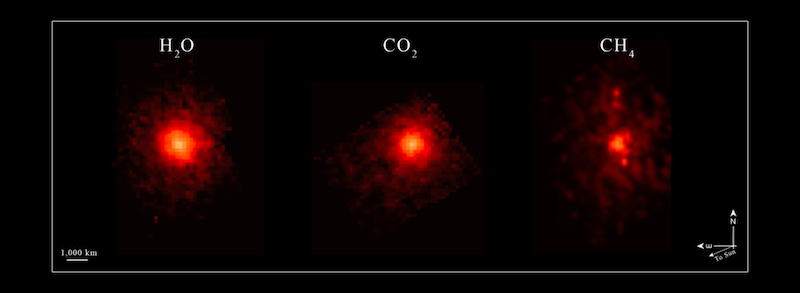
Why the delay in detecting the methane?
Scientists first spotted Comet 3I/ATLAS in July, 2025, and it passed closest to the sun in October. But they didn’t detect the methane until the comet was on its way out of the solar system in December. Why is that?
The researchers say it’s likely because the methane was buried under a significant amount of surface ice. It wasn’t until the comet swung closest to the sun during its departure that the comet warmed enough for the methane to sublimate. Sublimation is when a frozen substance turns directly into a gas instead of becoming liquid first.

Other recent 3I/ATLAS news
SETI also recently scanned 3I/ATLAS for possible radio signals. It was a last chance to see if – by any chance – the comet might actually be an artificial object. But alas, nothing was found.
Another study from April found that Comet 3I/ATLAS formed in a cold environment. This is consistent with the newest findings.
And in March, scientists found that 3I/ATLAS is bursting with alcohol, or methanol to be specific.
Bottom line: New analysis of data from the Webb space telescope shows that Comet 3I/ATLAS has methane. This shows its origin is different from comets in our solar system.
Source: The Volatile Inventory of 3I/ATLAS as Seen with JWST/MIRI
Read more: Interstellar comet 3I/ATLAS born in a cold environment
Read more: Interstellar object Comet 3I/ATLAS leaving the solar system
Like what you read?
Subscribe and receive daily news delivered to your inbox.
More from
Paul Scott Anderson


Oldest Mars meteorite reveals Mars lost its water early

Meteorite strike of New Jersey home reveals life clues