Good news! In some areas light pollution is getting better
On May 15, 2026, NASA shared new global maps that showed how light pollution has changed between 2014 and 2022. It’s part of what NASA calls its Black Marble project, in which three different satellites capture imagery of Earth at night.
And these satellites collect a long-term record of global nighttime light. The Black Marble shows where illegal fishing is occurring, natural gas is flaring, volcanoes are erupting and much more. And it shows the best locations to stargaze
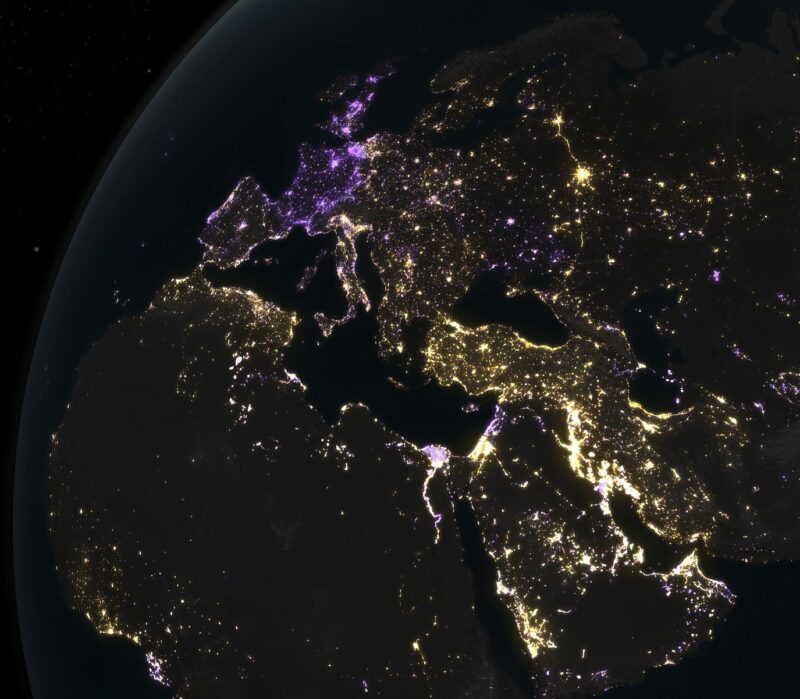
In the map above, purple areas show where nighttime lighting has been dimming. Note the concentrated area of purple in northwestern Europe. NASA Earth Observatory said:
LEDs and energy conservation measures coincided with reduced light pollution in Paris and throughout France (a 33% dimming), the U.K. (22% dimming), and the Netherlands (21% dimming).
Although not all dimming was from positive progress. NASA also said:
European nights dimmed sharply in 2022 during a regional energy crisis that followed the outbreak of the Russia-Ukraine conflict.
Some places are still getting brighter
Not surprisingly, there are still plenty of places on the globe that are seeing an increase in light pollution. On the two maps here, areas that show in yellow or gold brightened over the period from 2014 to 2022. Overall, global radiance increased by 34% during the study period.
In the U.S., the West Coast got brighter while the East Coast dimmed. The researchers attributed the East Coast dimming largely to adopting more energy-efficient LEDs and “broader economic restructuring.” Around the world, China and northern India showed a surge of lighting as cities grew.
The good news about light pollution is that it’s reversible. And you can start at home! Limit outdoor lights, point lights downward, use warm-colored or amber LEDs and install motion detectors so the light only comes on when needed. Read more about solutions to light pollution at Dark Sky International.
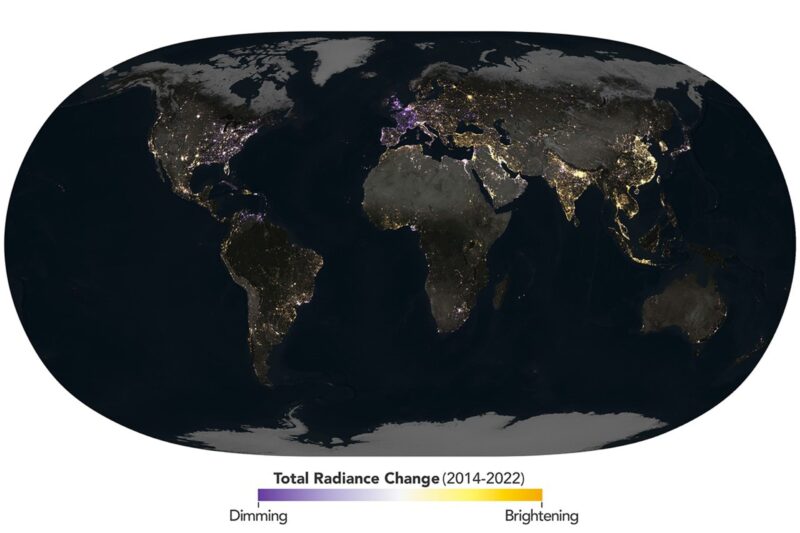
Bottom line: A new global map from NASA shows areas that are seeing a reduction in light pollution. See the maps here and learn how to limit light pollution where you are.
Like what you read?
Subscribe and receive daily news delivered to your inbox.
More from
Kelly Kizer Whitt


Hurricane Polo explodes into a Category 5 storm off Mexico

Visible planets and night sky guide for September
Fat Bear Week 2026: Here’s how to participate!
JUICE mission to fly by Earth next week! Details here