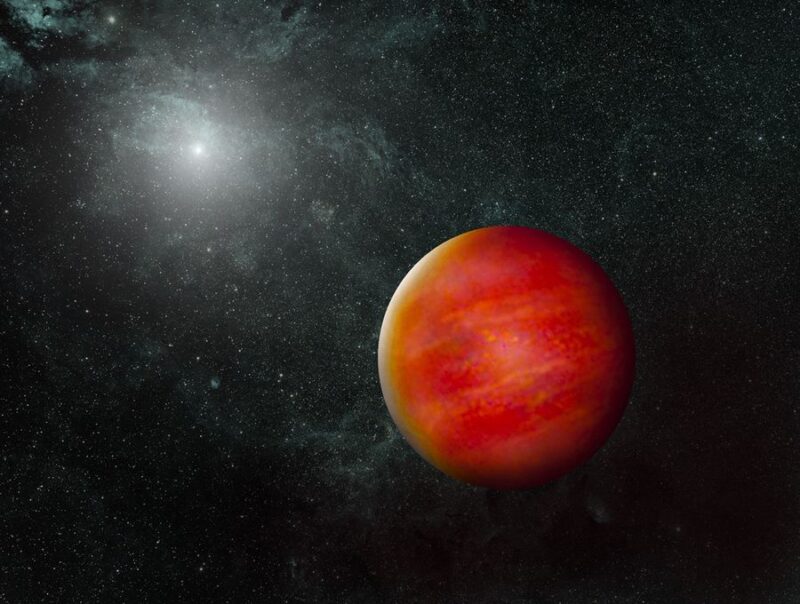
- Brown dwarfs are often called failed stars because they are not massive enough to become true stars.
- They don’t shine like stars, so they are dim and hard to spot.
- The known population of brown dwarfs has just doubled thanks to a citizen science survey.
Brown dwarf population doubles to more than 6,000
Sometimes known as failed stars, brown dwarfs are objects that fill the gap between Jupiter-type planets and stars. They don’t shine like stars, so they’re dim and hard to spot. But on May 5, 2026, NASA said volunteers have discovered some 3,000 brown dwarfs, doubling the known population.
The discoveries are thanks to citizen scientists in the Backyard Worlds: Planet 9 project. Volunteers have been combing images from NASA’s retired Wide-field Infrared Survey Explorer (WISE) and Near-Earth-Object WISE Reactivation mission (NEOWISE-R) for more than 10 years. Some 200,000 citizen scientists volunteered their time to look for objects that moved in the images.
And they’re not done yet! There are still more than 2 billion sources to sort through. You can join the Backyard Worlds: Planet 9 project to help.
And you can maybe even become an author of the next brown dwarf discovery paper. This latest paper has 75 authors, 61 of which are volunteers. The team submitted its paper to The Astrophysical Journal. The journal accepted the paper on April 1, 2026, and it is published on arXiv.
Brown dwarfs are our neighbors
Stars have large masses, and therefore high internal temperatures. That’s what sparks the thermonuclear fusion reactions that make them shine. On the other hand, brown dwarfs are not quite massive enough to light that internal spark. They still can have 18 to 30 times the mass of Jupiter, but never enough mass to ignite and shine like stars.
Because brown dwarfs are dim by nature, the new discoveries are all nearby. And these newly found brown dwarfs are helping us map the sun’s neighborhood.
Some of these brown dwarf discoveries are quite unique. They include extreme T subdwarfs, which are the most planet-like brown dwarfs. Two of these T subdwarfs weigh about 75 times the mass of Jupiter and are about 10 billion years old. They have also found ultracool brown dwarfs with companions. And they have even found brown dwarfs with auroras.
Scientists say brown dwarfs are so numerous that there’s probably one for every three or four stars near the sun. So there are plenty new discoveries of weird brown dwarfs awaiting. You can join the project here.
Bottom line: Volunteers combing through years of space images have made discoveries that double the brown dwarf population. And you can join in the search!
Like what you read?
Subscribe and receive daily news delivered to your inbox.
More from
Kelly Kizer Whitt


Could an Earthlike planet with 2 stars be nearby?

Visible planets and night sky guide for October
And the Fat Bear Week winner is … Backpack!
What are the world’s loudest birds? Here are 2 contenders