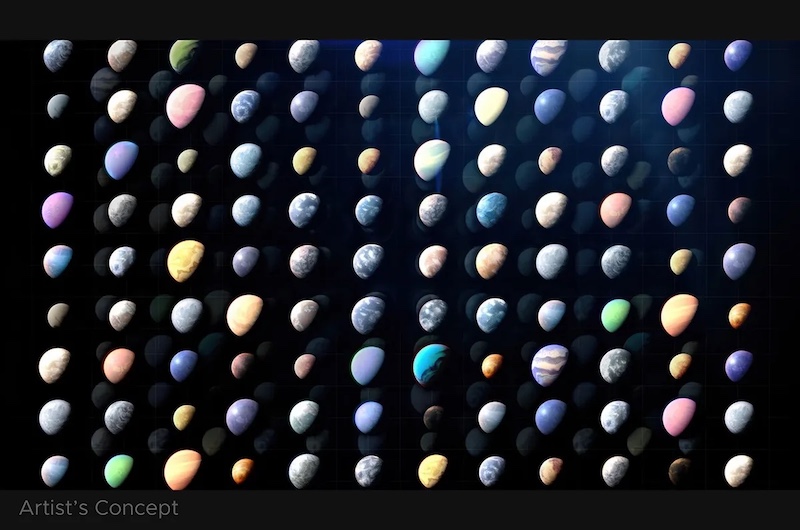
- NASA has uncovered over 10,000 new candidate planets across our galaxy.
- Scientists found them through a single survey of data captured by the TESS space telescope.
- The researchers used machine learning, a type of AI, to help detect the candidates.
Over 10,000 new exoplanet candidates
Discoveries of exoplanets – planets orbiting other stars – have increased in leaps and bounds in recent years. According to the NASA Exoplanet Archive, there are currently 6,278 confirmed planets. And now, thanks to an astonishing new study, the number of exoplanet candidates has just grown by over 10,000.
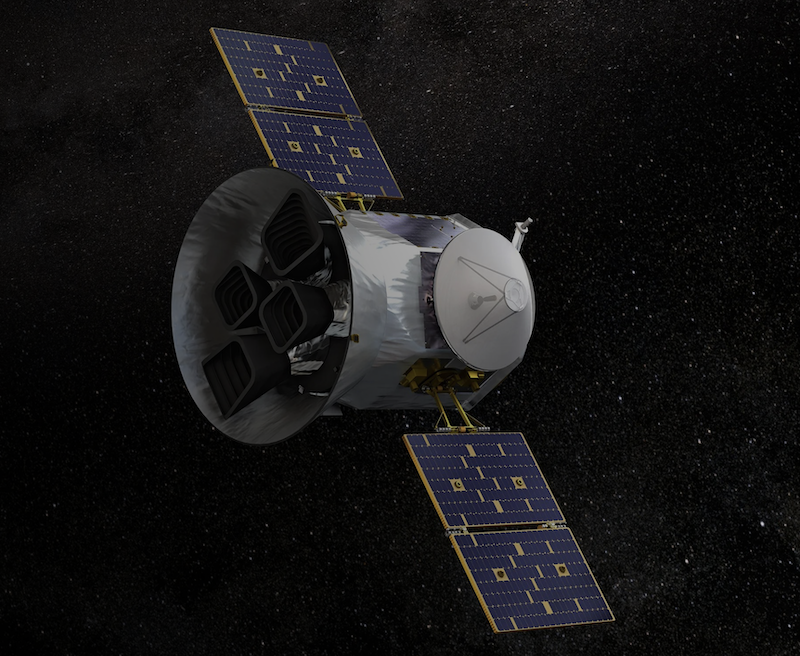
In a new paper published on April 21, 2026, a team of researchers led by Princeton University in New Jersey said it found the candidates in a single sweeping survey of data captured by NASA’s TESS (Transiting Exoplanet Survey Satellite) space telescope.
Searches for exoplanets with TESS usually focus on the brighter stars. But the new survey, named T16, saw the researchers analyze an enormous array of much fainter stars. To be precise, they analyzed the light curves – graphs that show the brightness of an object over a period of time – of over 80 million stars that TESS had imaged way back in 2018, during its 1st year of operation.
Overall, the survey revealed 11,554 candidate planets. And of those, 10,091 had never been detected before.
Jonathan O’Callaghan wrote about the discoveries in New Scientist on April 27, 2026 (paywalled). Mark Thompson also wrote about them for Universe Today on April 26, 2026, and Alfredo Carpineti wrote in IFLScience on May 1, 2026.
The researchers published the peer-reviewed paper in The Astrophysical Journal on April 28, 2026.
Most should turn out to be real planets
This haul of new exoplanets is unprecedented in number. Of course, they’re still candidates, and need to be confirmed in additional analysis. There are always some false positives, but the majority of candidates typically turn out to be real planets.
The researchers did choose one candidate from this batch to test. And sure enough, it’s a real world! Follow-up observations from the Magellan telescope in Chile revealed that the planet, named TIC 183374187, is a gas giant with a mass similar to Jupiter. It is what astronomers call a hot Jupiter, because it orbits close to its star, making it blisteringly hot.
How did they find so many?
TESS found these 10,000 new exoplanet candidates using the transit method. That’s when the planet passes in front of its star from our perspective. As they move in front of the star, the star dims slightly, and TESS can measure the amount of dimming.
Rather than only looking at brighter stars as usual, this search included fainter stars. As lead author Joshua Roth, a graduate researcher at Princeton University, told IFLScience:
Instead of looking at only the bright stars, which has been done previously, we expanded our search for planets to include fainter stars.
This just gives us a much larger base of stars that we can search for these planets. We developed a semi-automated pipeline that incorporates some machine learning to go through tons of this data and find planets. And we found about 10,000 new planet candidates.

Machine learning finds exoplanet candidates
The researchers used machine learning to help find the exoplanet candidates. That’s how they were able to sift through the data from over 80 million stars.
Machine learning is a form of artificial intelligence (AI). It uses algorithms that can “learn” the patterns of training data and, subsequently, make accurate inferences about new data.
These planetary candidates come from the 1st year of TESS data. That survey covered about half the sky. Now the researchers will continue with the 2nd year. Roth noted:
The next step will be to follow them up and to search more TESS data. We’re taking a slightly different approach for the 2nd year.
In fact, the data from the 2nd year might even be able to double the number of candidates found in the 1st year. Being able to find so many planetary candidates in a single survey will change the course of exoplanet hunting. As Roth described it:
I think what I’m most excited about is that this is a sign of this transition in exoplanetary science as a whole, that we’re sort of transitioning from the study of individual systems to having the facilities and the instruments and telescopes to perform these huge demographic-based surveys that hopefully really shine light on some of the planetary environments that we just haven’t been able to probe.
TESS launched on April 18, 2018. It completed its primary mission on July 4, 2020, and is now in its extended mission.
Bottom line: Using data from the TESS space telescope, astronomers have discovered over 10,000 new exoplanet candidates. That’s an unprecedented number for a single survey.
Read more: The tally is in! 6,000 exoplanets now confirmed
Read more: AI-powered robots are helping clean Europe’s ocean floor
Like what you read?
Subscribe and receive daily news delivered to your inbox.
More from
Paul Scott Anderson


Did formaldehyde on ancient Mars help kickstart life?

Black holes could have planets, new simulations suggest
Is this an alien radio signal from a super-Earth exoplanet?
Life on Enceladus? 2 new studies boost chances