



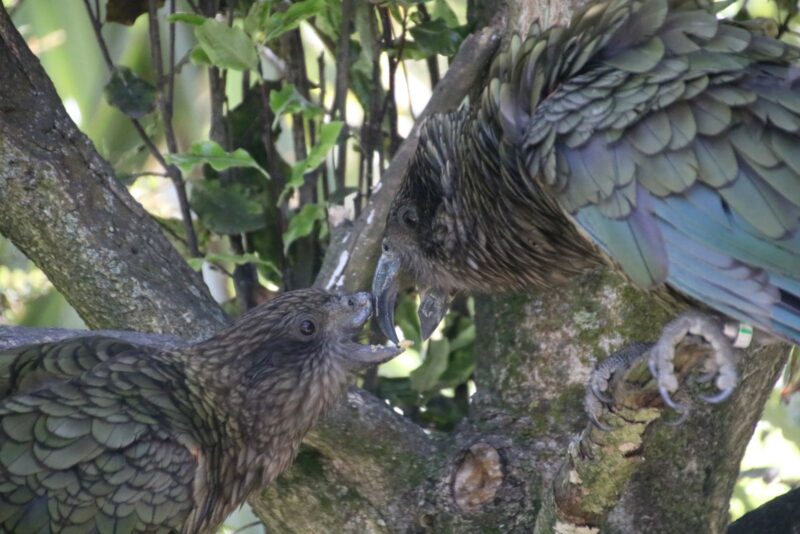
Meet Bruce the kea parrot. Bruce does not have an upper beak, but he’s still an alpha male. Thumbnail image via Ximena Nelson, professor at the University of Canterbury (used with permission).
A disabled kea parrot named Bruce, living at Willowbank Wildlife Reserve in New Zealand, has become the dominant male in his social group thanks to a unique fighting strategy. Researchers from the University of Canterbury said on April 21, 2026, that Bruce – who lacks an upper beak – not only survives but thrives socially by using his own original combat technique.
The researchers published their findings in the peer-reviewed journal Current Biology on April 20, 2026.
How a disabled parrot turned a disability into dominance
Scientists observed a captive group of endangered kea parrots at Willowbank Wildlife Reserve in New Zealand. They wanted to understand their social behavior and aggression patterns. Bruce immediately stood out because he had already gained attention for using pebbles as self-care tools in earlier observations. However, this new study focused on how he interacts socially, especially during conflicts.
The research team, led by Alexander Grabham of the University of Canterbury, documented Bruce’s behavior in detail. Then they compared it with other males and females in the group. They recorded 227 agonistic interactions (social conflict behaviors such as threats, fights or dominance displays) involving 12 birds in total (9 males and 3 females).
Want to hear Bruce? Video via Alexander Grabham.
Beak jousting is Bruce’s winning strategy
Bruce built his dominance through what researchers describe as a novel fighting style: beak jousting. Instead of relying on traditional beak clashes like other kea, he uses his exposed lower beak as a spear-like weapon. Grabham explained:
Everything we know about animal contests predicts that the bigger, better-armed competitor should prevail. Missing his entire upper beak should have put Bruce at a serious disadvantage. Yet Bruce, the only disabled bird in the group, was undefeated in his dominance interactions with other males. Bruce was the alpha male.
Bruce extends his neck to strike opponents at close range. But he also runs or jumps forward to increase force. Unlike other males, he consistently uses this method instead of kicking or conventional beak fights. In 73% of cases, his jousting immediately pushes opponents away.
Out of all recorded male interactions, Bruce took part in 36 and won every single one. Overall, he dominated all 162 male-male encounters observed in the group.
Here’s an example of Bruce beak jousting. En garde! Video via co-author Ximena Nelson, professor at the University of Canterbury (used with permission).
Social power and physical advantages
Bruce’s success does not stop at fighting. His dominance gives him clear social benefits. Researchers found he enjoys priority access to food sources and even receives grooming from other males, including beak cleaning … an unusual sign of social acceptance.
In addition, his body shows signs of lower stress. The study reports that Bruce has the lowest levels of corticosterone metabolites among the group. This indicates reduced physiological stress compared to his peers.
What Bruce’s success reveals about animal intelligence
Bruce’s case shows that intelligence plays a central role in how animals can succeed socially. Rather than relying only on physical ability, success can also come from how effectively an animal adapts and solves problems in its environment. Despite missing his upper beak, he has developed a unique fighting strategy that allows him to dominate his social group. As Grabham commented:
Bruce has not just found a way to compensate for his missing beak; he innovated a completely novel fighting style and turned it to his advantage.
This points to an important evolutionary idea: not all species are equally able to show this kind of adaptation. The study links such behavioral innovation to cognitive flexibility. And that is itself associated in previous research with larger brains and greater problem-solving capacity. In other words, this type of success is more likely in species that already have the neurological capacity for learning and innovation.
No upper beak, still flawless grooming. Video via Alexander Grabham (used with permission).
The disabled parrot has the advantage
The study also suggests that animals are sometimes able to compensate for physical limitations without human assistance. The researchers say that in some cases, animals may adapt so effectively that interventions like prosthetics might not always improve their quality of life, since natural innovation can sometimes outperform assistance. As Grabham noted:
If a disabled animal can innovate its way to success, well-intentioned interventions like prosthetics might not always improve their quality of life. Sometimes the animal can do better without help.
Bruce’s rise to dominance is a reminder that in highly intelligent species like kea, survival isn’t just about physical traits. What humans see as a disability might end up being an advantage for the animal.
No beak, no fear. That’s Bruce. Tough as they come. Video via Alexander Grabham (used with permission).
Bottom line: Bruce the disabled parrot has risen to alpha status among his peers. Bruce does not have an upper beak, yet uses a unique beak jousting tactic to get other parrots to submit.
Source: A disabled kea parrot is the alpha male of his circus
Read more: Monk parakeets: The more social, the richer their language
Read more: Australian lyrebirds have a hidden skill for farming
Like what you read?
Subscribe and receive daily news delivered to your inbox.
More from
Cristina Ortiz


Giant trees break a decades-old science theory

Walking shark discovered in Papua New Guinea
The giraffe weevil: When a beetle grows a giraffe’s neck
The boat-billed heron: When nature thinks big


