



Sun news February 28: More action from the sun’s far side


We know more action is about to arrive on the Earth-facing side of our star, because of the fiery prominence blasted out from beyond the sun’s limb, or edge, yesterday. The blast was produced just behind the sun’s southeast “shoulder.” So we didn’t see a flare associated with this event, which occurred at 10:15 UTC on February 27. But the active region that produced the prominence should show up, carried into view by the sun’s rotation, in the coming days.
Past 24 hours of sun news
(11 UTC February 27 – 11 UTC February 28)
Flare activity: Solar activity continued at low levels, with only C-class flares over the past day. The sun produced a total of 12 flares, 11 C-class (common) and 1 B-class (weak).
- Strongest flare was a C6.5 from AR4380 active region in the southeast, blasted out at 3:13 UTC on February 28.
- Lead flare producer: Active region AR4378 in the northeast topped the flare producer list with 5 C flares. AR4381 followed, with 4 C flares.
Sunspot regions: Today the Earth-facing side of our sun shows 4 numbered active regions. There is a newcomer on the northeast now numbered AR4381. AR4380 lost its delta and now shows a beta-gamma configuration.
Blasts from the sun? Available coronagraph imagery showed no Earth-directed coronal mass ejections (CMEs) during the past day.
Past 24 hours in space weather
Solar wind: Solar wind speeds at moderate-to-moderate-low levels for most of the period. The interplanetary magnetic field (IMF) was weak. Meanwhile, the Bz component was mostly southward oriented, with minor peaks northward. It ended the period around 11 UTC today with a southward orientation, which is favorable for auroras.
Earth’s magnetic field: Earth’s magnetic field continued showing from quiet to unsettled levels, Kp = 1 – 3. The Kp index sits slightly above level 1 at the time of this writing.
Sun news February 27: And now there are 3 sunspot regions!
We had three spotless days. Then we saw two sunspots rotating into view along the sun’s eastern horizon. What started as one sunpot, AR4379 in the southeast, has become two: AR4379 and AR4380. So today the sun is showing three sunspots (including AR4378). When it first appeared, between Tuesday and Wednesday mornings, AR4379 unleashed a flurry of 22 C-class flares. As it rotated further into view, and allowed a better analysis, specialists decided to split it, and AR4380 was born. After the split, AR4380 kept its beta-delta magnetic configuration, meaning it’s capable of producing more M-class (moderate) and even X-class flares.
Past 24 hours of sun news
(11 UTC February 26 – 11 UTC February 27)
Flare activity: Solar activity returned to low levels with only C-class flares over the past day. The sun produced a total of 12 C-class (common) flares.
- Strongest flare: C6.3 from an incoming, as-yet-unnumbered region in the northeast, blasting out at 19:09 UTC on February 26.
- Lead flare producer: The newly numbered active region AR4380 on the southeast limb (edge) led the period with 8 C-class flares.
Sunspot regions: The Earth-facing solar disk currently shows 3 numbered active regions.
Blasts from the sun? Available coronagraph imagery showed no Earth-directed coronal mass ejections (CMEs) during the period.
Past 24 hours in space weather
Solar wind: Solar wind speeds continued at moderate levels for most of the period. The interplanetary magnetic field (IMF) was weak. Meanwhile, the Bz component shifted intermittently between northward and southward orientations but stayed mostly southward during the strongest intervals. A southward orientation is favorable for auroras.
Earth’s magnetic field: Earth’s magnetic field ranged from quiet to unsettled levels, Kp = 2 – 3. At the time of this writing, the Kp index sits slightly above level 2.
Sun news February 26: 2 new sunspots end spotless 3 days
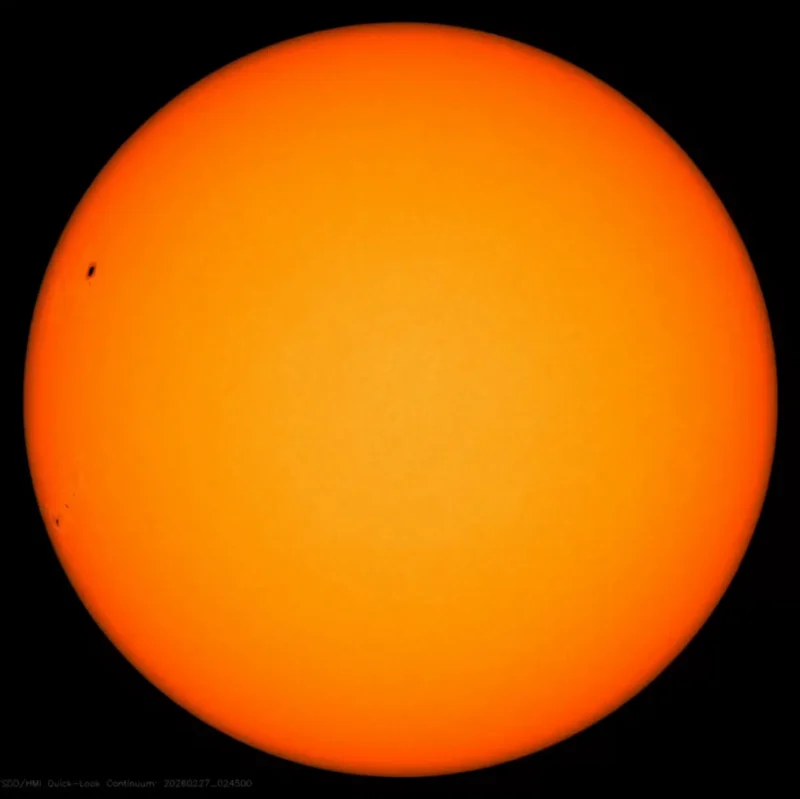
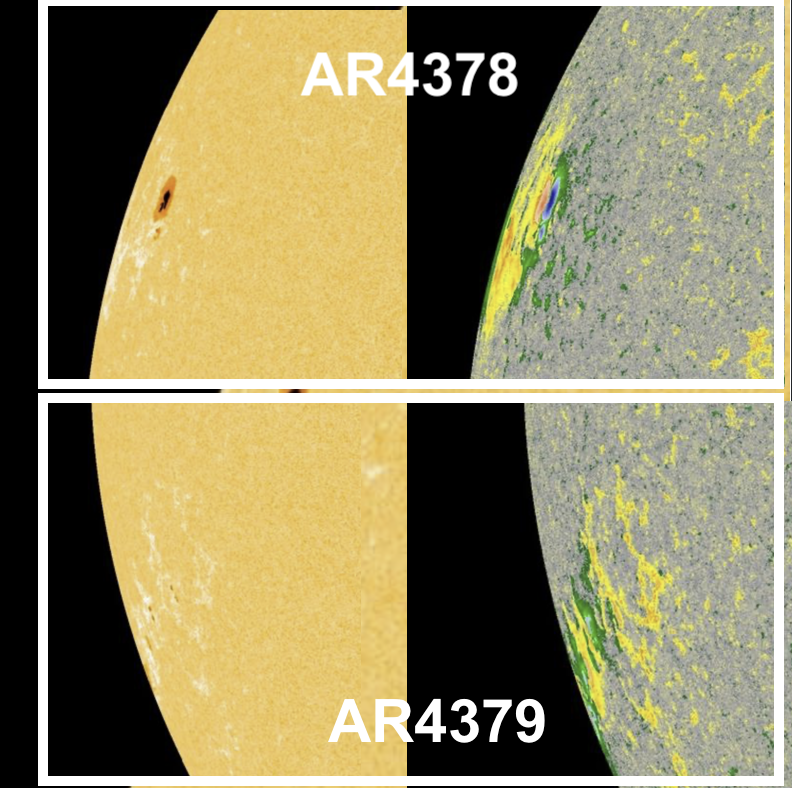
After three consecutive days with no sunspots on the Earth-viewed sun, two active regions have finally rotated into full view. Meet AR4378 in the northeast and AR4379 in the southeast. The southeastern region announced its arrival even before receiving an official number, unleashing a flurry of 22 C-class flares between Tuesday and Wednesday mornings. Now officially recognised as AR4379, this sunspot group has already added two M flares to its tally over the past 24 hours. Certainly the region to watch!
Past 24 hours of sun news
(11 UTC February 25 – 11 UTC February 26)
Flare activity: Solar activity climbed to moderate levels with two M-class flares during the past day. The sun produced a total of nine flares: 2 M-class (moderate), 6 C-class (common), and 1 B-class (weak).
- Strongest flare: M2.3 from the incoming region now numbered AR4379 at 15:59 UTC on February 25. This region on the southeast limb (edge) also produced a second M1.0 flare at 16:18 UTC on February 25. Both blasts triggered corresponding R1 (minor) radio blackouts that affected an area over eastern Brazil.
Sunspot regions: The Earth-facing solar disk contains 2 numbered active regions: AR4378 in the northeast and AR4379 in the southeast. AR4379 produced all the flares of the period.
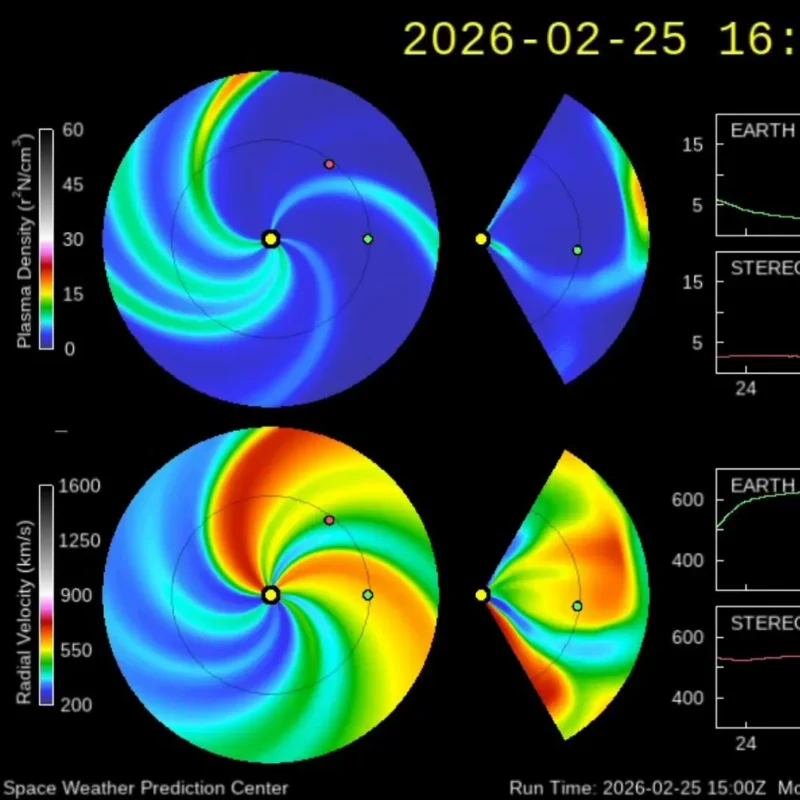
Blasts from the sun? An eruption associated with a C2.6 flare at 6:56 UTC on February 25 produced an Earth-directed coronal mass ejection (CME). Modeling indicates the CME will arrive at Earth late February 28 to early March 1.
Past 24 hours in space weather
Solar wind: Solar wind speeds held at moderate throughout the period. The interplanetary magnetic field (IMF) remained at moderate. Meanwhile, the Bz component stayed mostly southward, which is favorable for auroras.
Earth’s magnetic field: Earth’s magnetic field ranged from quiet to active levels, reaching Kp = 4 at 21:47 UTC on February 25. At the time of this writing, the Kp index sits slightly below level 4.
Sun news February 25: Flaring returns on a spotless sun!
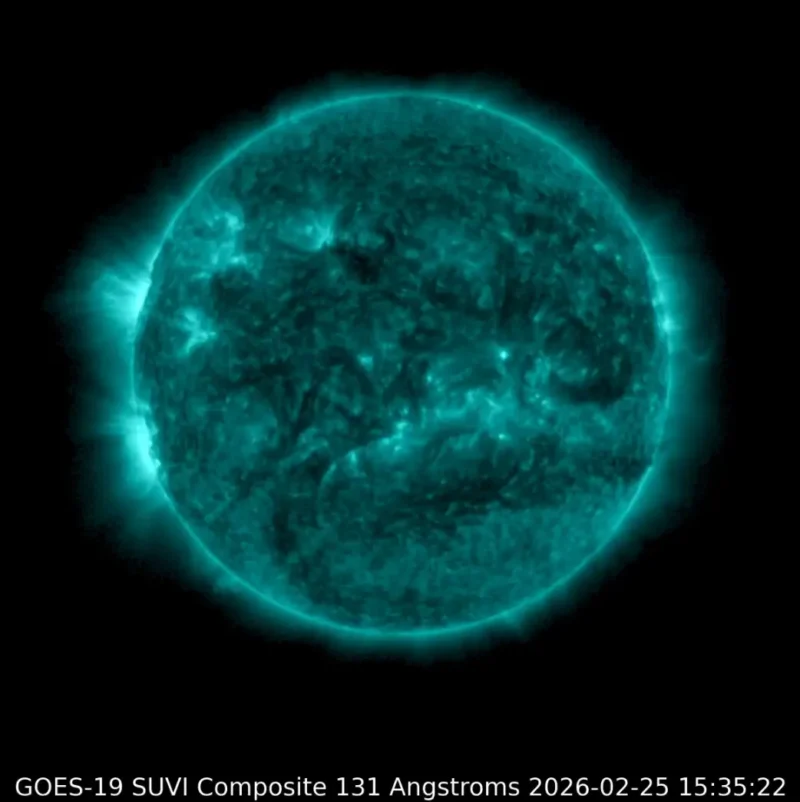
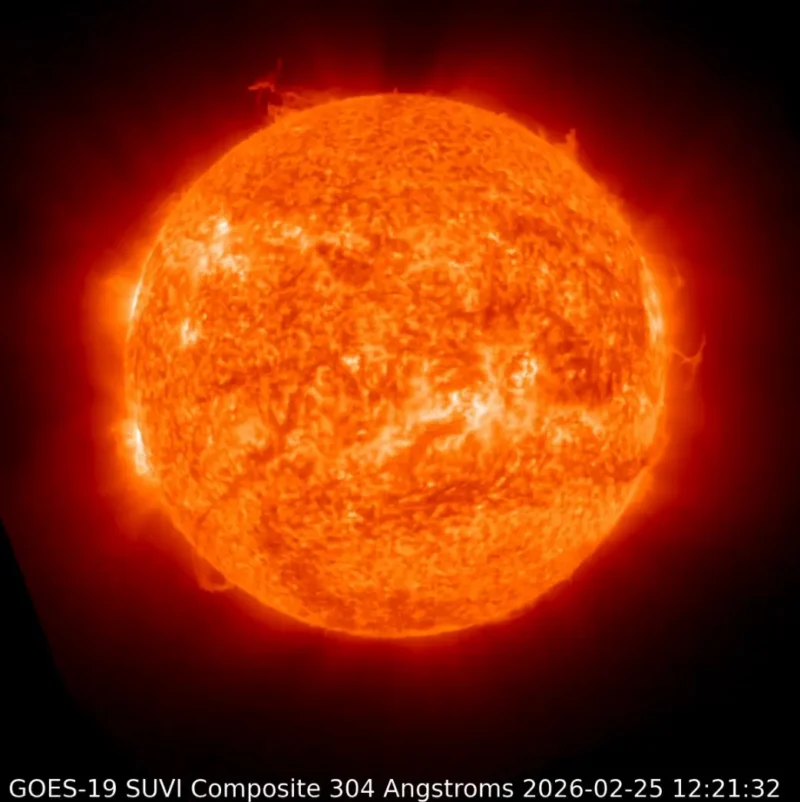
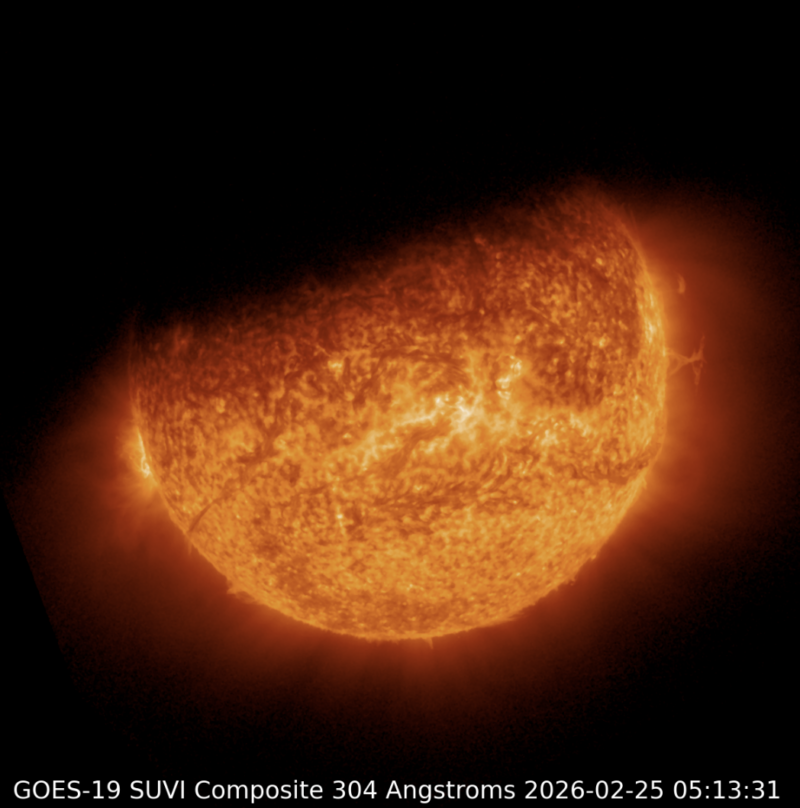
The sun has roared back to life, with an impressive 23 flares over the past day. And yet, our star’s Earth-facing side technically remains spotless. How? It’s because the sunspot region that produced all 23 flares is just emerging over the southeast horizon, and isn’t yet visible enough to be officially recognised. Still, this newcomer looks prolific, and should soon end the sun’s spotless streak!
Past 24 hours of sun news
(11 UTC February 24 – 11 UTC February 25)
Flare activity: Solar activity surged from very low to low with 23 flares: 22 C-class (common) and 1 B-class (weak).
- Strongest flare: C5.3 from an incoming, as-yet-unnumbered region on the southeastern horizon at 0:45 UTC on February 25. This incoming region on the southeast limb (edge) produced all 23 flares of the period.
Sunspot regions: The Earth-facing solar disk displays 0 numbered active regions.
Blasts from the sun? Available coronagraph imagery showed no Earth-directed coronal mass ejections (CMEs) during the period.
Past 24 hours in space weather
Solar wind: Solar wind speeds held at moderate-high levels throughout the period. The interplanetary magnetic field (IMF) remained at moderate levels. Meanwhile, the Bz component kept shifting between northward and southward orientations throughout the period. At the time of this writing, it points southward. A southward orientation is favorable for auroras.
Earth’s magnetic field: Earth’s magnetic field ranged from quiet to active levels, reaching Kp = 4 at 2:59 UTC on February 24. At the time of this writing, the Kp index sits at level 2.

Sun news February 24: Sun still spotless, but sunspots on the way!
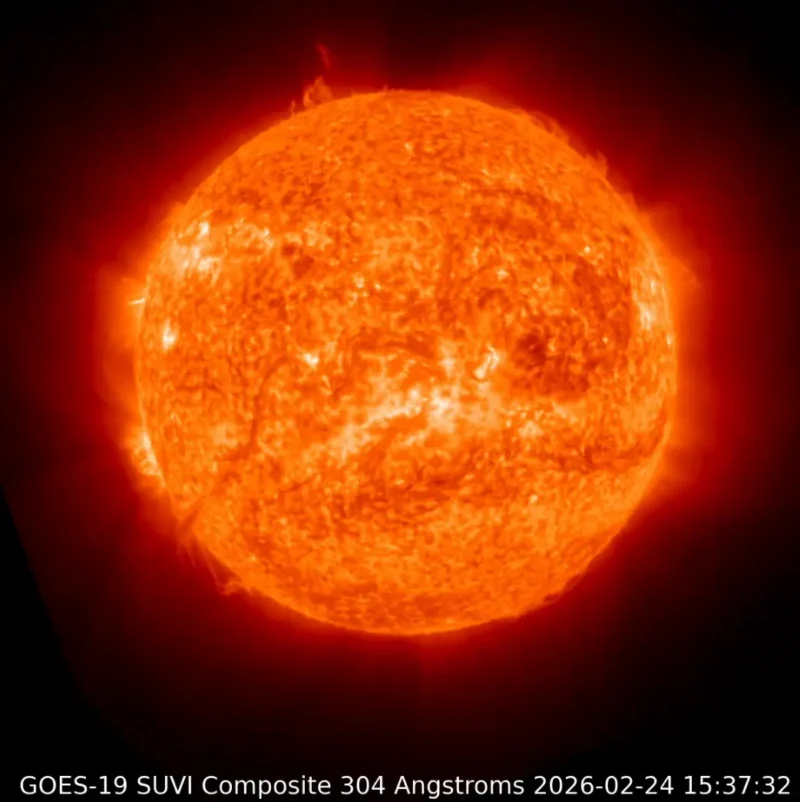
The sun has now gone two full days without any sunspot regions on its Earth-facing side, and is heading into a third. But we now know that active sunspot regions are blazing away on our star’s far side. Though these aren’t visible from Earth, they are visible to the Perseverance rover on Mars! The images aren’t as sharp as those from dedicated solar observatories, but three sunspot groups are clearly visible. We can even make out our old friend AR4366 – the producer of several X flares (strong) earlier this month which remains intact as it travels around the far side of our star.
Past 24 hours of sun news
(11 UTC February 23 – 11 UTC February 24)
Flare activity: Solar activity continued at very low levels. The sun produced 4 flares: 2 C-class (common) and 2 B-class (weak).
- Strongest flare: C1.1 from an incoming, as-yet-unnumbered region on the southeastern horizon at 7:34 UTC on February 24.
Sunspot regions: The Earth-facing solar disk displays 0 numbered active regions.
Blasts from the sun? Available coronagraph imagery showed no Earth-directed coronal mass ejections during the period.
Past 24 hours in space weather
Solar wind: Solar wind speeds rose to moderate-high levels during the first half of the period, then eased back to moderate levels. The interplanetary magnetic field held at moderate levels. The Bz component pointed northward early in the period, then turned south at 18:30 UTC on February 22 and remains so at the time of this writing. A southward orientation is favorable for auroras.
Earth’s magnetic field: Earth’s magnetic field ranged from active to quiet levels, reaching Kp = 4 at 18 UTC on February 23. At the time of this writing, the Kp index sits just below level 3.

Sun news February 23: First spotless day since 2022 confirmed
It’s official: February 22, 2026, marked the first fully spotless day since June 8, 2022. That ended a streak of roughly 1,355 consecutive days with visible sunspots on the solar disk. And still, there’s not a single sunspot adorning the visible side of our star this morning.
During the deep solar minimum before Solar Cycle 25 ramped up, 2019 logged 281 spotless days (77% of the year) and 2020 saw 192. The contrast with recent years, where spotless days dropped to zero, highlights just how active Solar Cycle 25 has been.
Does this mean solar maximum is behind us and the sun is winding down? Not so fast. While the sun is now in its declining phase, it remains highly active. Forecasters do not expect spotless days to return in meaningful numbers until the sun approaches the next solar minimum, which they place somewhere between 2029 and 2032, when Solar Cycle 26 is expected to begin. And history reminds us that some of the most powerful flares and coronal mass ejections often erupt after the cycle’s peak, during this declining phase. Yesterday’s blank sun was a rare milestone, but the sun still has plenty of fireworks left in this cycle.
Past 24 hours of sun news
(11 UTC February 22 – 11 UTC February 23)
Flare activity: Solar activity remained at low levels, with the sun producing 3 flares: 2 C-class (common) and 1 B-class (weak).
- Strongest flare: C1.5 from behind the southwestern horizon at 15:26 UTC on February 22.
Sunspot regions: The Earth-facing solar disk displayed 0 numbered active regions.
Blasts from the sun? Available coronagraph imagery showed no Earth-directed coronal mass ejections during the period.
Past 24 hours in space weather
Solar wind: The solar wind remained enhanced. The interplanetary magnetic field strengthened to moderate levels at times, with Bz swinging between north and south. The repeated southward dips favored auroral enhancement.
Earth’s magnetic field: Earth’s magnetic field ranged from active to stormy, reaching Kp = 5, with G1 (minor) geomagnetic storm intervals.
Sun news February 22 (UTC): A spotless sun for the 1st time since 2022
AR4374 has rotated out of view, leaving the Earth-facing solar disk free and clear of numbered sunspot regions. So if the disk stays clear through the day today, February 22, 2026 will mark the first spotless day since June 8, 2022. And it’ll snap a streak of roughly 1,355 consecutive days with visible sunspots.
That lone spotless day in 2022 was the only one that entire year. Since then, 2023, 2024, 2025, and 2026 have all recorded zero spotless days, meaning the sun has shown sunspots every single day for nearly four years. For comparison, during the deep solar minimum before Cycle 25 ramped up, 2019 logged 281 spotless days (77% of the year). And 2020 saw about 192. The transition from a mostly blank sun to one that has not gone spotless in years has been dramatic.
So what does a spotless day mean? It simply marks a day when the visible face of the sun shows no sunspots at all. Sunspots are regions of intense magnetic activity. So a spotless sun indicates a relatively quiet and disorganized solar magnetic field. Researchers have found that the number of spotless days in a given cycle strongly anti-correlates with the strength of that cycle’s maximum. And fewer spotless days during solar minimum tend to predict a stronger peak.
NASA and NOAA officially announced that Solar Cycle 25 had reached its maximum on October 15, 2024. As of early 2026, the sun is now in a declining phase of its 11-year cycle. But it remains active. Forecasters don’t expect spotless days to return in meaningful numbers until the sun approaches the next solar minimum, which they place somewhere between 2029 and 2032. That’s when Solar Cycle 26 is expected to begin.
And notably, some of the most powerful space weather events, major flares and CMEs, historically occur after the formal peak, during this declining phase. So while today’s blank sun offers a rare preview of quieter times ahead, don’t let it fool you. The sun still has plenty of fireworks left in this cycle.
Past 24 hours on the sun
(11 UTC February 21 – 11 UTC February 22)
Flare activity: Solar activity remained at low levels, with the sun producing 6 B-class and 2 C-class flares.
Sunspot regions: The Earth-facing solar disk displayed 1 numbered active region early in the past day. As of this morning, that region has rotated out of view.
Blasts from the sun? Available coronagraph imagery showed no Earth-directed coronal mass ejections (CMEs) during the past day.
Past 24 hours in space weather
Solar wind speeds increased, peaking after 12:30 UTC on February 21. The interplanetary magnetic field (IMF) was moderate. The Bz component was predominantly northward, limiting sustained auroral enhancement. But intermittent southward dips briefly favored auroral action.
Earth’s magnetic field ranged from unsettled to active levels, reaching Kp = 4 (Active). The authoritative NOAA summary indicated no G1 storm periods for this interval, but active conditions kept high-latitude aurora chances elevated (typical visibility favored Alaska, northern Canada, Iceland, and northern Scandinavia).
What’s ahead? Sun–Earth forecast
Flare activity forecast: Forecasters expect very low to low solar activity overall, with a chance for C-class flares on February 22–24 and a slight chance of isolated M-class flares (R1–R2) on February 23–24, mainly from any returning or near-limb regions as they evolve.
Geomagnetic activity forecast:
- On February 22, active intervals are likely as CIR effects persist. Aurora will likely be confined to the auroral zone, with occasional enhancement possible during southward IMF periods.
- By February 23, periods of G1 (Minor) geomagnetic storms are likely, due to the onset of negative-polarity coronal-hole high-speed solar wind stream influences. If Kp reaches 5, aurora could expand toward Seattle, Minneapolis, and Edinburgh.
- And on February 24, active levels are likely again, with continued risk of intermittent G1 storming depending on IMF orientation. Best viewing remains favored for high latitudes, with occasional expansion during stronger southward Bz.
Sun news February 21: The sun enters a quiet interval
The Earth-facing sun produced only very low activity over the past 24 hours, with only three faint B-class (weak) flares. No C-class flares occurred during the past 24 hours. And only two numbered active regions populate the sun today. One of them, AR4374, is heading out of view on the northwest limb (edge), as the sun’s rotation carries it to the far side. This leaves only AR4377; in an undynamic beta magnetic configuration. This region is showing signs of decay. Forecasters anticipate low levels of solar activity through February 24, when older, more active regions now on the far side may rotate back into view.
Past 24 hours on the sun
(11 UTC February 20 – 11 UTC February 21)
Flare activity: Solar activity dropped to very low levels with only faint B-class flares over the past 24 hours. The sun produced only three B-class (weak) flares.
- Strongest flare: B6.0 from active region AR4374 in the sun’s northwest at 12:16 UTC on February 20.
Sunspot regions: The Earth-facing side of our sun currently shows two numbered active regions.
Blasts from the sun? Available coronagraph imagery shows no coronal mass ejections (CMEs) during the period.
Past 24 hours in space weather
Solar wind: Solar wind speeds increased to moderate-high levels during the period. The interplanetary magnetic field (IMF) rose to moderate-high levels. The Bz component stayed south-oriented during the first half of the period until 0:24 UTC on February 21, when it turned northward and held that orientation through the end of the period at 10 UTC on February 21. Those southward turns are the intervals that most favor auroras.
Earth’s magnetic field: Our planet’s magnetic field ranged from quiet to active levels, Kp = 2 – 4. The Kp index reached 4, crossing that threshold at 23:40 UTC on February 20. This disturbance may represent remnants of the expected glancing blow, which arrived as a Kp = 4 disturbance rather than producing G1 (minor) geomagnetic storm conditions. At the time of this writing, the Kp index sat slightly below level 3.

Sun news February 20: A big coronal hole is aligning with Earth
A large coronal hole has emerged from the sun’s northeast and is now moving into alignment with Earth. What is a coronal hole? It appears as a dark regions in the sun’s corona, where open magnetic field lines let fast solar wind stream outward. So this hole’s fast solar wind is now streaming directly toward us. And fast solar wind is one of the key drivers of space weather. It can disturb Earth’s magnetic field, boosting chances for auroras. The effects are currently expected around February 22. Stay with us for further updates.
Past 24 hours on the sun
(11 UTC February 19 – 11 UTC February 20)
Flare activity: Solar activity continued at low levels with 3 faint flares over the past day: 2 C-class (common) and 1 B-class (weak).
- Strongest flare: C2.8 from active region AR4377 in the northwest at 3:07 UTC on February 20.
Sunspot regions: The Earth-facing side of our sun currently shows three numbered active regions.
Blasts from the sun? LASCO C2 captured a coronal mass ejection (CME) in the northeast during the past day. The event occurred at 9:10 UTC on February 19. Modeling is ongoing, but initial analysis indicates this is not an Earth-directed eruption.
Past 24 hours in space weather
Solar wind: Solar wind speeds averaged low-moderate levels during this period. The interplanetary magnetic field (IMF) was weak. The Bz component stayed north-oriented until 2:49 UTC on February 20, when it turned southward and held that orientation through the end of the period at 10 UTC on February 20. Those southward turns are the intervals that most favor auroras.
Earth’s magnetic field: Our planet’s magnetic field ranged from unsettled-to-quiet levels, Kp = 3 – 1. The anticipated glancing blow either didn’t arrive or produced no significant disturbance to Earth’s magnetic field. No G1 (minor) geomagnetic storming occurred. At the time of this writing, the Kp index sat at level 2.


Sun news February 19: A huge blast erupted from the far side
A huge blast erupted from the southwest limb (edge) of the sun. No flare appeared on the Earth-facing side of our star, indicating the enormous eruption occurred on the far side. A powerful prominence rose above the southwest horizon, hurling ejecta into space. The coronal mass ejection (CME) it produced first appeared in LASCO C2 at 4:36 UTC on February 18. The CME is not heading toward Earth. Specialists calculate that based on its location, the blast occurred in the vicinity of former active region AR4371.
Past 24 hours on the sun
(11 UTC February 18 – 11 UTC February 19)
Flare activity: Solar activity remained at low levels. During the past day the sun produced a total of 4 flares: 2 C-class (common) and 2 B-class (weak).
- Strongest flare: C2.2 from an incoming, as-yet-unnumbered active region in the southeast, blasting out at 20:42 UTC on February 18.
Sunspot regions: Today our star shows 3 numbered active regions on the side facing Earth.
Blasts from the sun? An eruption launched from the northeast at 18:30 UTC on February 18. Analysts are currently working to determine if any component is heading toward Earth. Beyond that, available coronagraph imagery shows no Earth-directed coronal mass ejections (CMEs) during the past day.
Past 24 hours in space weather
Solar wind: Solar wind speeds held steady at low-moderate levels for most of the period. The interplanetary magnetic field (IMF) was moderate. The Bz component kept shifting between southward and northward orientation but stayed mostly south-oriented throughout the period. As of 10 UTC on February 19, the Bz component has turned south. Those southward turns are the intervals that most favor auroras.
Earth’s magnetic field: Our planet’s magnetic field held at quiet-to-unsettled levels, Kp = 2 – 3. No G1 (minor) geomagnetic storming occurred. At the time of this writing, the Kp index sat just below level 3.


Sun news February 18: Space telescopes observed eclipse yesterday

Sun-observing satellites had a unique view of yesterday’s annular eclipse from space. Only lucky observers in Antarctica got a full view of the event, while observers in South Africa and southern areas of Argentina and Chile saw it partially. And spacecraft like NOAA’s GOES-19 captured a partial view of the eclipse a number of hours after the event was visible on Earth. Don’t miss the imagery from the CCOR-1 coronagraph below.
Past 24 hours on the sun
(11 UTC February 17 – 11 UTC February 18)
Flare activity: Solar activity continued at low levels with 6 flares. This time the sun sparked 3 C-class (common) and 3 B-class (weak) flares.
- Strongest flare: C1.8 from active region AR4374 in the northwest, blasting out at 23:23 UTC on February 17.
Sunspot regions: The Earth-facing side of the solar disk currently displays 4 numbered active regions.
Blasts from the sun? The sun produced some very slow coronal mass ejections (CMEs), but coronagraph imagery does not show any ejecta heading our way at Earth.
Past 24 hours in space weather
Solar wind: Solar wind speeds held steady at low-moderate levels for most of the period. The interplanetary magnetic field (IMF) was moderate. The Bz component kept shifting between a southward and northward orientation, but at low levels. At the time of this writing, the Bz component has turned south. Those southward turns are the intervals that most favor auroras.
Earth’s magnetic field: Earth’s magnetic field stayed at quiet-to-unsettled levels, Kp = 2 – 3. The anticipated G1 (minor) geomagnetic storm did not materialize. At the time of this writing, the Kp index has returned to level 2.
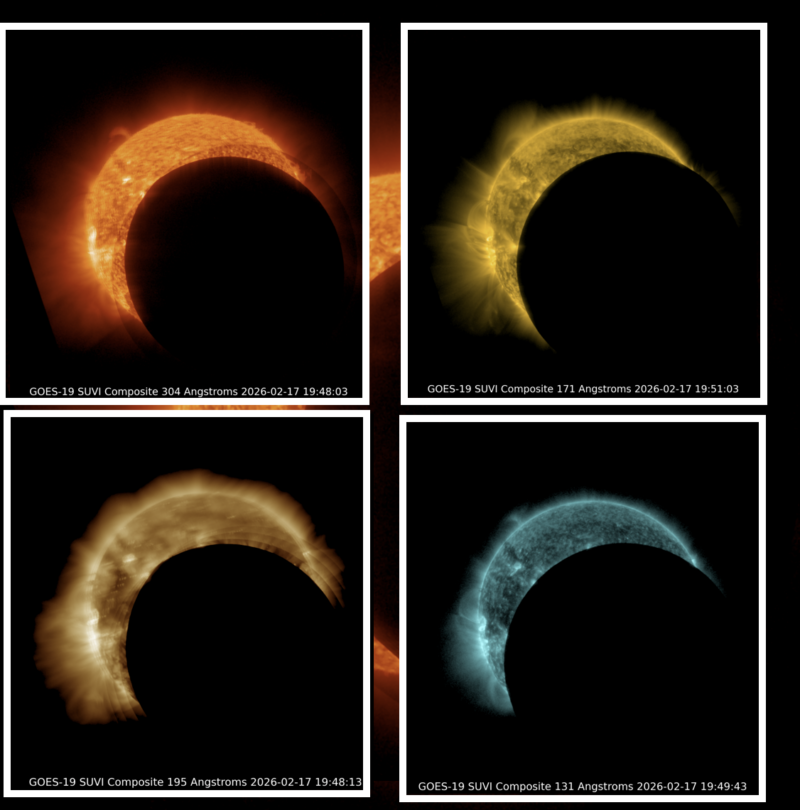

Sun news February 17: Moderate geomagnetic storm and auroras last night
Auroras flickered at far northern latitudes last night, as Earth’s magnetic field was buffeted by fast solar wind from a coronal hole. This drove geomagnetic storming up to G2 (moderate) levels. Intermittent southward turns of the magnetic field’s crucial Bz component repeatedly opened the door for the solar wind energy to pour in, energizing Earth’s upper atmosphere and triggering auroras. More storming – and more auroral activity – is possible tonight. Stay tuned!
Past 24 hours on the sun
(11 UTC February 16 – 11 UTC February 17)
Flare activity: Solar activity dropped to low levels with 6 flares: 2 C-class (common) and 4 B-class (weak).
- Strongest flare: C1.1 from an unassigned region near the southeast limb (edge) at 13:07 UTC on February 16.
Sunspot regions: 5 numbered active regions are visible today on the Earth-facing solar disk.
Blasts from the sun? A filament eruption at 12:30 UTC on February 16 produced a coronal mass ejection (CME). The eruption occurred near the center of the solar disk as seen from Earth. However, a large nearby coronal hole deflected most of the sun-stuff northward. Forecasters expect a glancing blow to arrive at Earth on February 19.
Past 24 hours in space weather
Solar wind: Solar wind speeds increased to moderate-high levels for most of the period. The interplanetary magnetic field (IMF) was moderate. The Bz component turned southward at 18 UTC on February 16, then shifted northward for most of the remaining period before turning south again at the end. Those southward turns are the intervals that most favor auroras.
Earth’s magnetic field: Earth’s magnetic field ranged from quiet to stormy levels, reaching Kp = 6 with G2 (moderate) geomagnetic storm conditions. Conditions crossed the G1 (Kp5) threshold at 18:36 UTC and the G2 (Kp6) threshold at 20:00 UTC. Auroras were visible at latitudes as far south as the states of New York and Wisconsin in the US, with the most favorable viewing windows tied to brief southward Bz excursions.

Sun news February 16: An M2.5 flare in the east breaks the calm

The sun broke its relative calm with a sharp M2.5 (moderate) flare around 4 UTC this morning. The eruption came from the eastern horizon, hinting at an active region starting to rotate into view. The flare triggered an R1 (minor) radio blackout, most noticeable across the sunlit Indian Ocean sector into parts of Australia and Southeast Asia.
Past 24 hours on the sun
(11 UTC February 15 – 11 UTC February 16)
Flare activity: Solar activity reached moderate-to-high, with 3 flares observed.
- Strongest flare: M2.5 from an unassigned region near the east limb (edge) at 4:03 UTC on February 16.
Sunspot regions: The Earth-facing solar disk displayed 5 numbered active regions.
Blasts from the sun? No Earth-directed coronal mass ejections (CMEs) were observed during the period in available imagery.
Past 24 hours in space weather
Solar wind: Solar wind speeds increased overall. The interplanetary magnetic field (IMF) was moderate. The Bz component stayed predominantly northward but dipped south at times. Those southward turns are the intervals that most favor auroras.
Earth’s magnetic field: Earth’s magnetic field ranged from unsettled to stormy levels, reaching Kp = 5 with G1 (minor) geomagnetic storm conditions. Aurora potential remained best at higher geomagnetic latitudes, with the most favorable viewing windows tied to brief southward Bz excursions.
SDO is in an eclipse season
NASA’s sun-observing Solar Dynamics Observatory (SDO) is currently in an eclipse season — a twice-yearly event in which Earth passes between SDO and the sun. In SDO images, you see a dark curve crossing the sun’s face. And it’s not the moon, and not a solar eclipse as we see from Earth. It’s an eclipse of the sun by Earth, as seen from space. EarthSky’s Deborah Byrd will show images of what SDO sees, and explain what the images show — and what they don’t show — and why perspective matters in astronomy. Watch in the player above, or on YouTube.Sun news February 15: A quiet Sunday for our sun, but storms coming
The sun seems to be taking a breather in terms of its flare output. The strongest of a handful of flares over the past day was a modest C6.0 event at 11:13 UTC on February 14 from AR4374. However, we may see some action in the coming days, with geomagnetic storms likely to return as solar wind from a coronal hole reaches Earth. Get ready!
Past 24 hours on the sun
(11 UTC February 14 – 11 UTC February 15)
Flare activity: Solar activity remained low-to-moderate, with 7 flares observed (2 Cs, 5 Bs). The strongest flare was a C6.0 from AR4374 at 11:13 UTC on Feb 14.
Sunspot regions: The Earth-facing solar disk displayed five numbered active regions.
Blasts from the sun? No Earth-directed coronal mass ejections (CMEs) were observed during the period in available imagery.
Past 24 hours in space weather
Solar wind: Solar wind speeds fell and then increased over the past day, peaking by the end of the window. The interplanetary magnetic field (IMF) was low, then strengthened slightly on Feb 14. The Bz component was primarily northward early, but turned strongly southward late and remained there through the end of the period. A southward Bz favors auroras.
Earth’s magnetic field: Earth’s magnetic field ranged from quiet to active levels, reaching Kp = 4 during the period.
What’s ahead? Flare forecast
Flare activity forecast: Low levels are expected, with a slight chance (10%) of M-class (R1/R2) flares through Feb 17, most likely from the more established spot groups including AR4374. The chance of an X-class flare remains at 1%.
Geomagnetic activity forecast:
- Feb 15: Periods of G1 (minor) storming are likely, with a chance of isolated G2 (moderate) storming. This will be driven by corotating interaction region (CIR) influences and the onset of solar wind from a coronal hole. Weak enhancements from a CME remain possible.
- Feb 16: G1 (minor) storming remains likely as coronal-hole high-speed stream influences persist.
- Feb 17: Activity is expected to ease to active levels (below storm thresholds) as enhanced solar wind gradually wanes.
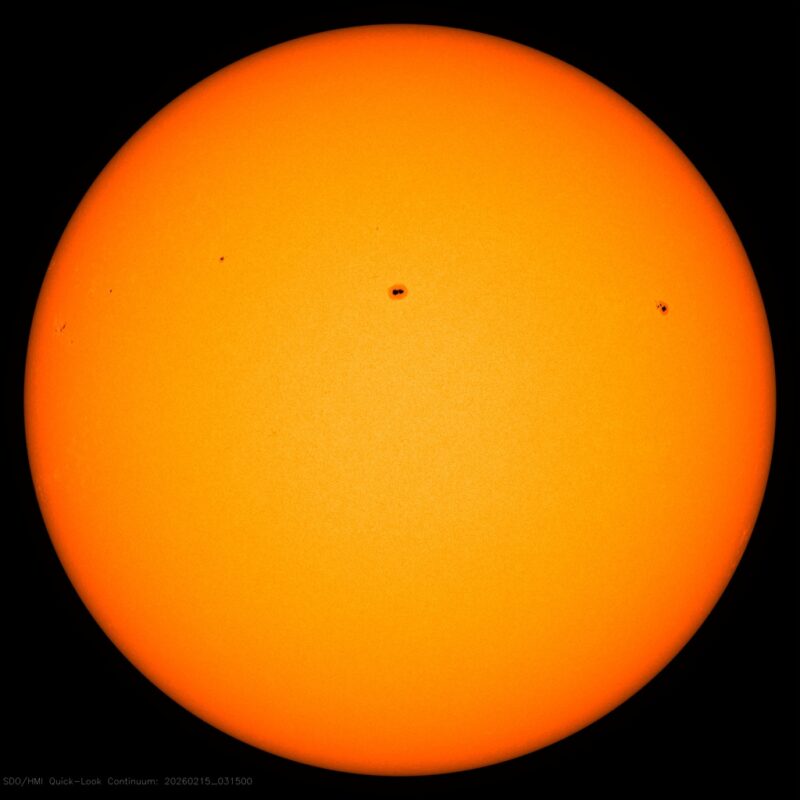
Sun news February 14: Huge transequatorial coronal hole

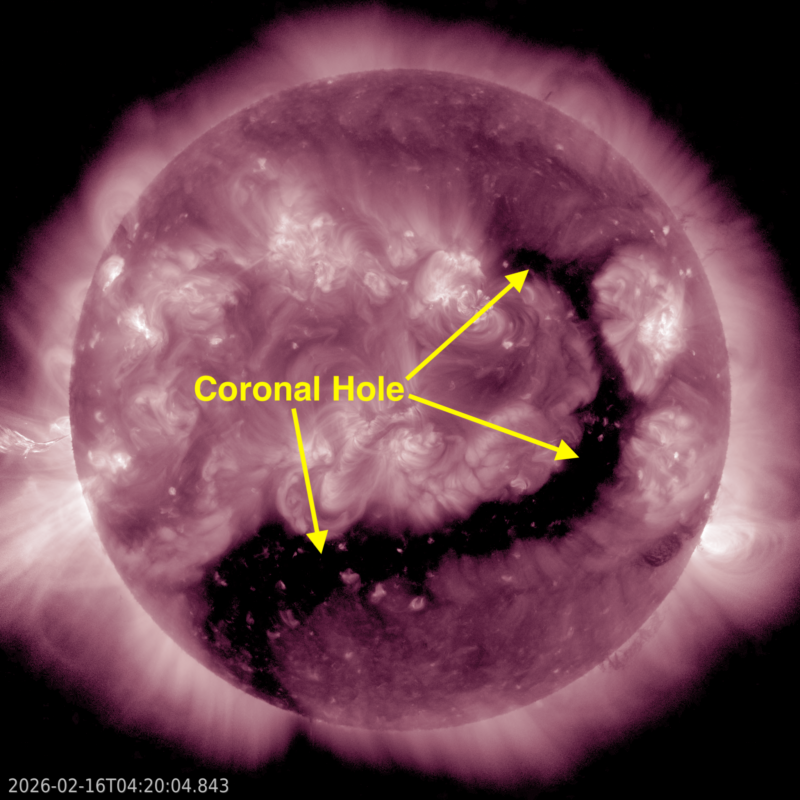
A huge transequatorial coronal hole is directly facing Earth. Its distinctive curved shape looks remarkably familiar. We saw a similar shape back in mid-January, and there’s a good chance we’re looking at the very same coronal hole. It traveled around the sun, survived its transit across the far side and emerged from over the eastern horizon early this week. What does this mean for us? The fast solar wind streaming from this coronal hole may start arriving at Earth in the next couple days. And when it does, it could spark auroras. Get ready!
Past 24 hours on the sun
(11 UTC February 13 – 11 UTC February 14)
Flare activity: Solar activity dropped down to low levels with C-class (common) and B-class (weak) flares. The sun sparked 8 flares during the past day: 2 Cs (common) and 6 Bs (weak).
- Strongest flare: A C2.0 from AR4374 at 6:10 UTC on February 14.
Sunspot regions: The Earth-viewed solar disk displays three numbered active regions today.
- Most active region: AR4374 is tied with AR4373 topping the list as lead flare producer with 2 flares each: one C-class and one B-class. It also produced the largest flare of the period.
- AR4374 (beta) is the largest sunspot region on the solar disk and the lead flare producer.
- AR4373 (alpha) produced 1 C flare and one B flare and shows as the second-largest sunspot region on the solar disk today.
- AR4366 continued flaring from the far side, signaling its presence just behind the west horizon via gorgeous displays of fiery jets.
Blasts of sun-stuff? Coronagraph imagery captured a coronal mass ejection (CME). The event is associated with the M1.1 flare from AR4373 yesterday. Modeling shows a component heading toward Earth. Arrival is estimated on February 15. No other CMEs appeared on available coronagraph imagery.
Past 24 hours in space weather
Solar wind: Solar wind speeds started to increase from low levels to low-moderate levels during the period. The interplanetary magnetic field (IMF) stayed moderate. The Bz remained mostly southward late yesterday but started to shift northward at 1:47 UTC on February 14. At the time of this writing, Bz continued its north orientation. A southward Bz favors auroral activity.
Earth’s magnetic field: As anticipated, Earth’s magnetic field registered quiet to unsettled levels during the period, with Kp values between 0 and 3. The high-speed solar wind stream continued to wane. At the time of writing, Kp sits almost at zero, just a hair above that level.


Sun news February 13: M flare and a spectacular solar jet

An M1.1 flare from sunspot group AR4373 kept solar activity at a moderate level over the past day. Overall flare production and intensity has lowered, particularly now that last week’s titan AR4366 has rotated out of view. But we still observed two of AR4366’s C flares from beyond the northwestern horizon, along with the gorgeous, arcing solar jet you can see above.
Past 24 hours on the sun
(11 UTC February 12 – 11 UTC February 13)
Flare activity: Solar activity remained moderate thanks to an isolated M-class flare. The sun fired 8 flares during the past day: one M (moderate), 3 Cs (common), and 4 B-class (weak) flares.
- Strongest flare: An M1.1 from AR4373 at 8:58 UTC on February 13. The flare triggered an R1 (minor) radio blackout over Madagascar.
Sunspot regions: Today the sun shows 5 numbered active regions as seen from Earth.
- Most active region: AR4373 in the northwest was the top flare producer with 3 flares: two B-class flares and the only M flare of the period.
- AR4371 (alpha) produced 2 flares: one C-class and one B-class flare. This active region has now rotated to the far side of the sun on the southwest horizon.
- Although we can’t see it, AR4366 continues flaring from the far side. It produced two C-class flares during this period.
Blasts of sun-stuff? Available coronagraph imagery showed no Earth-bound coronal mass ejections (CMEs).
Past 24 hours in space weather
Solar wind: Solar wind speeds averaged at low levels during the period, with a couple of peaks reaching moderate-high levels this morning. The interplanetary magnetic field (IMF) stayed moderate, while Bz remained mostly southward through most of the period. At the time of this writing, Bz has turned northward. A southward Bz favors auroral activity.
Earth’s magnetic field: Earth’s magnetic field ranged from quiet to active levels during the period, with Kp values between 1 and 4. Kp reached the 4 threshold at 2:13 UTC on February 13. The disturbance lasted only one three-hour period. At the time of writing, Kp = 3.
What’s ahead? Sun–Earth forecast
Flare activity forecast: Low-to-moderate flare activity will continue. The probability of M-class (moderate) flares is 10%, and the chance of an X-class flare remains at 5% today.
Geomagnetic activity forecast:
- February 13: Mostly quiet conditions are anticipated for the rest of the day. High-speed solar wind stream effects should continue to fade.
- February 14: Quiet-to-unsettled conditions are expected, driven by combined effects of a co-rotating interaction region and a possible weak coronal mass ejection (CME) the sun hurled on February 11.
- February 15: Unsettled-to-active conditions are possible, with the potential for G1 (minor) geomagnetic storming due to positive polarity fast solar wind.
Sun news February 12: AR4366 departs, still flaring from the far side!

AR4366, the sunspot region that amazed us with a barrage of X flares last week, has just been carried out of view by the sun’s rotation. But we can still see its flares! We observed 5 of AR4366’s eruptions from beyond the western horizon over the past day, including an M1.4 flare at 13:12 UTC on February 11. The event could have been larger in reality, as the flare’s light was partially blocked by the sun itself from our perspective.
Past 24 hours on the sun
(11 UTC February 11 – 11 UTC February 12)
Flare activity: Solar activity remains at moderate levels, with the sun firing 12 flares in the past 24 hours: 2 M-class and 10 C-class flares.
- Strongest flare: The two M flares are tied for the strongest flare of the period, as both were M1.4s. The first was from AR4366 at 13:12 UTC on February 11. The flare triggered an R1 (minor) radio blackout over the South Atlantic Ocean. And the second was from AR4367 at 2:40 UTC on February 12. That blast triggered an R1 (minor) radio blackoutout affecting an area over New Guinea.
Sunspot regions: Our sun currently shows 7 numbered active regions on the side we see from Earth.
- Most active region: AR4366 remained the top flare producer of the period, with 5 flares.
- AR4374 (beta) produced 3 C-class flares, and is now one of the two largest regions after AR4366’s departure, along with AR4373 (beta).
Blasts of sun-stuff? Analysts observed a small loop structure in the southwest at 19:48 UTC on February 10. Solar material fired out from this event might not be headed our way at Earth, but it may combine with a corotating interaction region (CIR) to enhance geomagnetic disturbance on February 14.
Past 24 hours in space weather
Solar wind: Solar wind speeds reduced from mildly disturbed to low levels during the period. The interplanetary magnetic field (IMF) stayed weak to moderate, while Bz was mostly southward through most part of the period. At the time of writing, Bz remains southward. A southward Bz favors auroral activity.
Earth’s magnetic field: Earth’s magnetic field ranged from quiet to active during the period, with Kp values between 2 and 4. The anticipated G1 (minor) geomagnetic storm arrived as a Kp = 4 disturbance for a three-hour period starting at 22:30 UTC on February 11. Overall, conditions reflected the waning influence of a negative-polarity coronal hole high-speed solar wind stream. At the time of writing, Kp = 3.
Sun news February 11: AR4366 in a prime spot to send us solar particles

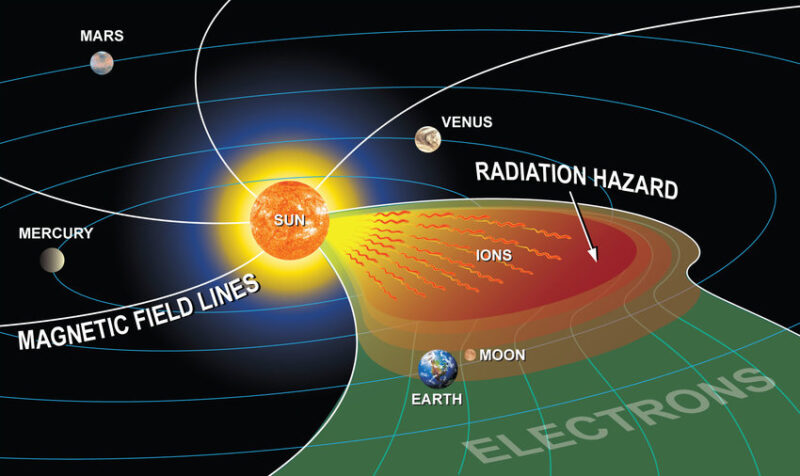
Farewell AR4366! This incredibly volatile sunspot region is now rotating out of view, having fired a volley of X flares in its time on the Earth-viewed sun. As the sun’s rotation carries it over the northwestern horizon, this sunspot group is moving into a prime position to send energetic solar particles toward Earth. That’s because it is now more directly connected to our planet through the Parker spiral: the curved, rotating magnetic field that emanates from the sun. This spiral acts like a space weather superhighway, guiding any charged particles that are fired from sunspots efficiently through interplanetary space. These particles aren’t a concern for you and I, but can be harmful for astronauts. So when regions as powerful as AR4366 are in this spot on the solar horizon, it can pose a risk for missions like soon-to-launch Artemis II.
Past 24 hours on the sun
(11 UTC February 10 – 11 UTC February 11)
Flare activity: Solar activity increased to moderate levels, with 3 M-class (moderate) flares over the past day. In total, the sun fired 14 flares in the last 24 hours: 3 M-class and 11 C-class flares.
- Strongest flare: M1.4 from AR4366 at 0:57 UTC on February 11. The flare triggered an R1 (minor) radio blackout over the Pacific Ocean west of Fiji Island.
Sunspot regions: Today the solar disk shows 7 numbered active regions on its Earth-facing side.
- Most active region: AR4366 erupted with 12 flares as it departed along the northwest horizon. After several quieter days, it produced three M-class flares and eight C-class flares, once again earning the title of top flare producer for the period.
- AR4366 (beta-gamma-delta) remains the largest and most magnetically complex region on the Earth-facing disk, even as it slips out of view along the northwest limb.
- Another flare-producing region during the period was AR4374 (beta), which generated three C-class flares.
Blasts of sun-stuff? Analysts are reviewing two eruptions to determine whether they launched any Earth-directed coronal mass ejections (CMEs). The strongest was a long-duration event at 19:10 UTC on February 10 in the northwest, associated with a C3.2 flare. Around the same time, observers detected another eruption in the northwest. LASCO C2 registered both events at 18:48 UTC on February 10 as two superimposed CMEs.
Past 24 hours in space weather
Solar wind: Solar wind speeds remained mildly disturbed during the period. The interplanetary magnetic field (IMF) stayed weak to moderate, while Bz shifted between north and south, with the strongest intervals oriented southward. At the time of writing, Bz remains southward. A southward Bz favors auroral activity.
Earth’s magnetic field: Earth’s magnetic field ranged from quiet to active during the period, with Kp values between 2 and 4. Kp reached 4 at 22:14 UTC on February 10 and remained so for two three-hour periods. Overall, conditions reflected the waning influence of a negative-polarity coronal hole high-speed solar wind stream. At the time of writing, Kp = 3.
What’s ahead? Sun–Earth forecast
Flare activity forecast: Low to moderate flare activity is expected. With AR4366 departing, the probability of M-class (moderate) flares drops from 65% to 15%, and the chance of an X-class flare decreases from 25% to 10% for February 11 through 13.
Geomagnetic activity forecast:
- February 11: Quiet-to-unsettled conditions are anticipated, although an isolated G1 (minor) geomagnetic storm remains possible. NOAA issued an alert for auroral displays at northern latitudes, including states such as Michigan and Maine.
- February 12: Mostly quiet conditions are anticipated as high-speed stream effects continue to fade and background solar wind conditions reassert themselves.
Sun news February 10: Solar Cycle 25’s decline continues, new data show

NOAA has just announced the sunspot number – a measure of solar activity – for January 2026. The monthly value was 112.6, an expected decrease from the value of 124 in December 2025. Solar Cycle 25’s activity continues to decline after its peak in August 2024, when the sunspot number was 216, although specialists have not yet declared Solar Maximum to be over.
Past 24 hours on the sun
(11 UTC February 9 – 11 UTC February 10)
Flare activity: Solar activity fell to low levels, with only 15 C-class (common) flares produced over the past day.
- Strongest flare: C9.2 from AR4374 at 23:02 UTC on February 10.
Sunspot regions: The solar disk currently shows 7 numbered active regions as seen from Earth.
- Most active region: AR4366 topped the list as the most prolific flare producer, blasting out 9 C-class flares.
- AR4366 (beta-gamma-delta) is at the very edge of the western solar horizon and remains the largest and most magnetically complex region on the Earth-facing disk.
- Two other active regions also produced C-class flares: AR4371 (alpha) and AR4374 (beta).
Blasts of sun-stuff? No Earth-directed coronal mass ejections (CMEs) were confirmed over the past day.
Past 24 hours in space weather
Solar wind: Solar wind speeds remained mildly disturbed over the past day. The interplanetary magnetic field (IMF) stayed weak to moderate, while Bz fluctuated between north and south, with the strongest intervals oriented northward. At the time of this writing, the Bz component has turned southward. A southward Bz favors auroral activity.
Earth’s magnetic field: Earth’s magnetic field remained quiet, with Kp values between 2 and 3. Overall, conditions matched the waning influence of a coronal hole high-speed solar wind stream.
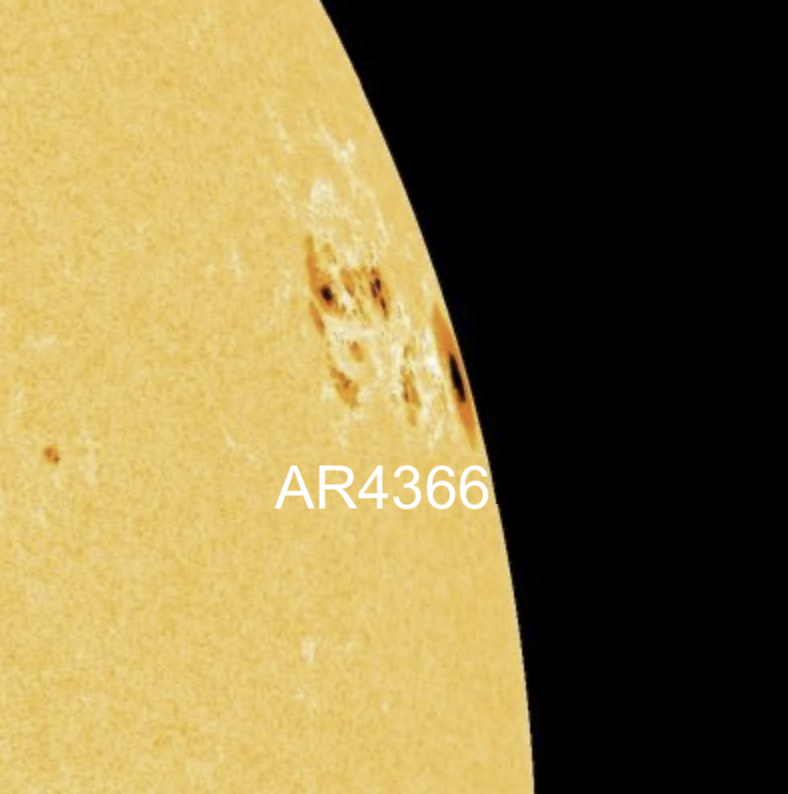
Sun news February 9: Our star remains restless with an M2.8 flare
The sun remained lively over the past day, with sunspot region AR4366 firing off 4 M-class (moderate) flares. The largest was an M2.8 at 2:14 UTC this morning, which triggered an R1 (minor) radio blackout over the seas between Australia and Papua New Guinea. After AR4366 fired an incredible volley of X-class flares last week, forecasters continue to flag this region as capable of more M and even X flares in the days to come.
Past 24 hours on the sun
(11 UTC February 8 – 11 UTC February 9)
Flare activity: Solar activity remained moderate-to-high, with 16 flares observed (4 M-class, 12 C-class).
- Strongest flare: M2.8 from AR4366 at 2:14 UTC on February 9. It triggered an R1 (minor) radio blackout.
- Other notable flares: M1.8 (11:13 UTC, February 8, AR4366); M1.7 (11:32 UTC, February 8, AR4366); M2.7 (13:46 UTC, February 8, AR4366).
Sunspot regions: The Earth-facing solar disk currently holds 9 numbered active regions.
- Most active region: AR4366 dominated the day’s activity, producing all the M-class flares and the bulk of the Cs.
- Regions to watch:
- AR4366 (beta-gamma-delta) showed some signs of decay, but remained the largest and most magnetically complex region on the Earth-viewed solar disk.
- The remaining regions were largely stable or in decay, with little flare output.
Blasts of sun-stuff? No Earth-directed coronal mass ejections (CMEs) were confirmed over the past day.
Past 24 hours in space weather
Solar wind: Solar wind speeds remained mildly enhanced for most of the past day before easing. The interplanetary magnetic field (IMF) stayed weak to moderate, while Bz fluctuated between about north and south. Southward Bz is favorable for auroras.
Earth’s magnetic field: Earth’s magnetic field ranged from quiet to unsettled, with brief active intervals peaking near Kp = 4. Overall, conditions were consistent with the waning influence of a coronal hole’s high-speed solar wind stream.
AR4366 was spectacularly active last week
SDO is in an eclipse season
NASA’s sun-observing Solar Dynamics Observatory (SDO) is currently in an eclipse season — a twice-yearly event in which Earth passes between SDO and the sun. In SDO images, you see a dark curve crossing the sun’s face. And it’s not the moon, and not a solar eclipse as we see from Earth. It’s an eclipse of the sun by Earth, as seen from space. EarthSky’s Deborah Byrd will show images of what SDO sees, and explain what the images show — and what they don’t show — and why perspective matters in astronomy. Watch in the player above, or on YouTube.Sun news February 8 (UTC): Giant sunspot still visible, still active

The sun was active over the past day with several C-class flares. The largest was a C6.1 flare from AR4366 that peaked at 07:32 UTC on February 8. This flare wasn’t strong enough to cause radio blackouts. But it shows that AR4366 still has the potential for more eruptions as it moves across the western side of the Earth-facing sun.
Meanwhile, here on Earth, our world’s magnetic field was slightly unsettled due to lingering fast solar wind from a coronal hole. Geomagnetic conditions ranged from unsettled to active (about Kp = 2–4), which can sometimes make auroras brighter at high latitudes. Solar wind speeds slowed down, and the interplanetary magnetic field (IMF) stayed moderate, with Bz switching between north and south, sometimes allowing energy to reach Earth’s magnetosphere.
So the sun is still showing signs of activity, and forecasters expect M-class flares in the next few days. A coronal mass ejection (CME) and new high-speed solar wind could also increase geomagnetic activity, possibly leading to brief G1 (minor) storms.
Past 24 hours on the sun
(11 UTC February 7 – 11 UTC February 8)
Flare activity: Solar activity remained at moderate levels, with 10 C-class flares observed. The strongest flare was the C6.1 from AR4366 at 07:32 UTC on February 8. AR4366 was the top flare producer of the past day, responsible for 7 of the 10 C-class flares (C1.9–C6.1), consistent with its beta-gamma-delta complexity noted by NOAA.
Sunspot regions: The Earth-facing solar disk displayed 9 numbered active regions in the past day. AR4366 (beta-gamma-delta) remained the largest and most complex group on the disk, producing the majority of C flares and retaining elevated M/X flare potential. The remaining regions were mostly unchanged or relatively simple, contributing only occasional low-end C flares.
Blasts from the sun? Experts didn’t observe any Earth-directed coronal mass ejections (CMEs) over the past day.
Past 24 hours in spaceweather
Solar wind: Solar wind speeds gradually decreased, slipping from a peak by the end of the period under waning coronal-hole high-speed stream influence. The interplanetary magnetic field (IMF) remained modest. The Bz component fluctuated between northward and southward directions; those intermittent southward turns briefly favored auroral enhancement.
Earth’s magnetic field: Earth’s magnetic field ranged from unsettled-to-active levels, reaching Kp = 4 at times. Conditions were consistent with coronal-hole fast-wind effects and variable Bz.
What’s ahead? Sun–Earth forecast
Flare activity forecast: Moderate flare levels are expected, with M-class flares (65%) likely (NOAA indicates R1–R2 potential) and a continued chance for an X-class flare (25%) through February 10, primarily from AR4366 as it remains magnetically complex (beta-gamma-delta).
Geomagnetic activity forecast:
Sun news February 7 (UTC): Now the sun’s west limb looks fiery
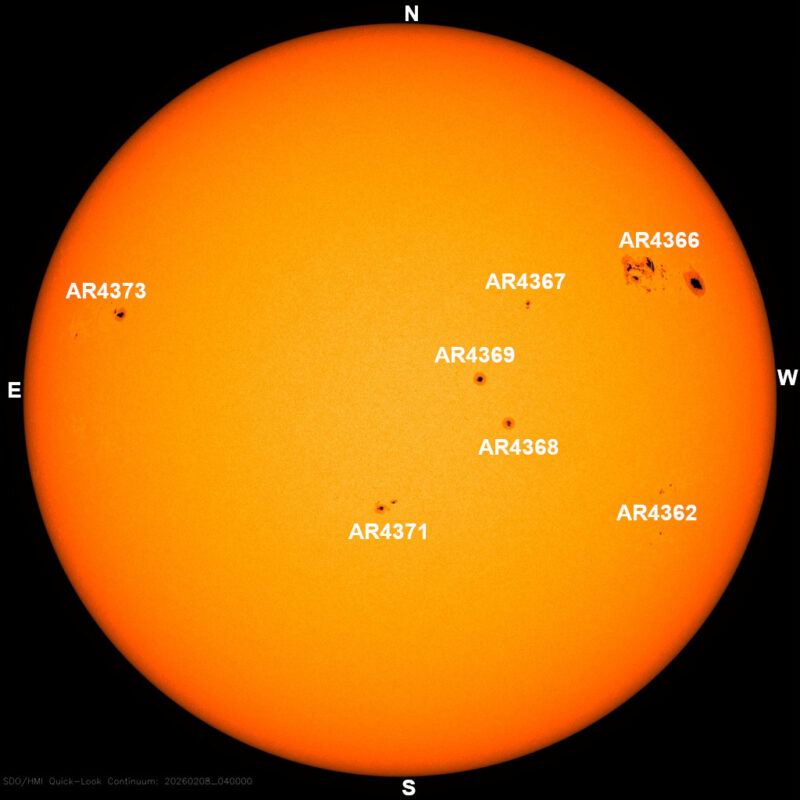
The sun looked fiery along its west horizon – the side now rotating out of view – over the past day. We saw prominences stretching from the northwest to the southwest limb. Otherwise, solar activity dropped to low, with only C (common) flares in the past day. It seems our star is catching its breath after an intense week of flare production (10 X flares!) from monster active region AR4366. Although this prolific sunspot is now showing signs of decay and producing fewer and milder flares, it still carries the hallmark beta-gamma-delta magnetic complexity. So it’s capable of generating additional M and even X flares. At the same time, AR4366’s delta-bearing companion, AR4371 (beta-delta), made its presence known with fresh C flare activity. Together, these two regions remain worth watching, as they may still have more in store.
Past 24 hours on the sun
(11 UTC February 6 – 11 UTC February 7)
Flare activity: Flare production on the Earth-facing solar disk fell to low, with only C flares in the past day. The sun produced a total of 10 C flares from 11 UTC on February 6 to 11 UTC on February 7. The strongest was a C7.3 flare at 8:19 UTC on February 7 from active region AR4362. The lead flare producer of the period was AR4366, responsible for 7 of the day’s 10 C flares.
Sunspot regions: The Earth-facing side of the sun displayed 8 numbered active regions in the past day. AR4366 (beta-gamma-delta) remained the largest and most magnetically complex region on the disk. Notably, AR4366 is no longer alone in hosting a delta configuration. But its companion AR4371 (beta-delta) retained its delta structure and produced a C2.0 flare during the period. Together, these regions continue to carry potential for M-class – and possibly X-class – flaring. In contrast, the remaining active regions appeared largely stable or declining and showed little to no flare activity.
Blasts from the sun? Several coronal mass ejections (CMEs) remain under watch, with possible glancing impacts at Earth beginning February 7 and extending through February 9. These arrivals could enhance auroral activity over the weekend, so skywatchers should stay alert. Expected CME arrivals include:
- A CME erupted at 19 UTC on February 3 from N10W30 (no numbered region assigned). Analysis points to an Earth arrival around February 7, with Kp guidance near 3–4, suggesting unsettled to active conditions below storm levels.
- A CME erupted at 15:48 UTC on February 5 from AR4362, associated with an M1.8 flare peaking near 15:08 UTC. Analysis suggests arrival near 8 UTC on February 8, with Kp estimates of ~3–5 and a low-end G1 (minor) storm risk if the magnetic field turns southward.
- A slower CME erupted at 14:12 UTC on February 5 from S33E10 (no numbered region assigned). Models suggest an Earth arrival around 8 UTC on February 9, with Kp ~3–4 and mostly unsettled to active conditions.
- Additionally, a CME off the sun’s south/southwest limb appeared in NASA/SOHO imagery at 15:48 UTC on February 5, likely linked to AR4362. A faint EUV wave observed by SUVI supports this association. Current model guidance captures the main Earth-impact possibilities for this source.
Past 24 hours in spaceweather
Solar wind: A strongly southward Bz dominated much of the period, effectively “opening the door” for solar energy to enter near-Earth space and briefly lifting geomagnetic conditions to Kp = 4. Meanwhile, solar wind speeds stayed moderately high, transitioning from lingering CME effects into a negative-polarity coronal hole high-speed stream. Wind speeds eased from around 600 km/s down to near 500 km/s by the end of the interval. The interplanetary magnetic field (IMF) remained weak overall. After remaining southward early (a configuration favorable for auroras), Bz turned northward around 9:45 UTC on February 7.
Earth’s magnetic field: Earth’s magnetic field ranged from quiet to active levels, with Kp = 2–4. The Kp = 4 threshold was reached at 15 UTC on February 6 and persisted through several three-hour synoptic periods. At the time of writing, Kp stood near 3.
What’s ahead? Sun–Earth forecast
Flare activity forecast: Moderate to high activity remains possible. Although the probability of M-class flares has dropped to about 75% as AR4366 shows reduced output, forecasters continue to monitor the fast-evolving AR4371. The likelihood of an X-class flare has also decreased, but both AR4366 and AR4371 remain the main drivers.
Geomagnetic activity forecast:
- February 7: Generally active conditions expected as elevated solar wind persists.
- February 8: Disturbances may reach G1 (minor) geomagnetic storm levels with the arrival of the February 3 filament-eruption CME.
- February 9: Unsettled to active conditions anticipated under the continued influence of fast solar wind from a coronal hole.

Sun news February 6 (UTC): What? No X flare? But the sun stayed busy
(11 UTC February 5 – 11 UTC February 6)

The sun produced a total of 10 X flares this week … but none over the past day. And sunspot region AR4366 is getting smaller, though it’s still magnetically complex, and though you can still see it through your eclipse glasses, if you look. So the serious action of the past week is declining now, but the sun stayed busy over the past day, punctuating the time with a sharp M2.2 (moderate) flare that was strong enough to trigger an R1 (minor) radio blackout on the sunlit side of Earth. Plus, during the last 24 hours, three coronal mass ejections (CMEs) erupted from our star sending solar stuff earthward. Meanwhile, closer to home, Earth’s geomagnetic field stayed mostly calm over the past day, but never fully relaxed. See solar wind and Earth’s magnetic field, below.
Past 24 hours on the sun
(11 UTC February 5 – 11 UTC February 6)
Flare activity: On the solar disk, flare production still clustered around the magnificently huge and magnetically complex sunspot region AR4366, along with a rapidly evolving, newly delta-bearing region, AR4371. Those two are keeping the odds elevated for more M-class flares. Solar activity remained at moderate to high levels over the past day, with 17 flares (6 Ms, 11 Cs). The strongest flare was the M2.2 from AR4362 at 19:28 UTC on February 5. It triggered an R1 (minor) radio blackout briefly affecting HF communications in the Pacific Ocean just west of South America. Other notable flares include M1.6 at 12:59 UTC (AR4366); M1.8 at 15:08 UTC (AR4362); M1.7 at 16:20 UTC (AR4366); M1.5 at 17:31 UTC (AR4366); M1.2 at 22:10 UTC (AR4372).
Sunspot regions: The Earth-facing solar disk displayed 9 numbered active regions. AR4366 (beta-gamma-delta) remained the most magnetically complex region and a major flare producer, though NOAA noted a slight decline in complexity while it continued to fire M-class flares. AR4371 (beta-delta) showed rapid growth and gained a delta configuration, raising its potential for additional M-class (and possibly X-class) flaring as it rotates toward better Earth-facing geometry. The remaining regions appear largely stable or declining in extent, contributing mainly low-level C-class activity.
Blasts from the sun? Experts tracked several coronal mass ejections (CMEs) over the past day. Some solutions suggest glancing Earth impacts in the February 7–9 window.
- A CME erupted at 19:00 UTC on February 3 from N10W30 (no numbered region assigned). Analysis shows Earth arrival around 16 UTC on February 7. Kp guidance spans ~3–4, suggesting mostly unsettled-to-active conditions (generally below storm thresholds).
- A CME erupted at 15:48 UTC on February 5 from AR4362, associated with the M1.8 flare peaking near 15:08 UTC. Analysis shows arrival near 8 UTC on February 8. Kp estimates range ~3–5, pointing to active conditions and a low-end G1 (Minor) storm risk if the magnetic field turns southward.
- A slower CME erupted at 14:12 UTC on February 5 from S33E10 (no numbered region assigned). Analysis shows Earth arrival around 8 UTC on February 9 with Kp ~3–4, implying mostly unsettled-to-active conditions.
- A CME off the sun’s south/southwest limb was seen in NASA/SOHO imagery at 15:48 UTC on February 5, likely tied to AR4362, with a faint EUV wave seen by SUVI. Current model guidance above captures the main Earth-impact possibilities being monitored for this source.
Past 24 hours in spaceweather
Solar wind: Early in the past day, a strongly southward Bz “opened the door” for energy to pour in, briefly lifting geomagnetic conditions to G1 (minor) storm levels before Bz turned northward and activity eased. Solar wind speeds increased through the period as Earth transitioned fully into a negative-polarity coronal hole high-speed stream, rising from about 400 km/s to over 600 km/s by the end of the interval. The interplanetary magnetic field (IMF) peaked at 02:19 UTC on February 5 and then weakened late in the period. The Bz was southward early on (a configuration that favors auroras), then turned northward around 5:32 UTC on February 5 and stayed mostly northward afterward, limiting sustained geomagnetic response.
Earth’s magnetic field: Looking ahead, models continue to watch several CMEs for possible arrivals this weekend into early next week, timing that could keep aurora watchers checking the sky again.Earth remained under the influence of a coronal hole fed solar wind stream. Over the past day, Earth’s magnetic field ranged from quiet-to-stormy intervals, reaching Kp = 5 (a G1 (Minor) geomagnetic storm) during the early portion of the interval when Bz was strongly southward. Conditions later relaxed to quiet to unsettled once Bz turned northward, even as wind speeds remained elevated.



Sun news February 5:Yet another X flare from powerhouse AR4366!
The astonishingly prolific sunspot region AR4366 unleashed a powerful X4.2 flare around 12 UTC yesterday, its 10th X flare since Sunday. While the flaring pace of this region remains intense, there are signs that it may have finally stopped growing. As of today, AR4366 is slightly smaller than yesterday, now with a surface area roughly equivalent to 6.5 Earths. But even if its growth has peaked, its highly complex beta-gamma-delta magnetic structure continues to fuel frequent M- and X-class flares, keeping space weather conditions elevated and forecasters on alert.
Past 24 hours on the sun
(11 UTC February 4 – 11 UTC February 5)
Flare activity: Solar activity remained at high levels, driven almost entirely by AR4366. During the period, the region produced the headline-grabbing X4.2 flare, along with another 8 M-class flares and 9 C-class flares, for a total of 18 flares. Active region AR4371 contributed a single C flare.
- These are all the past day’s M flares:
February 4: M1.1 at 11:35 UTC and M1.9 at 15:34 UTC.
February 5: M2.5 at 2:21 UTC; M2.7 at 4:36 UTC; M2.1 at 5:06 UTC; M1.3 at 6:19 UTC; M1.0 at 8:33 UTC; and M1.2 at 8:46 UTC.
Sunspot regions: The Earth-facing solar disk displayed 8 numbered active regions. Giant sunspot region AR4366 (beta-gamma-delta) continued to dominate, remaining both the largest and most magnetically complex region on the disk. AR4362 (beta) lost its gamma configuration and stayed stable and flare-quiet.
Blasts from the sun? Despite the high flare rate, not every eruption launched a coronal mass ejection (CME). During the period, observers detected three CMEs. Modeling and analysis ruled out two as Earth-directed. A third eruption, following the X4.2 flare, originated around 13:50 UTC on February 4. Current guidance suggests this eruption could deliver a glancing blow to Earth around February 8.
Past 24 hours in space weather
Past 24 hours in spaceweather
Solar wind: Solar wind speeds rose from low to moderately high by the end of the period. The interplanetary magnetic field started weak, then jumped abruptly to strong levels around 14:20 UTC on February 4. That was likely due to an early-arriving CME associated with the earlier X8.1 flare. The Bz component stayed mostly northward until about 22 UTC on February 4, when it swung strongly southward and created ideal conditions for auroral activity. By the time of this writing (11 UTC), Bz had turned northward again.
Earth’s magnetic field: After this early CME arrival, Earth’s magnetic field responded by rising from quiet conditions to G1 (minor) geomagnetic storm conditions. At the time of this writing, G1 conditions remain ongoing.


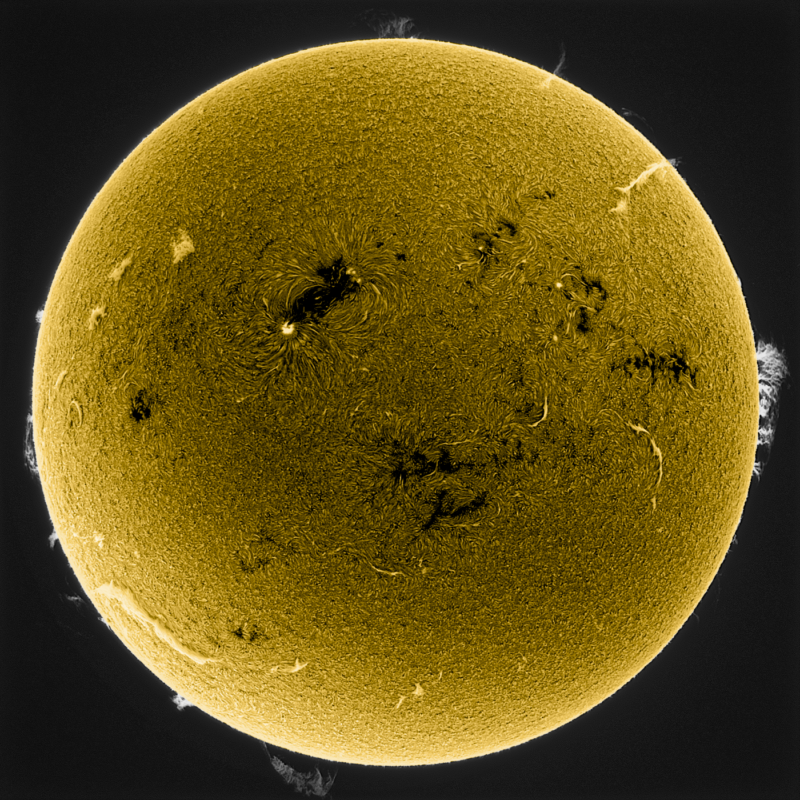
Update: And one more makes 10! The sun fired off another X flare, this one an X4.2, at 6:13 a.m. CST on February 4. More on that to come!
Sun news February 4: Another X flare from monster AR4366!
The monster sunspot region AR4366 is still firing on all cylinders! This prolific region blasted out another X flare yesterday, its 9th since Sunday. This time it was an X1.5 flare, fired at 14:08 UTC, which caused an R3 (strong) radio blackout over the south Atlantic Ocean east of Brazil. AR4366 also produced another 11 M flares, plus 9 Cs. Specialists continue to model the blasts of sun-stuff (coronal mass ejections or CMEs) this region has sent into space over the past few days. The first could give a glancing blow to Earth as early as tomorrow night. Meanwhile, this region is moving toward a geoeffective position, meaning that any CMEs it fires out will be heading straight toward Earth. Stay tuned!
Past 24 hours on the sun
(11 UTC February 3 – 11 UTC February 4)
Flare activity: Solar activity is at high levels. Alongside the X1.5 flare, we observed another 15 Ms and 10 Cs for a total of 26 flares over the past day. Amazingly, all of these flares came from AR4366.
- These are all the past day’s M flares:
February 3: M7.2 at 14:56 UTC; M2.1 at 16:36 UTC; M2.5 at 18:08 UTC; M2.0 at 22:50 UTC; M3.5 at 23:09 UTC. February 4: M1.2 at 1:10 UTC; M1.4 at 1:39 UTC; M1.4 at 1:55 UTC; M2.1 at 2:30 UTC; M4.9 at 2:39 UTC; M2.1 at 3:55 UTC; M1.8 at 9:20 UTC; M3.1 at 10:12 UTC; M1.5 at 10:46 UTC and M1.6 at 10:55.
Sunspot regions: The solar disk shows 9 numbered active regions on the side we see from Earth. Super sunspot region AR4366 (beta-gamma-delta) remains the largest and most complex. AR4362 (beta-gamma) developed a gamma configuration but remained stable.
Blasts from the sun? We observed a filament eruption at 4 UTC on February 3, which produced a coronal mass ejection (CME). Modeling and analysis is ongoing. The X flare and all the M flares produced by active region AR4366 are under analysis to determine if any CMEs are coming to us at Earth. For now, the active region is not yet located at a position where CMEs will give our planet a direct hit.
Past 24 hours in spaceweather
Solar wind: Solar wind speeds were mostly low over the past day. The interplanetary magnetic field was weak late on February 3 but increased to moderate levels during the rest of the period. The Bz was northward late on February 3 but moved southward from early February 4. A southward orientation favors auroral displays.
Earth’s magnetic field: Earth’s magnetic field remained at quiet levels. At the time of this writing the Kp index = 2.
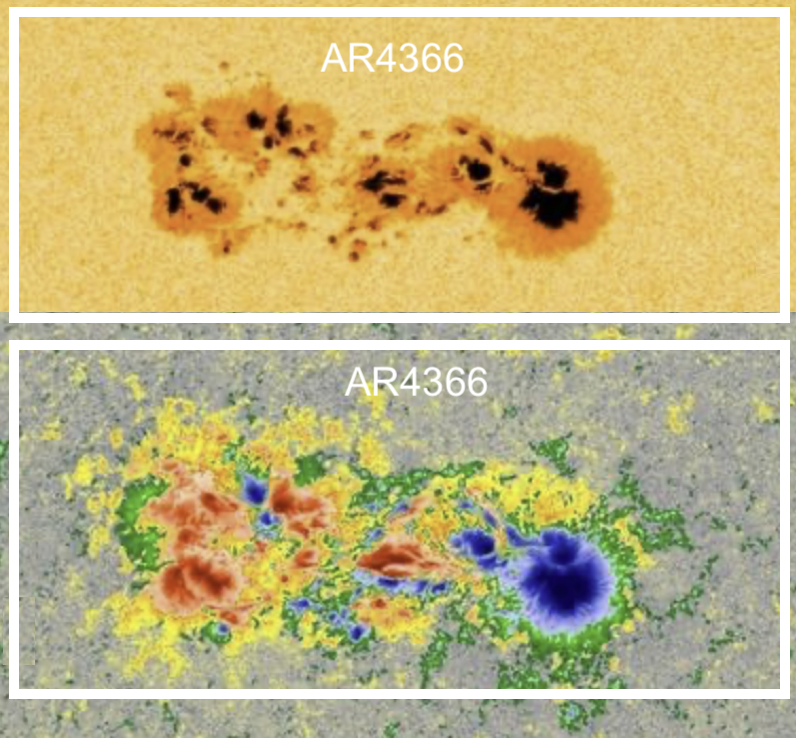
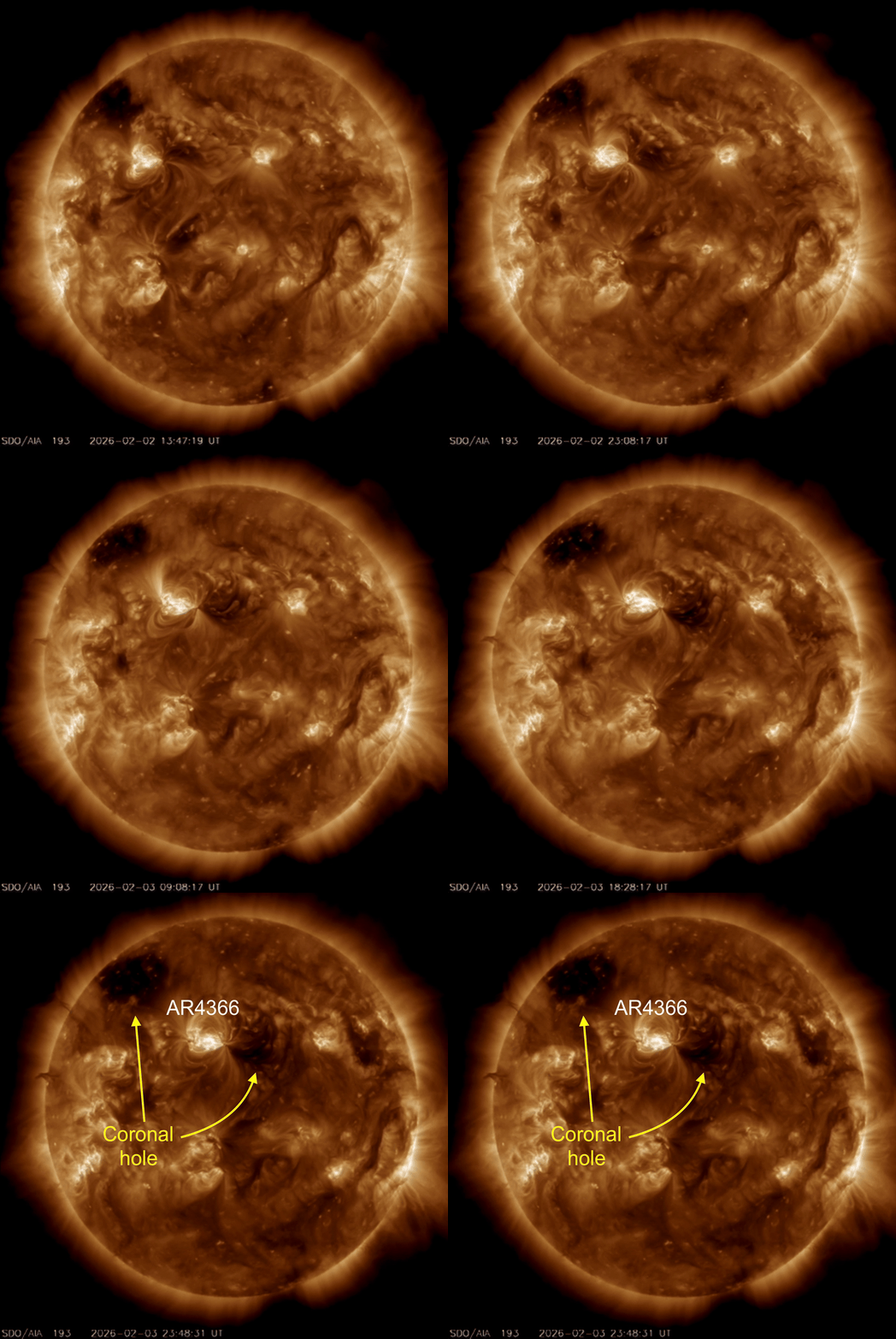
Sun news February 3: Monster sunspot keeps going, releases 14 M flares!
The sun remained restless over this past day, releasing 14 M (moderate) flares! The strongest was a punchy M7.2 flare (getting close to an X flare). And the sunspot region responsible? None other than monster sunspot AR4366! The M7.2 flare was strong enough to drive an R2 (moderate) radio blackout across parts of Earth’s sunlit hemisphere. The steady run of M-flares preceding it all contributed to jumpy shortwave conditions for radio operators and polar-route communicators. Meanwhile, Earth’s space environment remained comparatively calm. The solar wind stayed slow and the interplanetary magnetic field remained weak. So aurora prospects largely remained confined to the usual high-latitude zones.
The bigger story is what’s coming next. Multiple coronal mass ejection (CME) analyses tied to the recent major eruptions from AR4366 now point to potential arrivals from late February 4 into February 6, with a glancing-hit scenario still favored by operational guidance. If the magnetic field in the incoming material turns southward, it could open the door for stronger geomagnetic responses and brighter auroras later this week. Possible excitement to come! Stay with us.
Past 24 hours on the sun
(11 UTC February 2 – 11 UTC February 3)
Flare activity: Solar activity continued at high levels, with 17 flares observed (14 M-class; 3 C-class). The strongest flare was an M7.2 flare from AR4366 at 7:01 UTC on February 3. So our star remains restless! And the magnetically complex delta structure in AR4366 keeps the risk of another X-class outburst firmly on the table.
- All the M flares produced during the period were by active region AR4366. These are all the M flares (chronological):
M6.7 at 11:24 UTC; M1.1 at 13:39 UTC; M4.0 at 15:01 UTC; M2.4 T 17:10 UTC; M2.4 at 18:29 UTC; M2.9 at 20:09 UTC; M3.3 at 21:08 UTC; 23:27 M2.5 at UTC (all these flares produced on February 2). The following M flares were produced on February 3: M1.5 at 1:49 UTC; M1.8 at 4:22 UTC; M2.6 at 5:55 UTC; M3.6 at 7:47 UTC and M3.7 at 10:12 UTC.
Sunspot regions: Currently the Earth-viewed side of the solar disk shows 8 numbered active regions. Active region AR4366 (beta-gamma-delta) kept its magnetic configuration and continued its growth, exhibiting an increasingly complex delta configuration. It is the largest in extent sunspot region in the solar disk as we see it from Earth. The rest of the numbered sunspot regions are stable and showing unproductive compared with AR4366.
Blasts from the sun? A coronal mass ejection is coming to us at Earth. It is associated with the X8.1 flare. Analysis and modeling suggest an arrival at Earth on February 5 near 23 UTC. Kp estimates of 3–4 as it may provide a glancing blow.
Past 24 hours in spaceweather
Solar wind: Solar wind speeds decreased, running in a quiet slow-wind regime by the end of the period. The interplanetary magnetic field remained weak. The Bz component was weak but south oriented during most part of the period. A south orientation favors auroral displays.
Earth’s magnetic field: Earth’s magnetic field ranged from quiet levels, reaching Kp = 0–2.



Sun news February 2: Giant sunspot region EXPLODES with X8.1 flare!
Solar activity has surged into overdrive! Sunspot region AR4366 – which just rotated into view on the east of the sun – has rapidly grown into a behemoth nearly 10 times wider than Earth. This explosive growth has left the region magnetically unstable, with a delta-class configuration that has been crackling almost nonstop. First, it unleashed a marathon, triple-peaked flare early on February 1. That M7–X1–M6 (moderate-strong-moderate) flare sequence lasted more than six hours. It signaled that something much bigger was brewing.
Then, late on February 1, AR4366 erupted with a powerhouse X-class X8.1 flare, the 3rd-largest flare of Solar Cycle 25! The flare came at 23:44 UTC on February 1. The blast triggered an R3 (strong) radio blackout across Earth’s sunlit hemisphere, disrupting high-frequency (HF) communications for aviation, maritime and amateur radio users — especially across the Pacific east of Australia and into New Zealand. Extreme ultraviolet radiation from the flare strongly ionized Earth’s upper atmosphere, causing prolonged HF signal absorption below 20 MHz and radio loss.
Just under an hour later, at 00:42 UTC on February 2, AR4366 fired again with a powerful X2.9 flare, hammering nearly the same sector of Earth’s atmosphere and reinforcing the ongoing radio impacts. Even as Earth’s geomagnetic field remained relatively calm, this barrage of X- and M-class eruptions kept spaceweather watchers on high alert.
Since then, 6 additional M flares fired off from AR4366, then an X1.7.
As to whether a big chunk of sun-stuff combined with magnetic fields (a coronal mass ejection or CME) is headed Earth’s way … we don’t know yet. The picture is still developing. Early coronagraph views from NOAA and SOHO show several CMEs lifting off the solar limbs that do not appear Earth-directed. But the X8.1 flare was accompanied by clear coronal dimming signatures in SUVI imagery. And that’s often a telltale sign that the sun launched a CME. Initial modeling suggests any associated CME would be slow-moving, with a possible arrival later this week if its trajectory shifts.
Past 24 hours on the sun
(11 UTC February 1 – 11 UTC February 2)
Flare activity: Solar activity was at very high levels, with 26 flares observed (5 X-class, 21 M-class). The strongest flare is an X-class X8.1 from AR4366 at 23:44 UTC on February 1. It triggered an R3 (strong) radio blackout affecting HF communications across Earth’s sunlit hemisphere.
- Other notable flares include (chronological):
X-class X1.5 at 00:15 UTC (February 2), X-class X2.8 at 00:31 UTC (February 2), X-class X2.9 at 00:42 UTC (February 2), and X-class X1.7 at 07:39 UTC (February 2) — all from AR4366 and each capable of R3 (strong) blackout conditions on the dayside. - All M-class flares recorded in the period (chronological, all from AR4366): M5.1 at 15:57 UTC (February 1), M1.2 at 16:47 UTC, M1.1 at 17:32 UTC, M2.5 at 17:43 UTC, M2.1 at 18:15 UTC, M1.9 at 18:48 UTC, M1.9 at 19:12 UTC, M2.2 at 20:20 UTC, M1.4 at 23:12 UTC, M4.4 at 02:35 UTC (February 2), M5.2 at 02:45 UTC, M1.9 at 03:44 UTC, M3.0 at 04:39 UTC, M1.6 at 05:10 UTC, M2.3 at 05:19 UTC, M1.9 at 10:17 UTC.
Sunspot regions: The Earth-facing solar disk displayed 7 numbered active regions. AR4366 (beta-gamma-delta) gained area and remained highly complex, explosively producing repeated X-class flares and many M-class flares. It dominated the disk, responsible for essentially all significant activity. The remaining regions on the visible disk were generally stable, magnetically simple and unproductive compared with AR4366.
Blasts from the sun? Observers noticed several CMEs lifting off from the sun in the past day. One eruption received an initial Earth-arrival model estimate; other CMEs seen near the limbs were not Earth-directed. A coronal mass ejection was likely launched around 00:48 UTC on February 2 from N13E35 (AR4366), associated with the X-class X8.1 flare. This was supported by coronal dimming signatures. Analysis suggests Earth arrival on February 5 near 23 UTC. Kp estimates of 3–4 suggest mostly active-to-unsettled conditions, but confidence is limited until coronagraph-based geometry is confirmed.
Past 24 hours in spaceweather
Solar wind: Solar wind speeds decreased, running in a quiet slow-wind regime near 300–400 km/s by the end of the period. The interplanetary magnetic field remained weak (Bt at or below about 6 nT). The Bz component was weak and variable; with no sustained strong southward intervals reported, conditions were not favorable for significant aurora expansion.
Earth’s magnetic field: Earth’s magnetic field ranged from quiet levels, reaching Kp = 0–2.
What’s ahead? Sun–Earth forecast
Flare activity forecast: Moderate-to-high levels are expected, with continued risk (75%) for M-class flares primarily from AR4366. Another X-class flare remains plausible (25%) over the next 24–48 hours as the region stays large and magnetically complex.

SDO is in an eclipse season
NASA’s sun-observing Solar Dynamics Observatory (SDO) is currently in an eclipse season — a twice-yearly event in which Earth passes between SDO and the sun. In SDO images, you see a dark curve crossing the sun’s face. And it’s not the moon, and not a solar eclipse as we see from Earth. It’s an eclipse of the sun by Earth, as seen from space. EarthSky’s Deborah Byrd will show images of what SDO sees, and explain what the images show — and what they don’t show — and why perspective matters in astronomy. Watch in the player above, or on YouTube.Update 2: X8.1 and X2.9 flares blast from AR4366
Late on February 1, AR4366 erupted with an X8.1 flare at 23:44 UTC, triggering an R3 (strong) radio blackout across Earth’s sunlit side—disruptive for HF radio, aviation, and maritime communications, especially over the Pacific east of Australia. Just one hour later, at 00:42 UTC on February 2, the region fired again with an X2.9 flare, hammering nearly the same sector of Earth’s atmosphere.

Update: X1 flare blasts from AR4366
AR4366 is on a tear! This crackling sunspot region fired off an X1 flare plus five more M-class eruptions, including a trio of heavy hitters (M6.6, M6.7, and M5.8). This video showcases the region’s explosive energy as seen by the Solar Dynamics Observatory (SDO) in the 171 and 131 angstrom wavelength channels, where hot, tangled magnetic structures light up in dramatic detail.

Sun news February 01 (UTC): Activity levels surge to high with M6.6 flare!
A powerful M6.6 flare blasted out from AR4366 at 9:53 UTC this morning (February 1). The flare triggered an R2 (moderate) radio blackout across the sunlit side of Earth. As a result, users – particularly for aviation and maritime operators – experienced short-lived but noticeable high-frequency (HF) radio disruption over Earth’s dayside, along with degraded signal conditions for amateur radio. Even so, near-Earth space stayed calm. The solar wind continued to ease as the last influence of a coronal hole stream faded. And Earth’s magnetic field remained quiet.
Past 24 hours on the sun
(11 UTC January 31 – 11 UTC February 01)
Flare activity: Solar activity reached high levels, with 21 flares observed (5 M-class, 16 C-class). The strongest event was an M6.6 from AR4366 (N11E43) at 09:53 UTC on February 1. It triggered an R2 (Moderate) radio blackout affecting HF users across the sunlit hemisphere, including aviation and maritime communications over southern Africa. In addition, other notable flares (chronological) included:
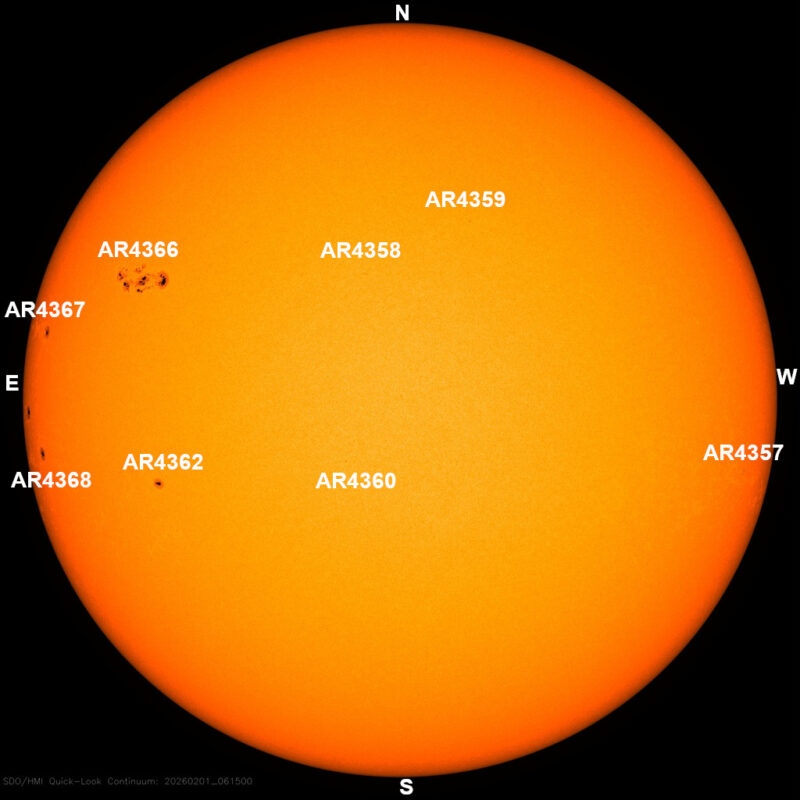
Sunspot regions: The Earth-facing solar disk displayed 10 numbered active regions. Leading the activity was a rapidly developing, magnetically complex northeast region, AR4366 (beta-gamma-delta). Throughout the period, AR4366 dominated flare production, accounting for the M6.6 event, the remaining M-class flares, and the majority of C-class activity, including several mid-to-upper C flares.
Blasts from the sun? Experts did not observe any Earth-directed coronal mass ejections (CMEs) over the past day.
Past 24 hours in space weather
Solar wind: Solar wind speeds decreased steadily as coronal-hole high-speed stream conditions faded. At the same time, the interplanetary magnetic field (IMF) remained weak. The Bz component stayed near neutral overall and showed little sustained southward turning. Without prolonged southward Bz, Earth’s magnetic field remained relatively closed, which limited auroral enhancement.
Earth’s magnetic field: Earth’s magnetic field ranged from quiet to very quiet levels, with Kp holding in the 0–2 range throughout the period and no geomagnetic storms observed.
What’s ahead? Sun–Earth forecast
Flare activity forecast: Low overall levels are expected, although a continued chance (35%) of M-class flares remains through February 3, primarily from AR4366 as it stays magnetically complex. In addition, a slight chance (5%) of an X-class event cannot be ruled out if the delta configuration strengthens; however, confidence remains low.
Geomagnetic activity forecast:
- February 1: Mostly quiet conditions are expected as an ambient solar wind regime persists; aurora activity should remain near background, best confined to Alaska, northern Canada, Iceland, and northern Scandinavia.
- February 2: Quiet to occasionally unsettled conditions are possible; however, no significant enhancements are forecast without an Earth-directed CME or renewed coronal-hole influence.
- February 3: Quiet conditions are favored overall; any brief unsettled intervals would most likely arise from minor variations in IMF orientation rather than strong solar wind speed increases.
SDO is in an eclipse season
NASA’s sun-observing Solar Dynamics Observatory (SDO) is currently in an eclipse season — a twice-yearly event in which Earth passes between SDO and the sun. In SDO images, you see a dark curve crossing the sun’s face. And it’s not the moon, and not a solar eclipse as we see from Earth. It’s an eclipse of the sun by Earth, as seen from space. EarthSky’s Deborah Byrd will show images of what SDO sees, and explain what the images show — and what they don’t show — and why perspective matters in astronomy. Join us – and bring your questions – beginning at noon central (18 UTC) on Wednesday, January 28. Watch in the player above, or on YouTube.
Like what you read?
Subscribe and receive daily news delivered to your inbox.
More from
C. Alex Young


Sun news: Bam bam! The sun issues a 1-2 punch

Sun activity archive for July 2026
Sun activity archive for June 2026
Sun activity archive for May 2026


