Planet Labs just unveiled striking satellite imagery of Blatten, laying bare the tragic aftermath and what little is left of the village.
— Nahel Belgherze (@wxnb.bsky.social) May 30, 2025 at 3:25 AM
10 million tons of rubble dropped in glacier collapse
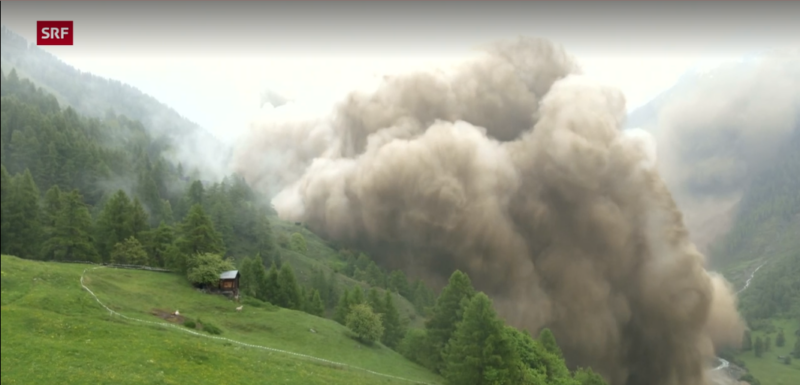
The village of Blatten in the Swiss Alps was almost entirely destroyed on Wednesday (May 28, 2025) by ice, mud and rock that fell from a glacier in the surrounding mountains. The village had been home to 300 residents. Approximately 90% of the village’s buildings were crushed during the glacier collapse. The flow of the adjacent Lonza River was also blocked.
A portion of the area’s Birch Glacier fell from the summit of Petit Nethorn Mountain onto Blatten, which is located in the Valais Canton in southern Switzerland. The glacier collapse took place at around 3:30 p.m. local time (13:30 UTC).
As of Friday, one person is still missing. The missing person is a 64-year-old man who did not evacuated. Some 300 people who lived in the village and all livestock had evacuated in the days prior, due to the threat of a collapse.
Raphael Mayoraz, chief of the Natural Dangers Service for Valais in southern Switzerland, told the French-language Swiss news outlet Le Temps that about 10 million tons (9 million metric tonnes) of rubble fell onto the doomed village and the alpine valley around it. He said it appeared that most of the glacier had collapsed:
We don’t know yet what’s left on top, but almost everything fell. It’s the worst of the envisaged scenarios that it (the collapse) produced.
Watch a glacier collapse. This is a portion of the Birch Glacier – about 30 miles (50 km) north of the iconic Matterhorn in Switzerland – falling onto the Swiss village of Blatten. How Earth’s changing climate influenced this catastrophe is uncertain, but climbing temperatures in the region are thought to have been a factor.
Before and after the glacier collapse
SPEECHLESS BEFORE / AFTER #BLATTEN
The magnitude of destruction after the 3:24 pm collapse of Birch Glacier is immense! ?
All the forest has been razed and the ice/wood/debris dammed the Lonza river ?
Some buildings of Blatten are buried ?
? Pomona
— Melaine Le Roy (@subfossilguy.bsky.social) May 28, 2025 at 10:34 AM
A view from Thursday morning
The 10% of the village that didn’t get buried in the glacier collapse now has to contend with the rising waters of the dammed Lonza River.
What is left of #Blatten this morning at 10:35 am! ?
The lake has grown since yesterday, with only the roofs of the lowest buildings still visible! ?
? @ABettmeralp
— Melaine Le Roy (@subfossilguy.bsky.social) May 29, 2025 at 6:32 AM
River flow blocked, lake forming
The German-language Swiss news outlet Pomona reported that the debris cone left by the glacier’s collapse stretches for 1.24 miles (2 kilometers) along the path of the Lonza River. The debris pile is between 160 and 650 feet (50 to 200 meters) wide. Mayoraz said:
It’s like a mountain.
Video provided by Le Temps shows a lake forming from the trapped waters of the now-blocked Lonza River. Simulations had predicted this scenario, and the possibility that a rupture in the natural dam that formed on Wednesday could lead to additional future debris flows.
Role of climate change uncertain in unprecedented glacial collapse
How Earth’s changing climate influenced this catastrophe is uncertain. Climate expert Christian Huggel of the University of Zurich told Reuters that various factors led to Birch Glacier’s disintegration. However, the local permafrost, he said, has recently been affected by climbing temperatures in the Alps. Because loss of permafrost can degrade the stability of mountain rock, Huggel told Reuters he believes climate change played some role.
Huggel also said the level of damage caused by this glacier collapse hasn’t been seen in the Swiss Alps in this century or the one preceding it.
Bottom line: A glacier collapse in the Swiss Alps has buried a village and blocked a nearby river. At least one person is reported missing.
Like what you read?
Subscribe and receive daily news delivered to your inbox.
More from
Dave Adalian


Fall hummingbird migration in progress across North America

Venus rings found high above the planet’s thick clouds
Save the Frogs Day is today, Tuesday, April 28
Join the worldwide 2026 City Nature Challenge this weekend!