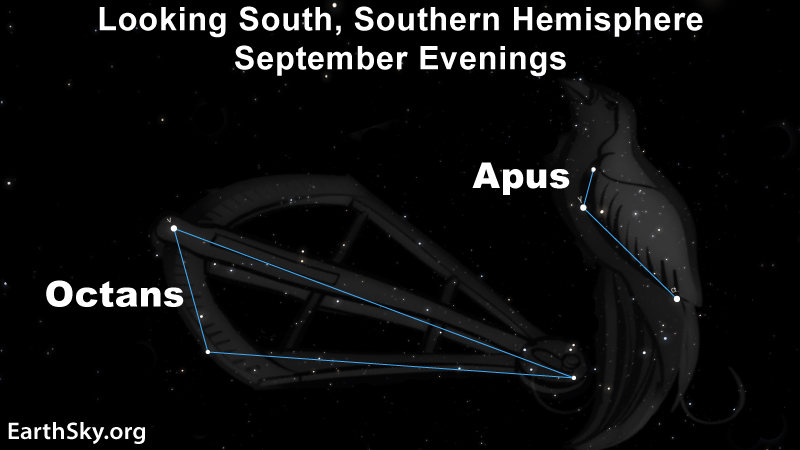
Octans and Apus
Octans the Octant and Apus the Bird of Paradise circle the south celestial pole. If you want to see them, you’ll have to be in the Southern Hemisphere. In fact, the south celestial pole lies inside the constellation boundary for Octans.
Both of these constellations are south circumpolar constellations. Of course, the north has circumpolar constellations too. Constellations such as Ursa Minor, Ursa Major and Draco can be seen any night of the year from the Northern Hemisphere. Octans and Apus are two constellations that Southern Hemisphere observers can view on any clear evening.
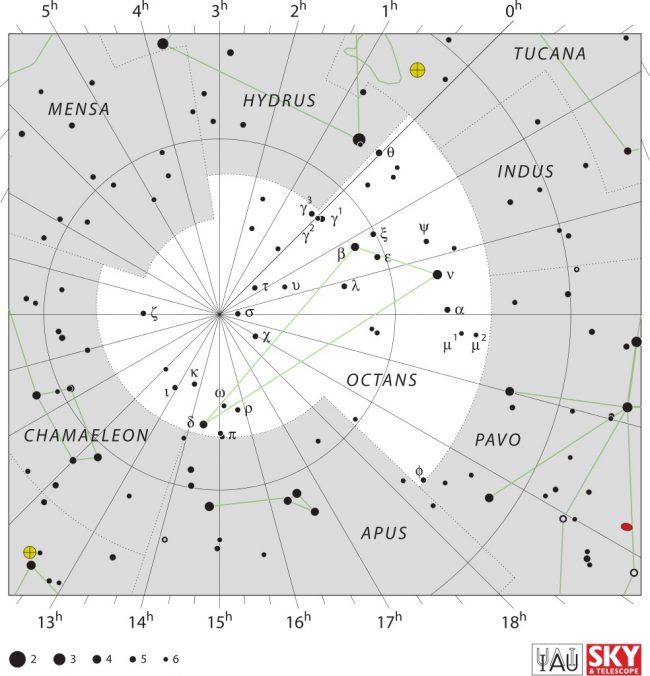
Octans the Octant
And Octans is a key constellation for another reason. When we look in its direction in space, we are looking toward Earth’s south celestial pole. Polaris is the famous star marking the location of the north celestial pole. But the Southern Hemisphere has no bright star near its celestial pole. That is why you might hear astronomers say there’s no pole star for the Southern Hemisphere sky.
There is an extremely dim galaxy that’s nearly at the location of the south celestial pole. And that galaxy has the fitting name of Polarissima Australis. It shines much too dimly to be viewed without optical aid, at magnitude 13.5.
The brightest star in Octans is only moderately bright at +3.7 magnitude. It is Nu Octantis, a double star, located some 69 light-years away. The star is home to a confirmed super-Jovian exoplanet. So far, no other planets have been found in the Nu Octantis system.
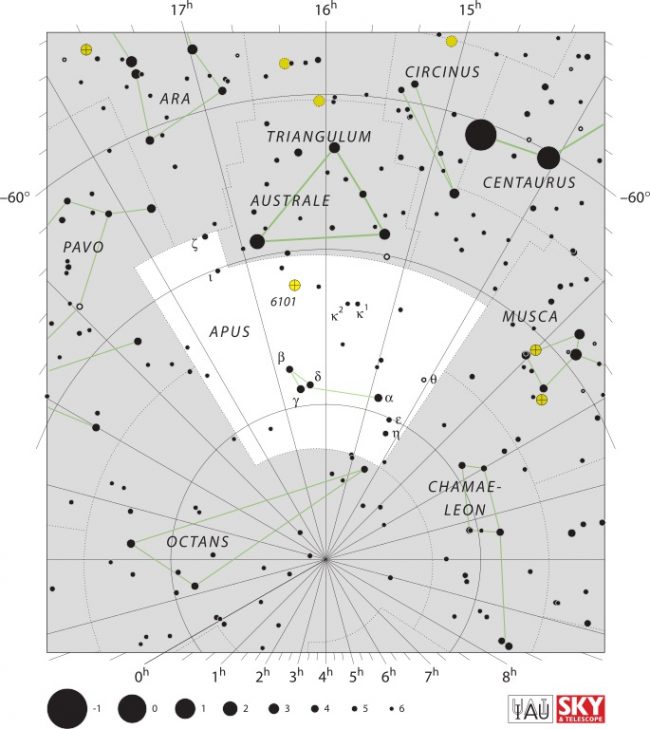
Apus the Bird of Paradise
Then, next to Octans, is Apus the Bird of Paradise. It’s small and ranked 67th in size out of the 88 constellations. It lies between Octans and Triangulum Australe the Southern Triangle. The stars in Apus are quite dim. The brightest member of the constellation is Alpha Apodis at magnitude 3.83. Alpha Apodis lies about 430 light-years from Earth. Slightly fainter is Gamma Apodis at magnitude 3.86 and 150 light-years distant. This star is a strong source of X-rays.
Bottom line: Octans and Apus are two constellations that you have to be in the Southern Hemisphere to see. Plus, Octans is home to the south celestial pole.
Like what you read?
Subscribe and receive daily news delivered to your inbox.
More from
Kelly Kizer Whitt


Hurricane triplets spin across the Pacific Ocean

BepiColombo mission 1 step closer to Mercury today
Corona Australis is the sparkling Southern Crown
Lake Powell hits record low, continues to drop