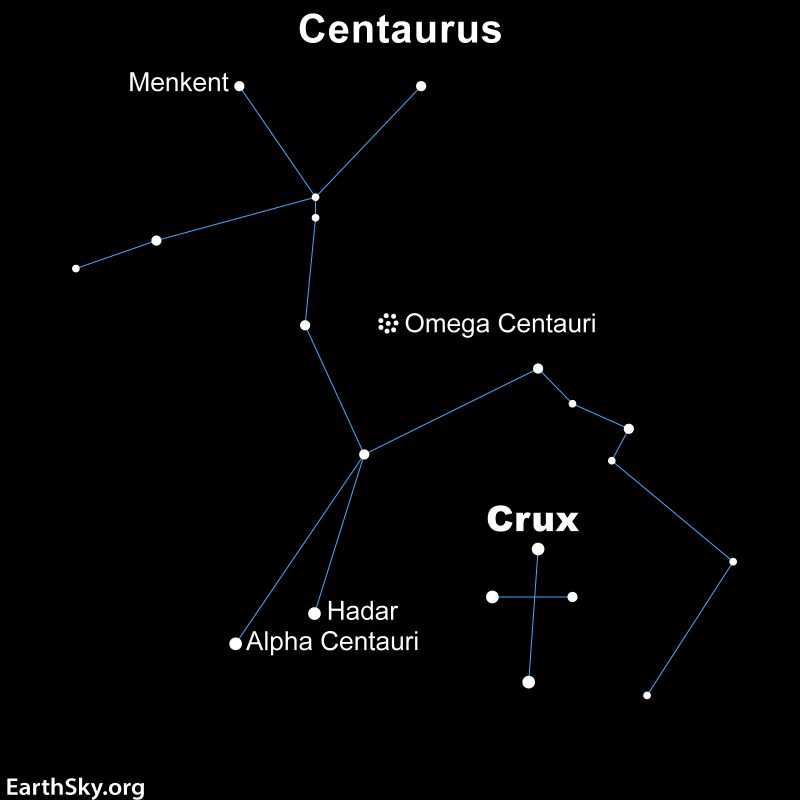
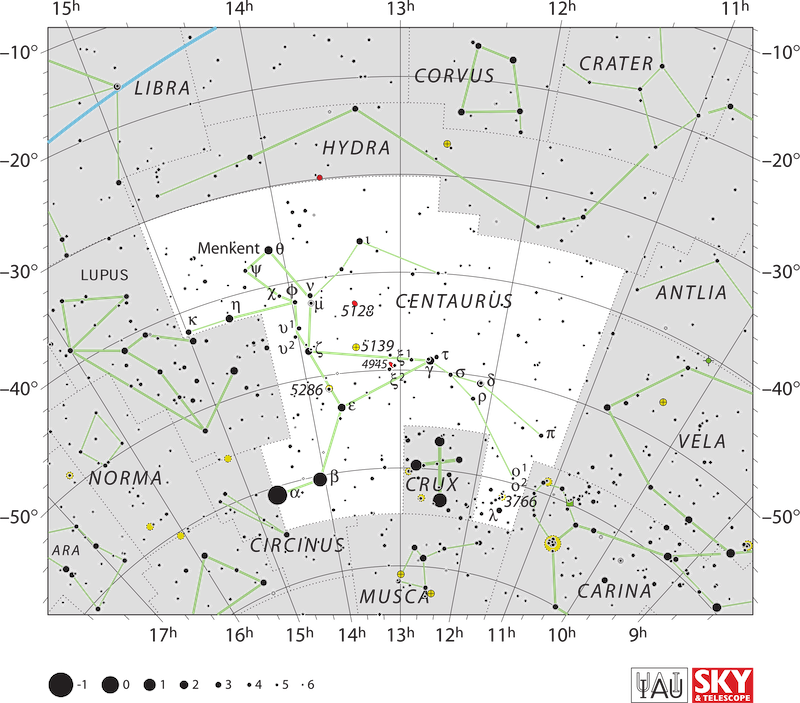
Centaurus the Centaur lies well south of the celestial equator. So it’s a southern constellation, and a huge one! It ranks 9th largest among the 88 official constellations. And the Centaur contains the closest known stars to our sun.
Closest stars to the sun
Alpha Centauri, also known as Rigil Kentaurus, is the closest star to our sun. It lies 4.3 light-years away. Because it’s so close, it appears bright. In fact, it’s the 3rd brightest star in the sky, shining at magnitude -0.27.
Alpha Centauri is a three-star system. Alpha Centauri A and B are both sunlike stars, with A outshining B. The third star, however, is a faint red dwarf. This star, Alpha Centauri C, is also known as Proxima Centauri. That’s because out of the three stars in the system, it’s the closest to Earth. By itself, it shines at 11th magnitude.
Seeing Centaurus from the Southern Hemisphere
Via Daniel Gaussen, Founder & Guide – Stargaze Mackenzie – New Zealand
For observers in the Southern Hemisphere, Centaurus is one of the great highlights of the autumn and winter night sky. It climbs high overhead on May and June evenings and appears far more impressive than it does from northern latitudes.
The bright stars Alpha Centauri and Beta Centauri dominate the southern sky and are easily recognized beside the nearby Crux, the Southern Cross.
Under dark southern skies, the Milky Way running through Centaurus is especially rich, filled with star clusters, dark nebulae and binocular targets such as Omega Centauri, which can appear like a hazy star to the unaided eye.
Seeing Centaurus from the Northern Hemisphere
Centaurus sits so far south on the sky’s dome that – if you live above 25 degrees north latitude – you will not be able to see it. The bulk of Earth itself will block it from your view at all times.
But you might see Centaurus from these U.S. national parks, if you can find a clear view to the south:
- Everglades National Park is the only park in the contiguous (mainland) United States far enough south (roughly 25.3 degrees north latitude) to glimpse it right at the southern horizon on a perfect night.
- Dry Tortugas National Park, Florida: Located about 70 miles west of Key West at 24.6 degrees north latitude, this park sits safely below the 25 degree north threshold, making it the only mainland-adjacent national park with a clear view of the entire constellation.
- Hawai’i Volcanoes National Park & Haleakala National Park, Hawaii: Located between 19 degrees and 20 degrees north latitude, these parks offer an incredible view of Centaurus high above the southern horizon.
- National Park of American Samoa: As the only U.S. national park in the Southern Hemisphere (14.3 degrees south latitude), spectacular Centaurus doesn’t just sit on the horizon here. It climbs high directly overhead.
Meet the Pointers of Centaurus the Centaur
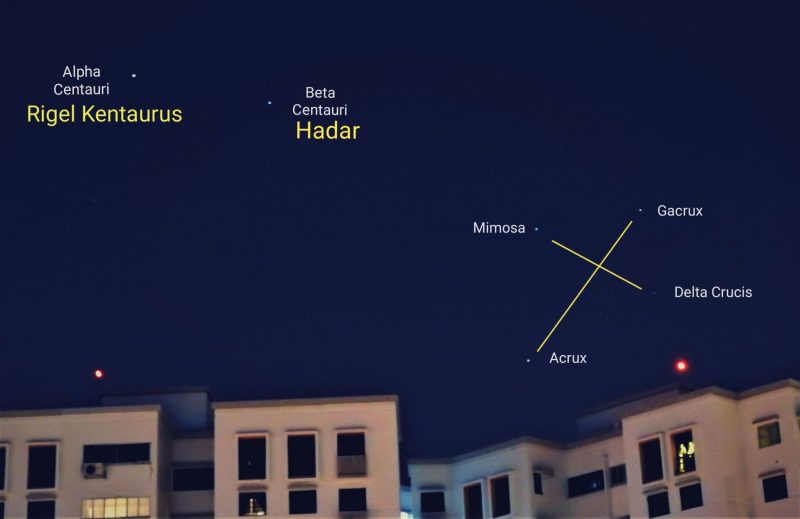
Alpha and Beta also bear the nickname of the Southern Pointer stars. Southern stargazers know these two can guide you to the Southern Cross, or Crux, and the south celestial pole.
Beta Centauri is only 4.5 degrees from Alpha Centauri. Beta also bears the proper name Hadar.
Beta Centauri is magnitude 0.61 and lies 348 light-years away. This blue-white supergiant is the 11th brightest star in the sky. Indeed, when compared to its bright neighbor Alpha, it looks distinctly bluer. In addition, it’s also a three-star system.
There’s one other notable named star in Centaurus. It’s Menkent, or Theta Centauri. It lies 24 degrees north of Alpha and Beta. Theta is magnitude 2.06 and lies 61 light-years away.
Omega Centauri, the Running Chicken and a Blue Planetary
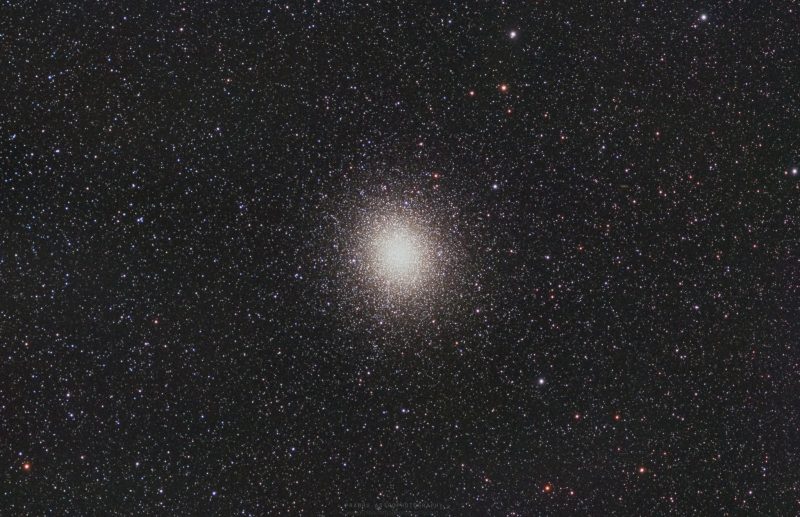
The best-known deep-sky object in the constellation of the Centaur is Omega Centauri (NGC 5139). Omega Centauri is a magnificent globular cluster that lies about halfway between Beta and Theta Centauri and a few degrees west. In fact, at magnitude 3.7, you can spot the cluster without optical aid. But binoculars or a small telescope bring out its wonders. This crowded cluster is an old collection of stars in our galaxy about 15,800 light-years away. The globular cluster is about 12 billion years old.
Similarly, the Running Chicken is a quirkily nicknamed cluster and gas cloud, IC 2944, in Centaurus. It lies on the other side of Crux from Alpha and Beta Centauri, where Centaurus wraps around the Southern Cross. At the southern tip of Centaurus, this star cluster with nebulosity shines at magnitude 4. The star Lambda Centauri is here, along with dark clouds that stick out in front of the background nebulosity. These dark clouds are known as Bok globules.
The last-deep sky target is NGC 3918, known as the Blue Planetary. This planetary nebula shines at magnitude 8 and lies about 6 degrees north of the Running Chicken. It bears a resemblance to Neptune through a telescope.
Bottom line: Centaurus the Centaur is a constellation found in Southern Hemisphere skies that contains some of the closest stars to our sun.
Like what you read?
Subscribe and receive daily news delivered to your inbox.
More from
Kelly Kizer Whitt


Hurricane triplets spin across the Pacific Ocean

BepiColombo mission 1 step closer to Mercury today
Corona Australis is the sparkling Southern Crown
Lake Powell hits record low, continues to drop