Venus after sunset in August 2026
In August 2026, Venus – the planet next inward from Earth, and the brightest planet in Earth’s sky – will be shining in the west after sunset. You can’t miss Venus! It’s exceedingly bright and will penetrate the bright evening twilight. It’ll remain visible in the evening sky through October, 2026, when it’ll drop into the sunset glare. And between now and then is an exciting time to view Venus.
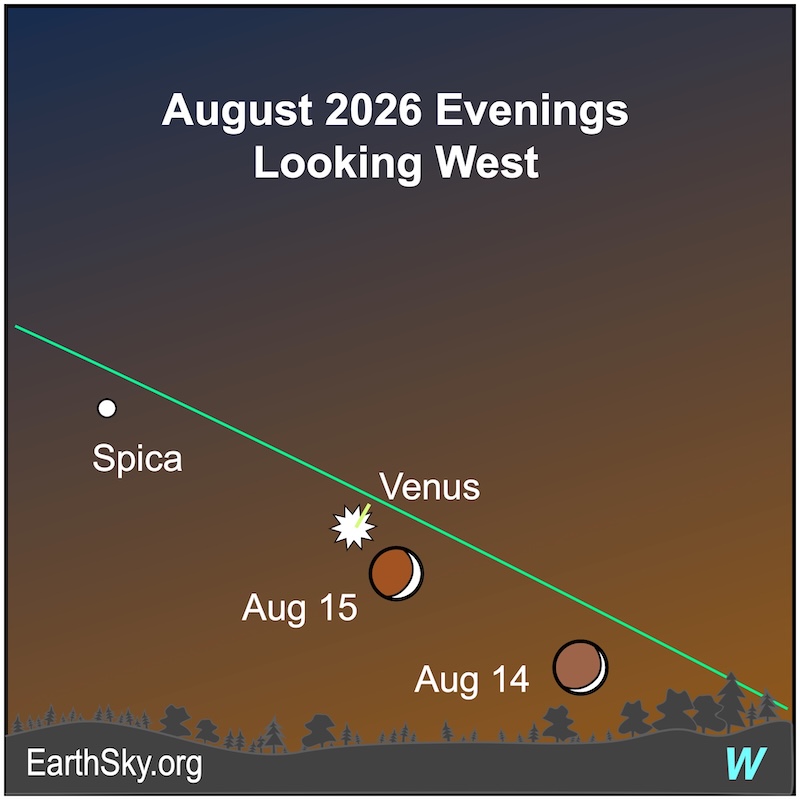
Greatest elongation – when Venus will reach its farthest distance from the sunset – will happen at 6 UTC on August 15, 2026. For all of Earth, the western twilight will still be the time and place to look for Venus. Around the evening of August 15, Venus will be near the young moon.
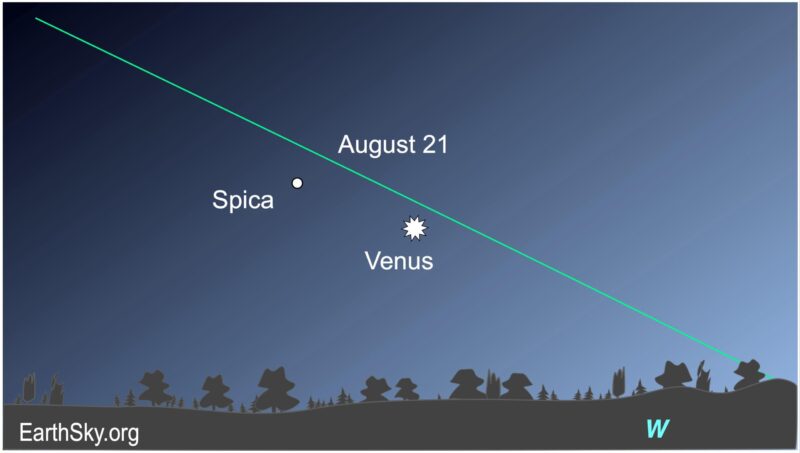
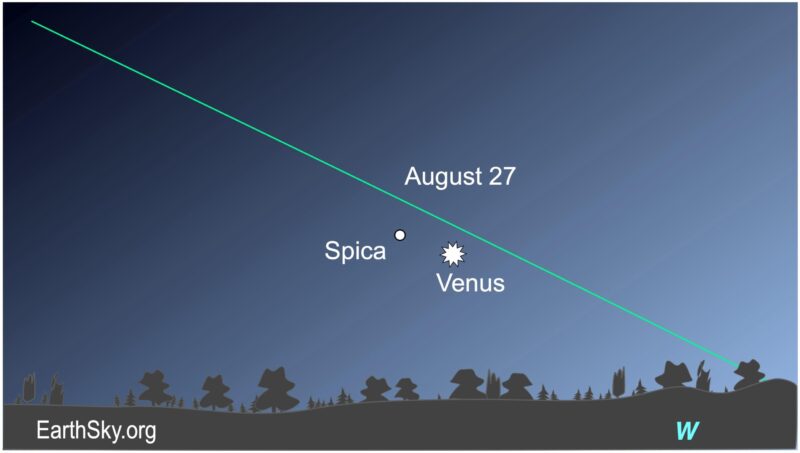
Plus there’s a bright star near Venus now in the evening twilight. It’s Spica, brightest star in the constellation Virgo. Venus and Spica are drawing closer together on the sky’s dome. Their conjunction will fall on September 2-3, 2026, shortly before Spica disappears into the sunset.
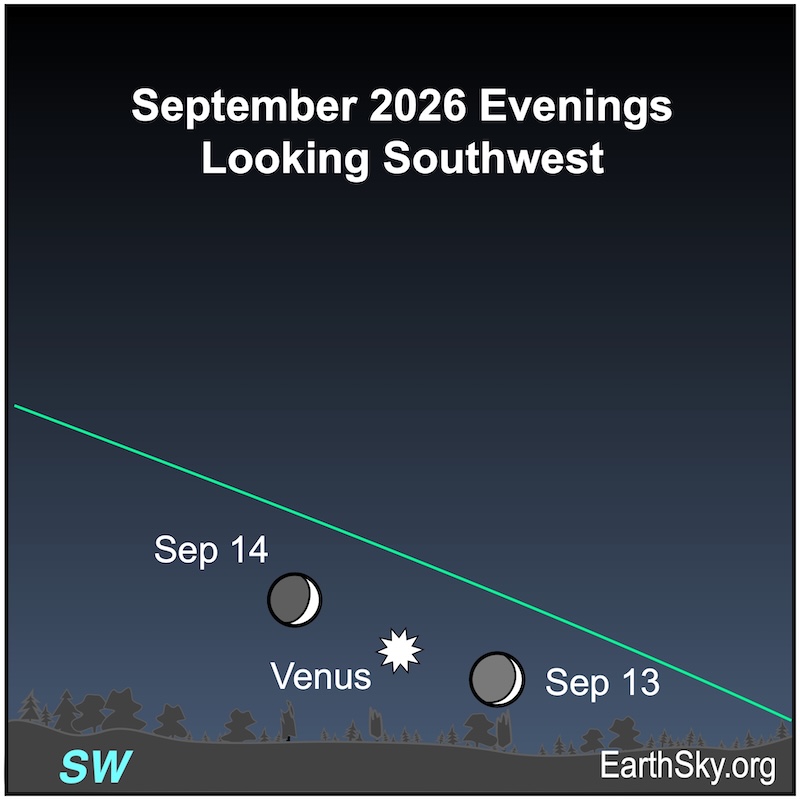
Afterwards, shortly before Venus itself drops into the sunset, Venus will reach another greatest brilliancy in the evening sky. That’ll happen around September 18, 2026.
So start watching Venus now!
For precise sun and Venus rising times at your location:
Old Farmer’s Almanac (U.S. and Canada)
timeanddate.com (worldwide)
Stellarium (free online planetarium program)

When is greatest elongation?
Greatest elongation will happen at 6 UTC on August 15, 2026 (1 a.m. CDT). Still, no matter where you are on Earth, watch for Venus in the west after sunset. At this elongation, the distance of Venus from the sun on the sky’s dome will be 46 degrees. The maximum possible distance (angular separation) of Venus from the sun on the sky’s dome at greatest elongation is approximately 47.3 degrees.
Magnitude at greatest elongation: Venus will be shining at magnitude -4.4.
Through a telescope: Venus will appear 49% illuminated, near a first quarter phase, 24.48 arcseconds across.
As the 2nd planet in orbit (going outward from the sun), Venus is bound by an invisible tether to the sun in our sky. It’s always east before sunrise, or west after sunset (never overhead at midnight).
2026 Venus finder charts
A comparison of elongations
Not all of Venus’ greatest elongations are created equal. That’s because the farthest from the sun that Venus can ever appear on the sky’s dome is about 47.3 degrees. On the other hand, the least distance is around 45.4 degrees.
Elongations are also higher or lower depending on the time of year they occur and your location on Earth.
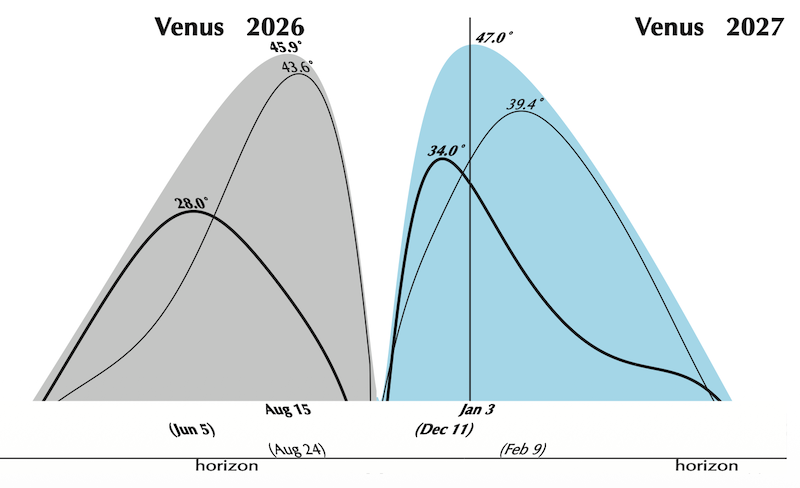
More Venus evening elongation comparisons for 2026
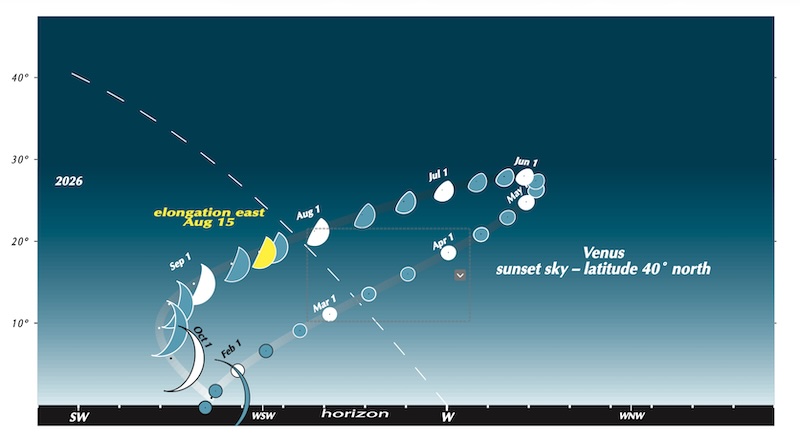
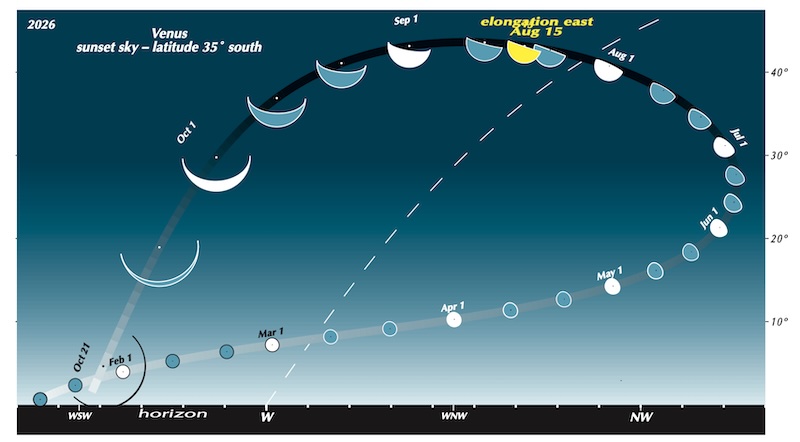
Venus events in 2026
January 6, 2026: Superior conjunction (passed behind sun from Earth)
August 15, 2026: Greatest elongation (evening)
October 24, 2026: Inferior conjunction (races between Earth and sun)
January 3, 2027: Greatest elongation (morning)
Bottom line: Look for Venus after sunset! It’s high in the August evening sky for all to see. Look west for a dazzling point of light.
Like what you read?
Subscribe and receive daily news delivered to your inbox.
More from
Editors of EarthSky


How many stars can you see on a moonless night?

Cassiopeia the Queen ascends in September and October
Roman space telescope has launched! You can adopt a pixel
Sapphire: September birthstone comes in many colors