
Sun news for September 13, 2026. We saw a violent filament eruption in the sun’s southwest around 19:45 UTC yesterday. It was associated with a C1.4 flare from sunspot region AR4528. This fiery eruption occurred in the middle of a lull of solar activity, with few faint flares and all active regions stable or in decay. Image via NOAA.
Sun news September 14: Violent filament eruption last night
Today’s top story: The solar southwest was lit up last night by a violent filament eruption. The eruption came from the vicinity of sunspot region AR4528, and has been associated with a C1.4 flare at 19:45 UTC. The blast sent a chunk of sun-stuff into space, which could give Earth a glancing blow by early Thursday.
Strongest flare:C1.4, peaking at 19:45 UTC on September 13 from an as-yet-unnumbered active region now located in southwest solar quadrant.
Lead flare producer: The southwestern region and AR4529 were tied for the lead with just one flare each.
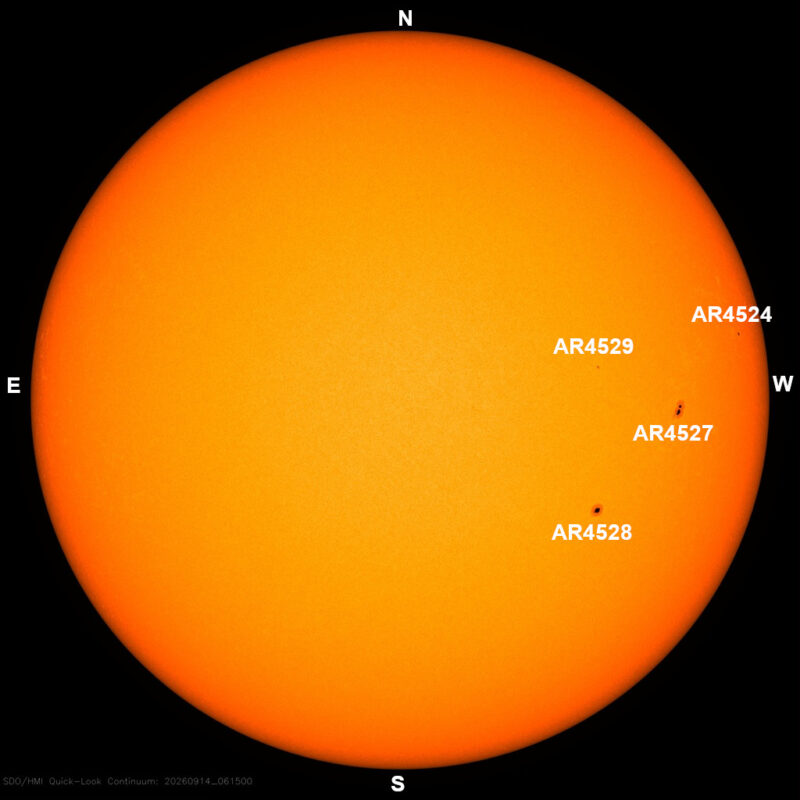
Sunspot regions: Currently the sun shows four numbered regions on its Earth-viewed side. They are grouped to the west of the solar disk, leaving a wide area on the east hemisphere with no active regions at all.
AR4524 (alpha), AR4527 (alpha), AR4428 (alpha), AR4529 (beta): All regions are magnetically simple and are either stable or slowly decaying.
Blasts from the sun? The abovementioned filament eruption hurled plasma into space at 19:45 UTC on September 13. A glancing blow is anticipated by early September 17. Other than that, observers detected no Earth-directed CMEs in available coronagraph imagery during the past 24 hours.
Past 24 hours in space weather
Solar wind:Solar wind speeds reached moderate levels through the first half of the period. At around 21 UTC on September 13, conditions started to decrease to background levels.
Bt, Bz and magnetic coupling: The total interplanetary magnetic field (IMF) was weak. The north-south component (Bz) kept a moderately southward orientation throughout most of the period.
Earth’s magnetic field: The geomagnetic field kept quiet, with the Kp at 0 – 2.
What’s ahead? Sun–Earth forecast
Flare activity forecast: Forecasters expect very low to low activity through September 15. The chance for M-class flares to occur dropped from 10% yesterday to 5% today.
Geomagnetic activity forecast:
September 14: Quiet conditions anticipated. Isolated unsettled periods could come with the arrival of fast solar wind from a coronal hole. G1 (minor) geomagnetic storm intervals are reasonably possible. Auroras might be visible as far south as northern Scotland and similar latitudes.
September 15: A second coronal hole high-speed stream is expected to arrive, maintaining unsettled-to-active conditions. Again, isolated G1 intervals are possible. Aurora visibility could extend slightly further south than usual at high latitudes.
September 16: Quiet-to-active levels likely as the high-speed stream influence gradually wanes. The likelihood of elevated geomagnetic activity decreases over the course of the day.
This image shows sun activity – with the most active regions labeled – as of 6 UTC on September 14, 2026. Original image, without labels, via NASA SDO. Courtesy of NASA/SDO and the AIA, EVE, and HMI science teams, with labeling by EarthSky. Armando Caussade posted today’s sun. Why are east and west on the sun reversed?
The sun in recent days
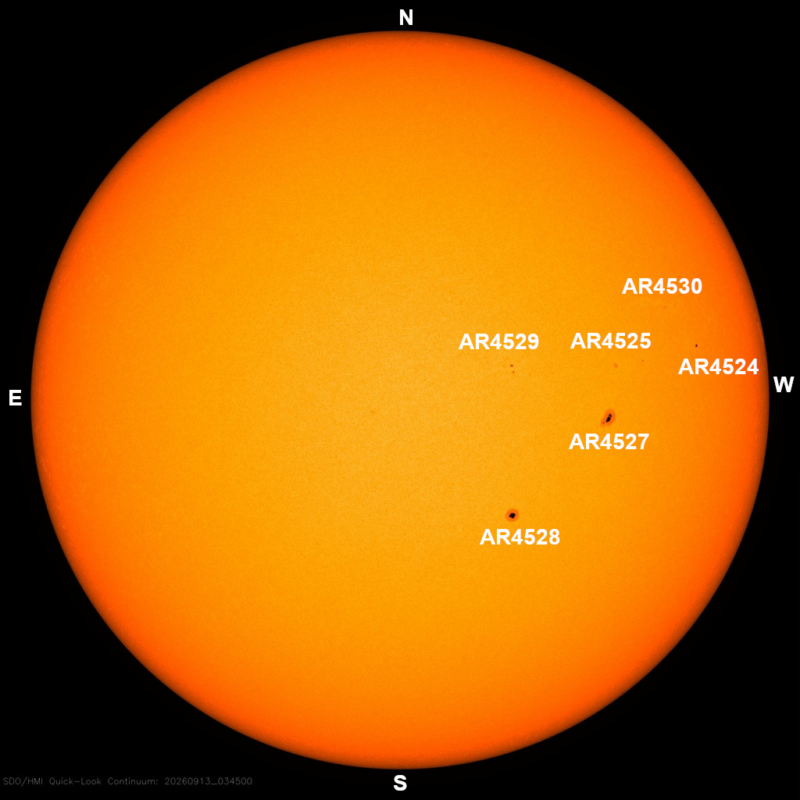
This image shows sun activity – with the most active regions labeled – as of 3 UTC on September 13, 2026. Image via NASA/SDO.
Earlier sun images
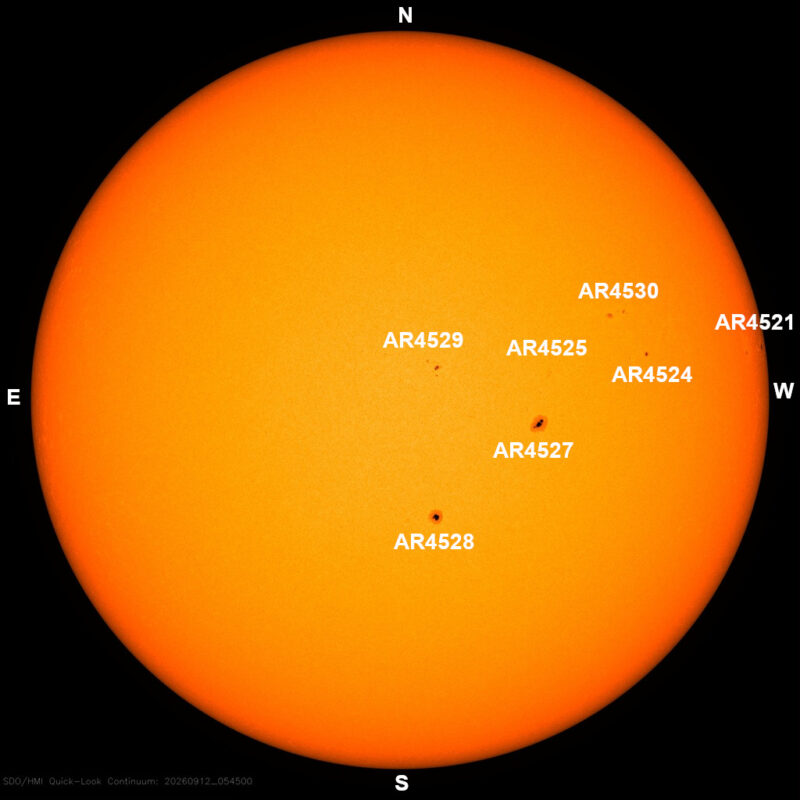
This image shows sun activity – with the most active regions labeled – as of 5 UTC on September 12, 2026. Image via NASA/SDO.
Sun images from our community
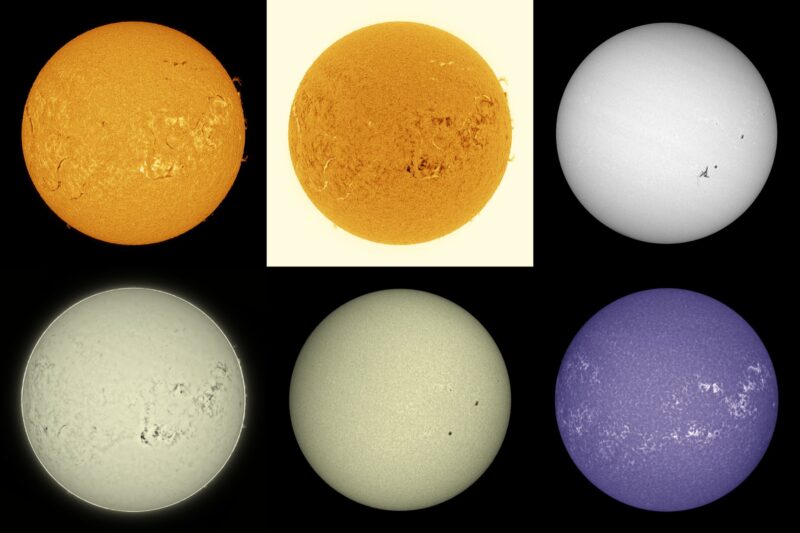
View at EarthSky Community Photos. | Mario Rana in Hampton, Virginia, captured these filtered images on September 13, 2026. Mario wrote: “The sun in hydrogen-alpha, white light, helium D3, sodium D2, and calcium-H. I happened to capture the C1.41 flare which peaked about 19:44 UTC. It can be easily seen in the white light image.” Thank you, Mario!
More sun images from our community
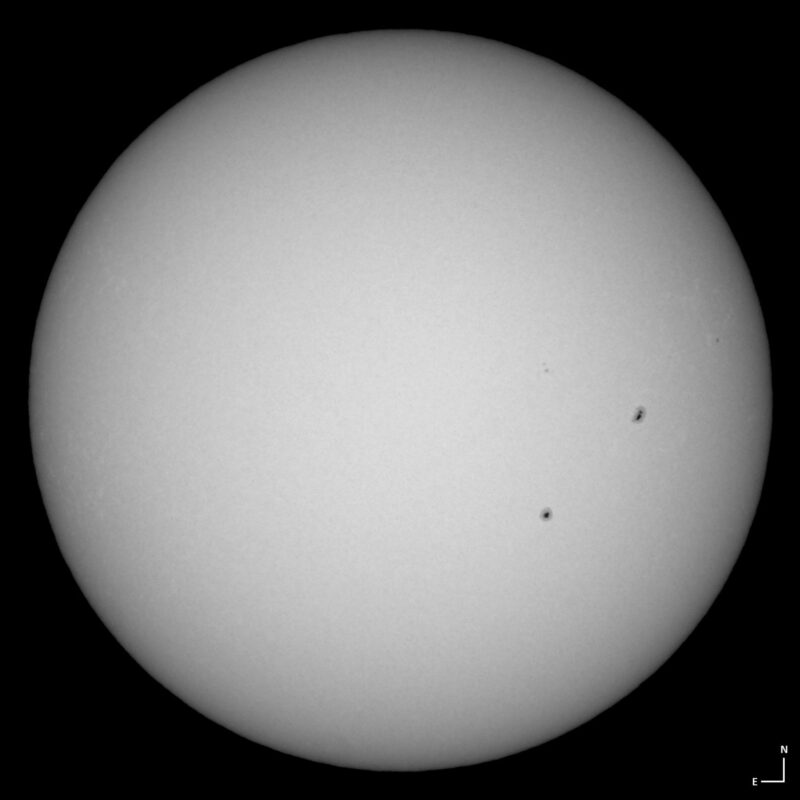
View at EarthSky Community Photos. | Patricio León in Santiago, Chile, captured this filtered image on September 13, 2026. Patricio wrote: “The pair of sunspots AR4527 and AR4528 are approaching the western limb to exit the solar face and no replacement is seen behind them. A central coronal hole has appeared in the northern hemisphere but solar wind speed has not been affected yet.” Thank you, Patricio!
We sometimes feature sun images obtained using hydrogen-alpha filters. Read why.
Bottom line: Sun news September 14, 2026: A violent filament eruption sent plasma into space. Initial analysis suggests a glancing blow at Earth on September 17.
C. Alex Young is a solar astrophysicist studying the Sun and space weather. Alex is passionate about sharing science with diverse audiences. This led him to start The Sun Today with his designer wife, Linda. First through Facebook and Twitter then adding an extensive website thesuntoday.org, the two work together to engage the public about the Sun and its role in our solar system. Alex led national engagement efforts for the 2017 total solar eclipse. He is the Associate Director for Science in the Heliophysics Science Division at NASA Goddard Space Flight Center.
Armando is known primarily as an astronomy educator, after 30+ years of extensive public outreach and 10 years teaching in colleges. As one of only a handful of science communicators in Puerto Rico during Comet Halley's last visit, he assumed a pioneering role starting in 1985 when science was just beginning to enter the collective mindset. Over the years, his work as a teacher, speaker and writer, inspired people to pursue interests in science and brought enduring change to Puerto Rican culture. After being accepted into the 2014–2015 Antarctic season of PolarTREC, Armando was assigned to the Amundsen-Scott South Pole Station, where in 2015 he successfully conducted 10 days of work at the IceCube Neutrino Observatory. His affiliations include Ana G. Méndez University, Cupey campus (2014 to 2021), the University of Puerto Rico, Aguadilla campus (2015 to 2017), NASA JPL's Solar System Ambassadors (2004 to 2006), and NASA Space Grant (2017 to 2019) where he served as an affiliate representative.
Raúl Cortés studied engineering at the Autonomous University of Nuevo León in Monterrey, Mexico, obtained a scholarship to continue his studies in Japan and after returning to Monterrey he got credits on MBA from the Graduate School of Mechanical and Electrical Engineering Faculty. He became a teacher at the University UANL teaching Math and Physics and dedicated the rest of his professional career to serve in engineering areas for USA, Japan and Germany based corporations. His passion for the skies go back to when he was a child, always intrigued about the stars and constellations and reading and researching about the matter. From 2010 on, he dedicated his attention to photographing the stars, constellations, the moon and the sun. Raúl's work on his photography has been published and posted on the ESC as well as in other platforms and has gained attention to be published by local Monterrey newspapers.
Like what you read? Subscribe and receive daily news delivered to your inbox.
Thank you! Your submission has been received!
Oops! Something went wrong while submitting the form.