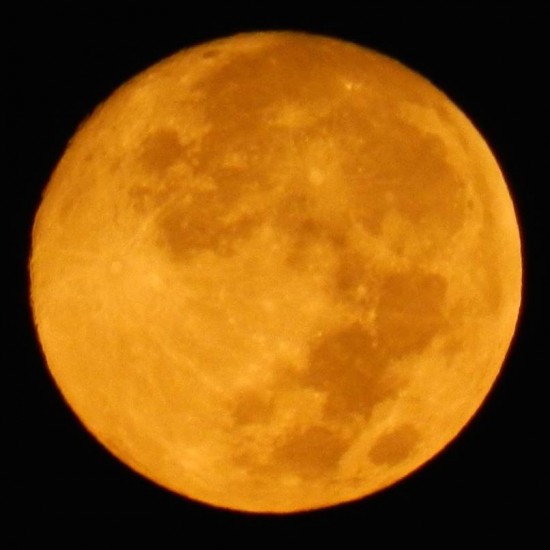
Full moon comes on September 16, 2016, and, for the Northern Hemisphere, this upcoming full moon is known as the Harvest Moon. It’s a particularly close and large Harvest Moon, which some will call a supermoon. And the September 16 moon will undergo a very subtle kind of eclipse known as a penumbral eclipse, visible from the world’s Eastern Hemisphere.
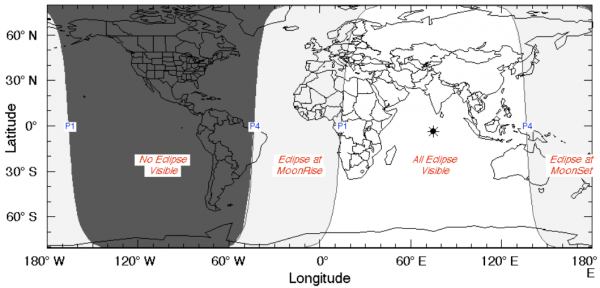
The moon will reach the crest of its full phase on September 16 at 1905 UTC. That’ll be 3:05 p.m. ET for us in North America; thus, the moon is beneath our horizon as it turns exactly full, and we will miss out on the September 16 penumbral lunar eclipse.
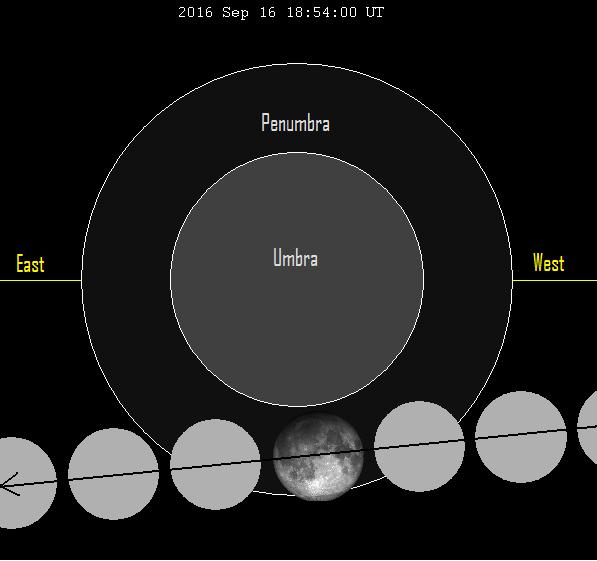
If you are in the world’s Eastern Hemisphere, know that this is a very subtle eclipse. Some will look right at it and swear no eclipse is taking place! The moon sweeps through Earth’s penumbral (light) shadow from 1655 to 2054 UTC; translate to your time zone.
Your best bet for actually witnessing this faint penumbral lunar eclipse is around mid-eclipse, which takes place at 18:54 UTC.
At best, it’ll look like a dark shading on the moon.
Read more about this eclipse at Fred Espenak’s EclipseWise.

Can’t see the eclipse? If you’re in the Northern Hemisphere, you can see the Harvest Moon on September 16.
The Harvest Moon is the full moon that falls the closest to the Northern Hemisphere’s autumnal equinox. In the Southern Hemisphere, this September full moon counts as the closest full moon to your spring equinox. For Southern Hemisphere dwellers, it’s not a Harvest Moon. Your Harvest Moon comes around the March equinox.
For all of us, the Harvest Moon can come anywhere from about two weeks before to two weeks after the autumn equinox (September for Northern Hemisphere, March for Southern Hemisphere). In some years, the Northern Hemisphere’s Harvest Moon can come as late as early October. The last October Harvest Moon was October 4, 2009, and will next occur on October 5, 2017.
One of you asked:
Is the phase of the moon consistent across the United States? Recently, on a trip to the California coast we saw a full moon, but it did not appear to be in the same phase just one day later in the western Pennsylvania sky.
The moon’s phase does appear the same as seen from across the U.S. – even from across the world – more or less. When the moon is full, for example, it’s more or less full for all of us. So looking up at night unites us all, across the planet. We all see the moon as nearly full around now, for example.
The moon’s phase is continuously changing, though, even if that change isn’t perceptible to the eye. From one night to the next, the moon can definitely appear different in phase from the previous night. What’s more, your perception of the moon might be affected by other things – for example, by whether you’re seeing the moon in twilight or late at night, whether it’s peeking from behind trees or shining in solitary splendor, whether it’s a big reddish moon low in the sky or a smaller whiter moon closer to overhead.
There are seasonal variations, too. Around the time of full moon in spring, the moon rises much later one evening than it does the evening before. That’s happening around now, in Earth’s Southern Hemisphere.
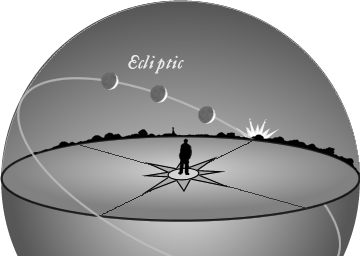
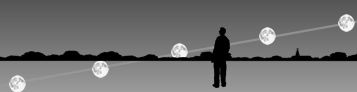
In late summer and fall, the opposite is true. At middle and far northern latitudes in the Northern Hemisphere, full moons in September and October are characterized by a shorter-than-average time between successive moonrises. These moonrises close to the time of sunset – around the time of the full moon in September and October – are the essence of the Harvest Moon phenomenon.
By the way, Lance Bullion captured the image at the top of this post. It’s the beautiful setting Harvest Moon, colored by the extra thickness of Earth’s atmosphere in the direction toward the horizon.
You’ll see a similarly colored rising Harvest Moon during the next several evenings, if you catch the moonrise, shortly after sunset.
Bottom line: There is an eclipse of the 2016 Harvest Moon on September 16. It’s a very subtle kind of lunar eclipse, known as a penumbral eclipse.
Minor lunar standstill lessens impact of 2016 Harvest Moon
The lunar calendars are coming! They’ll help you the moon phases throughout the year.
Like what you read?
Subscribe and receive daily news delivered to your inbox.
More from
Deborah Byrd


Visible planets and night sky guide for October

What star in the northeast flashes colorfully? It’s Capella!
Proxima Centauri is the closest star to our sun
NASA’s Perseverance rover on Mars sets off-world driving record