



It’s the 5th-brightest star
Look for the star Vega, the 5th-brightest star in Earth’s sky. If you’re anywhere in the Northern Hemisphere, you’ll find this beautiful, blue-white star easily. That’s because Vega is located relatively far to the north on the sky’s dome. At latitudes of 52 degrees N. or higher, it’s circumpolar, never rising or setting but circling endlessly in the northern sky. Meanwhile, for us for us at U.S. and similar latitudes, Vega makes a wide arc across our northern sky and is visible for much of every night, for much of every year.
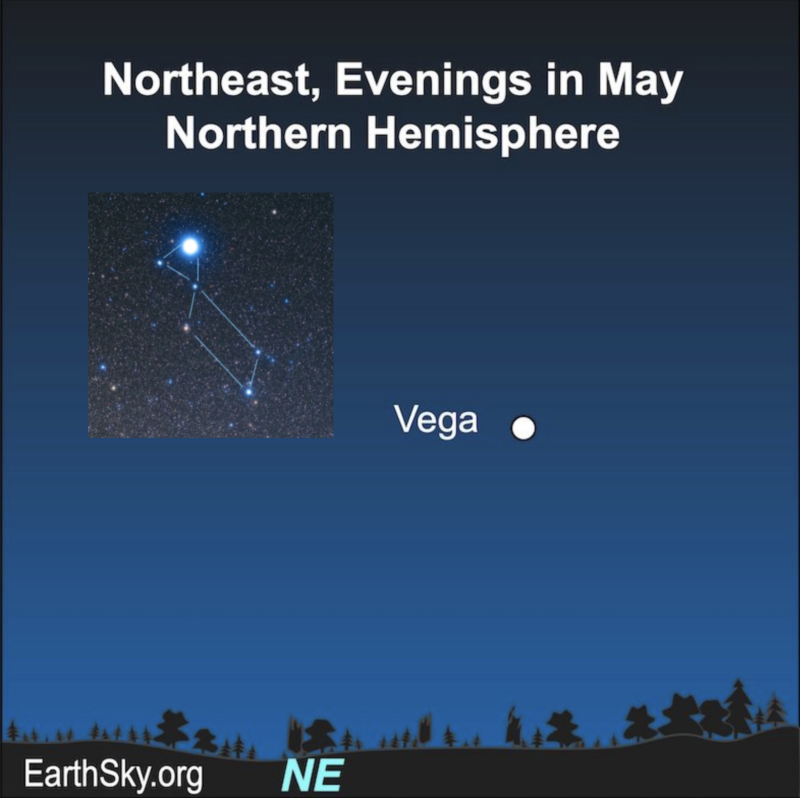
So, for Northern Hemisphere viewers, the month of May is the perfect time to get to know Vega. You’ll look northeast one May evening, and find Vega shining brightly there. This bright star transits the meridian (crosses a line bisecting due south and due north in your local time) in the hours shortly before dawn in mid-May. Like all stars, Vega rises some four minutes earlier each day, as Earth moves around the sun. That’s why Vega will adorn the evening sky – shifting ever westward as night passes, and as the seasons pass – throughout the northern summer and fall.
From mid-latitudes in the Southern Hemisphere, the perspective is shifted. From there, you won’t see Vega on May evenings; the bulk of Earth will block it from your view. Southern Hemisphere viewers need to wait until later at night in the month of May for Vega to rise and to make its small arc above the Southern Hemisphere’s northern horizon. But the transit time – when Vega is highest in your northern sky – is the same for all earthly viewers. From across Earth’s globe, watch for Vega highest in the sky in the hours before dawn in May.
And, from all of Earth, Vega is bright! It’s so bright that you can see it easily even from inside small cities, and even on moonlit nights. Notice the star’s color: blue-white.
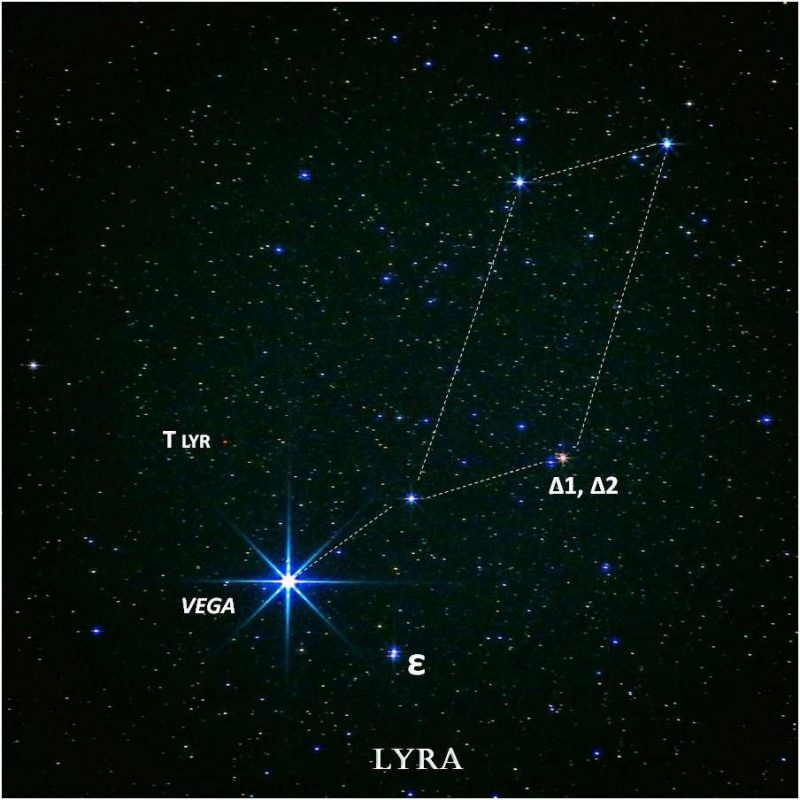
Because it’s the brightest star in the constellation Lyra the Harp, Vega is sometimes called the Harp Star.
Vega from the Northern Hemisphere
In the Northern Hemisphere, Vega is generally considered a late spring or summer star. But again it’s up most of the time, throughout the year.
Observers in the Northern Hemisphere typically begin noticing Vega in the evening around May, when this star comes into view in the northeast in mid-evening.
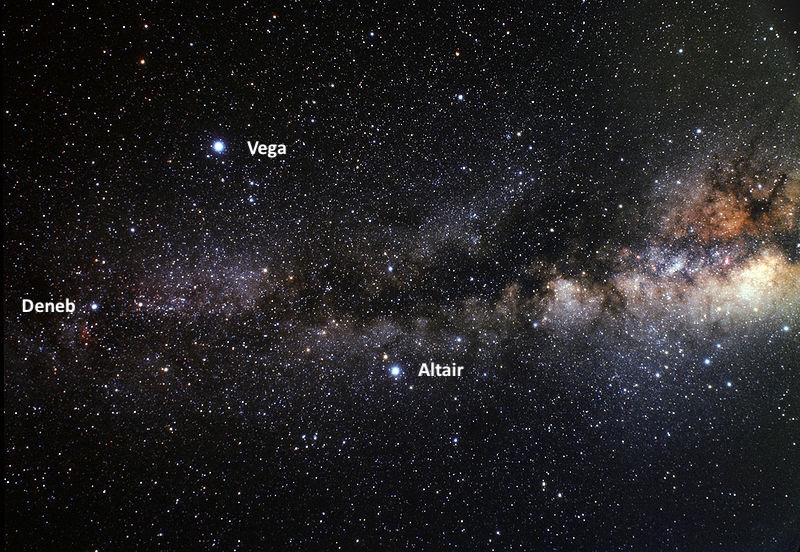
Beginning around June, people begin to notice Vega in the company of two other bright stars, in two other constellations: Deneb in Cygnus the Swan and Altair in Aquila the Eagle. Together, these three bright stars make up a large triangle pattern, an asterism, which we in the Northern Hemisphere call the Summer Triangle.
Throughout northern summer, Vega shines brightly in the east in the evening. It’s high overhead on northern autumn evenings, and in the northwest by December evenings.
Vega from the Southern Hemisphere
Via Daniel Gaussen, Founder & Guide – Stargaze Mackenzie – New Zealand
Southern Hemisphere stargazers feel differently about Vega from our friends on the northern part of the globe. And, again, that’s because Vega is located so far to the north on the imaginary celestial sphere surrounding Earth.
From the Southern Hemisphere, Vega appears bright. It appears blue-white in color. But it never climbs high above our northern horizon. As seen from 35 degrees S. latitude, its maximum altitude is only about 15 degrees. If you hold your hand at arm’s length and make a fist, the width of your fist covers about 10 degrees of the sky. So – as seen from that southerly latitude – Vega appears, at most, about one-and-a-half fist widths above the northern horizon.
Plus, from 35 degrees S. – approximately the latitude of Santiago, Chile, Buenos Aires, Argentina, and Adelaide, Australia – Vega’s entire passage across the sky, from rising to setting, takes only about four hours! So you can see that Vega isn’t a feature of southern skies very long each night, or for many months of the year.
It’s one of those elusive bright stars that southern stargazers long to see higher in the sky, shining in all its glory. To see it that way, they must travel northward on Earth’s globe.
In May, Vega doesn’t come into view until the early morning hours. But – as is true on the northern half of Earth – its best altitude is before dawn. As the months progress, Vega shifts into more convenient evening viewing. By July, Vega begins rising in late evening. And September is your most convenient time for evening viewing of Vega; then this star reaches its highest point for the night at nightfall … a clear bluish presence above the northern horizon.
Because Vega stays low in southern skies, it is more strongly affected by atmospheric dimming and color distortion than it is for northern observers. It appears less sharp in a telescope and more noticeably twinkling to the unaided eye.
Yet even from far southern latitudes, Vega’s brilliance makes it easy to identify. It remains one of the brightest northern stars visible from the south, with its blue-white light providing a useful and easily recognizable reference point for orienting the northern sky.
Bottom line: If you’re in the Northern Hemisphere, Vega is easy to identify in its constellation Lyra at this time of year. Just look northeast in the evening hours for a bright, bluish star above the northeastern horizon.
Read more: Summer Triangle star: Vega is bright and blue-white
Like what you read?
Subscribe and receive daily news delivered to your inbox.
More from
Deborah Byrd


Summer Triangle: Star pattern of the season


