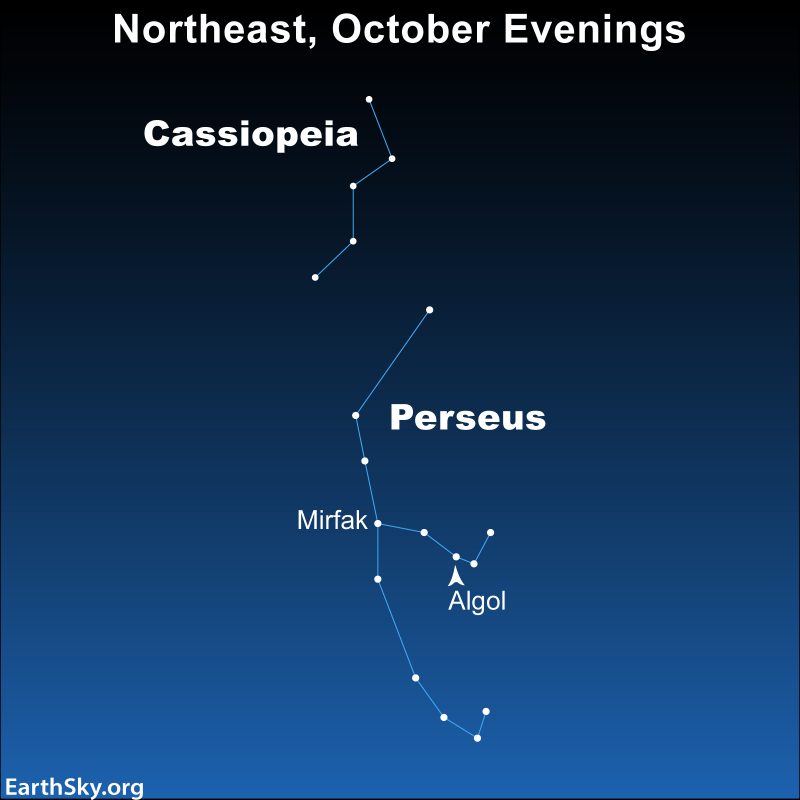
If you know how to locate the easy-to-spot constellation Cassiopeia the Queen, with its distinctive M or W shape, then you’re ready to find Perseus. Perseus the Hero follows Cassiopeia across the sky as seen from the Northern Hemisphere on autumn and winter evenings. Cassiopeia and Perseus are tokens of autumn in the Northern Hemisphere.
Cassiopeia’s bright stars and easy-to-recognize shape makes it easy to identify and, therefore, one of the most famous constellations in the sky. Perseus’s stars are fainter than Cassiopeia’s, and its shape is less pronounced. Because it appears at its best during the evening on cold months, I think of its brightest stars as forming an icicle dangling down from Cassiopeia, with the star Algol off to the side. If you have access to a dark sky, it will be that much easier to spot Perseus.
Where to find Cassiopeia and Perseus
You’ll see both Cassiopeia and Perseus in the northeast on October evenings. The pair will be higher up in the evening sky in late autumn and winter. Or, as night passes, you’ll see them both ascending in the northeast, then arcing high in the north, then descending in the northwest, with Perseus following Cassiopeia all the while. Both Perseus and Cassiopeia are circumpolar from about 40 degrees north latitude to farther north. In other words, as seen from northern parts of the U.S. and Canada, they never set below the horizon, but instead circle endlessly around Polaris, the North Star.
The brightest star in Cassiopeia is Schedar. However, all the stars shine similarly bright, which is part of what makes the constellation so easy to pick out.
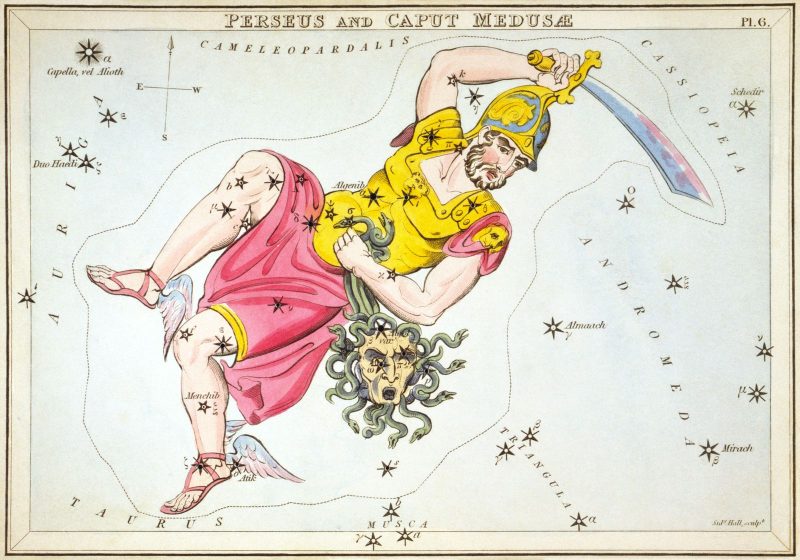
The brightest star in Perseus is Mirfak. But its second brightest star, Algol, gets more attention. Algol is the Demon Star. It marks the head of the demon Medusa, and it’s also a variable star. That means it varies in brightness at a regular rate, every few days, which observers can watch without the need for optical aid.
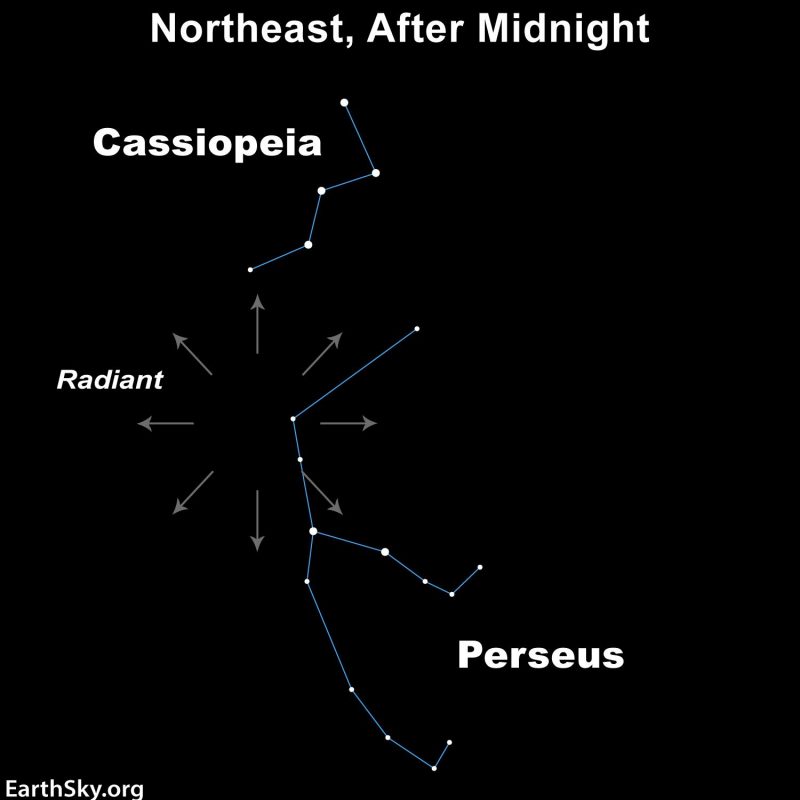
The radiant for the Perseids
Although these constellations are best seen in the evening in autumn and winter, you can also see Cassiopeia and Perseus in the latter part of Northern Hemisphere summer, from late night until dawn. Plus, the annual Perseid meteor shower peaks around August 12 or 13, and if you trace the paths of these Perseid meteors backward, they’ll appear to originate between the two constellations.
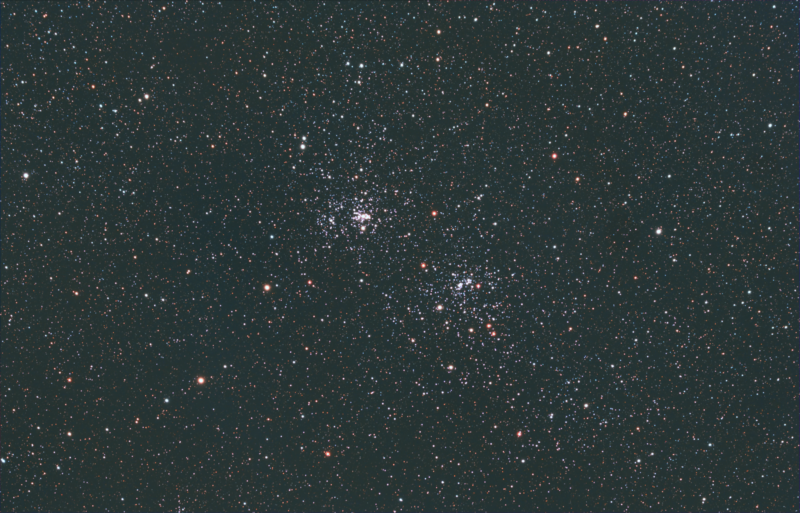
The Double Cluster in Perseus
Last, but not least, after you’ve found Cassiopeia and Perseus, be sure to scan between them with your binoculars. Assuming your sky is dark, you’ll easily spot the magnificent Double Cluster in Perseus. This pair of open clusters makes for an easy target through a telescope and will wow your friends.
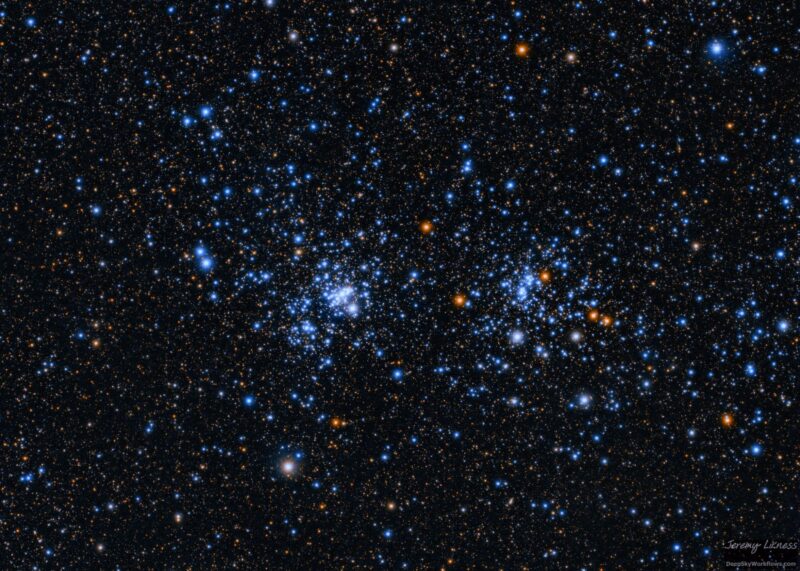
Bottom line: Cassiopeia and Perseus are neighbors in the fall sky. Use Cassiopeia’s distinctive W or M shape to locate the dimmer Perseus on autumn and winter evenings.
Like what you read?
Subscribe and receive daily news delivered to your inbox.
More from
Bruce McClure


See the year’s fastest sunsets and sunrises around equinoxes

Equinox fun: Track the sun’s shift now until the solstice
Delta Cephei helps measure cosmic distances
The Wild Duck cluster, M11, a lovely open cluster in Scutum