Are sloths really as slow as people say? Are they equally slow in all environments? Read slowly to find out more about these calm and smiling animals.
Why so slow?
Sloths do everything their own way: slowly. That’s why in Spanish we know them as “perezosos,” which literally means “lazy.”
Their slowness starts with their digestive system. Sloths don’t spend the day eating. What happens here is that they have a big stomach with four chambers! Food must pass through all four chambers, and that takes time.
So, sloths cannot eat large amounts of food daily because their stomachs are already full of slowly digestible food. This is why they have a slow metabolism, which is what gives the body its energy.
In fact, digestion is so slow that these mammals come down to the ground approximately every eight days to defecate. This gives them a great advantage because they can remain in the safety of the trees for a long time, thus avoiding being eaten on land.
They are their own ecosystem
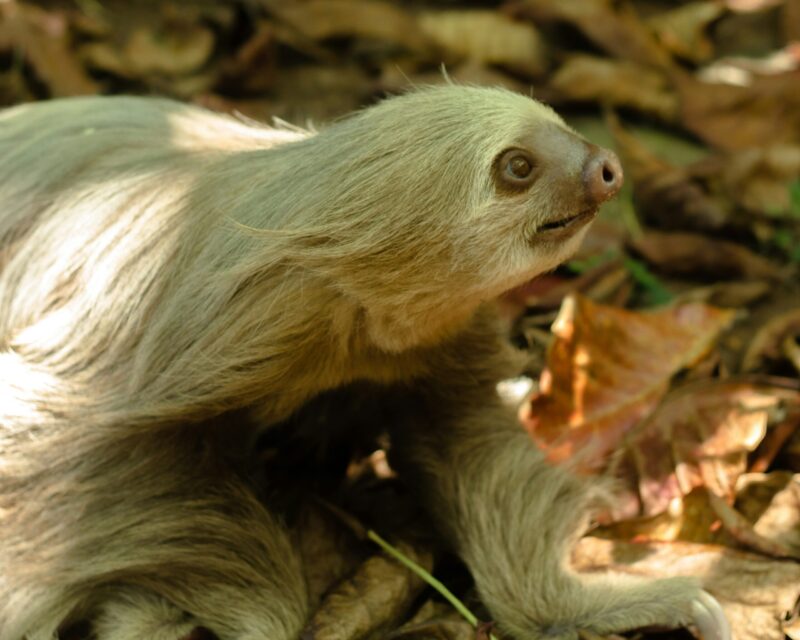
Sloths are solitary animals, but they are not really alone. They are so slow that an entire ecosystem grows in their fur! Different species of algae, fungi and insects live in their hair.
But that’s not something bad at all. These mammals have a mutualistic symbiotic relationship with the ecosystem that grows in their fur. This means that they help each other. Fungi, algae, and insects benefit greatly from this relationship as they have a habitat in which to thrive.
On the other hand, the sloth benefits too because these organisms give it a greenish color that helps it camouflage it among the trees from predators.
Hunters who use their sight, such as birds of prey, often miss sloths when searching for prey. And it’s not just something visual, sloths also smell like the jungle.
Where to find them?
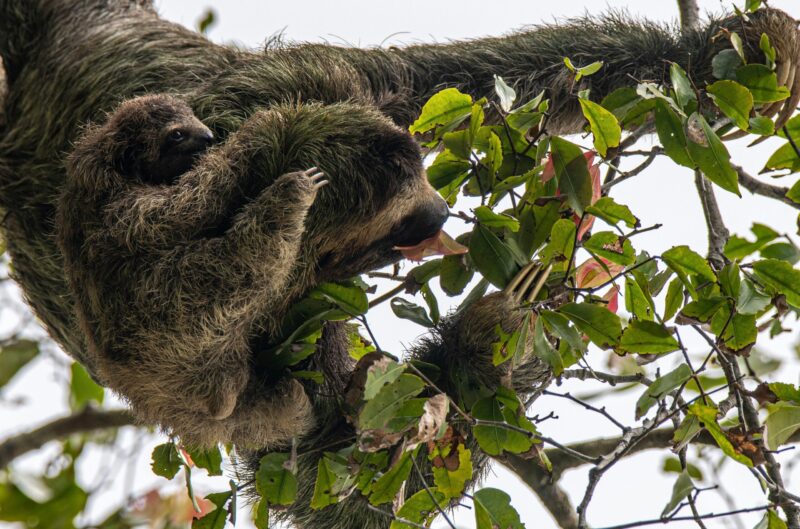
Sloths live among tree branches and rarely touch the ground. They are native to the large rainforests of Central and South America.
And what do they eat? I will give you a clue: They are surrounded by their food … You guessed it! They are folivorous mammals; this means that they feed primarily on leaves.
And in case you were wondering, the similarity between sloths and primates is only apparent, as they are not closely related. Sloths are related to anteaters and more distantly to armadillos.
Their faces are round with tiny ears. So cute! But, sight and hearing are not their best senses, so sloths rely mainly on touch and smell. In addition, they have an impressive bone and muscle anatomy.
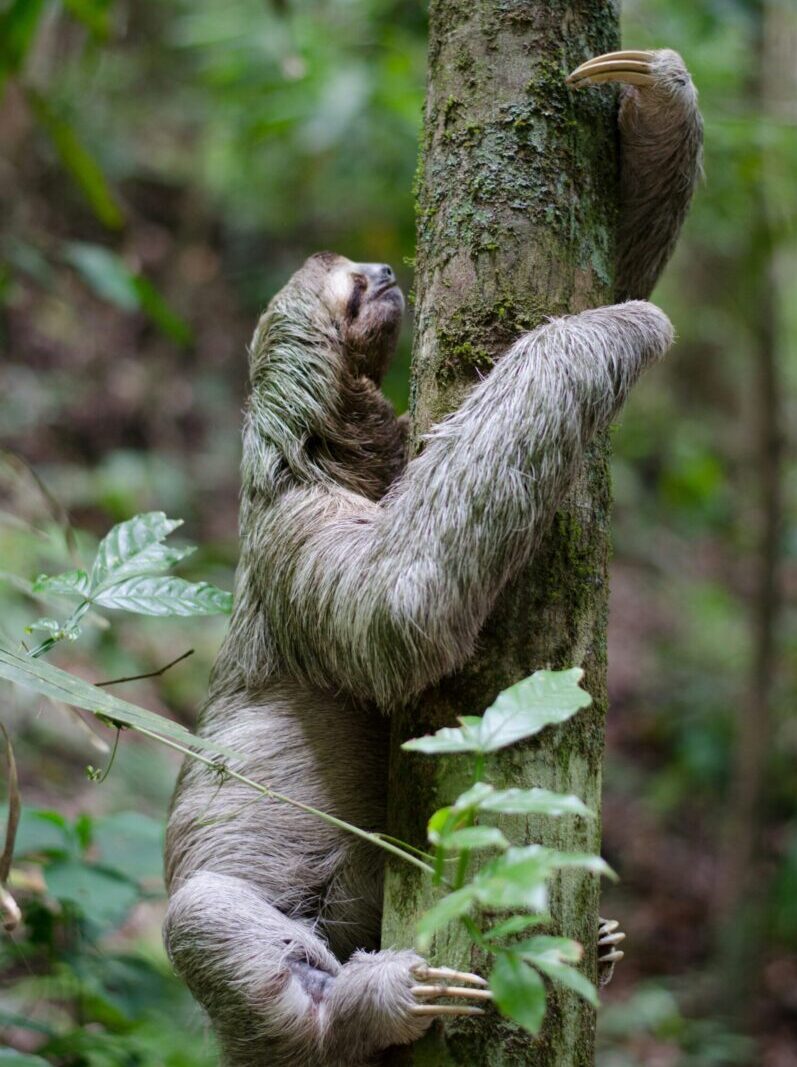
These animals have very strong claws that they use to hang from tree branches and to climb trees.
Claws and types of sloths
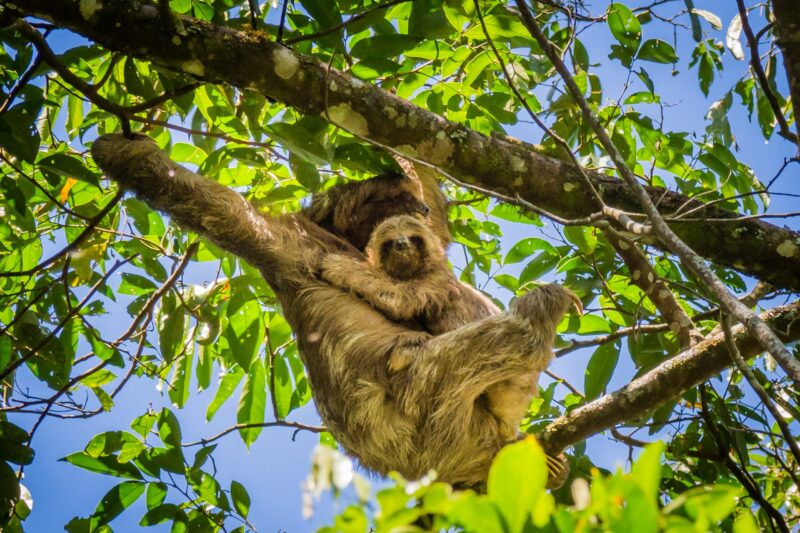
There are 6 species of sloths that can be classified into two genera: three-fingered and two-fingered. This classification only applies to the front legs, since all sloths have three toes on their hind legs. Although we talk about fingers, they are actually claws.
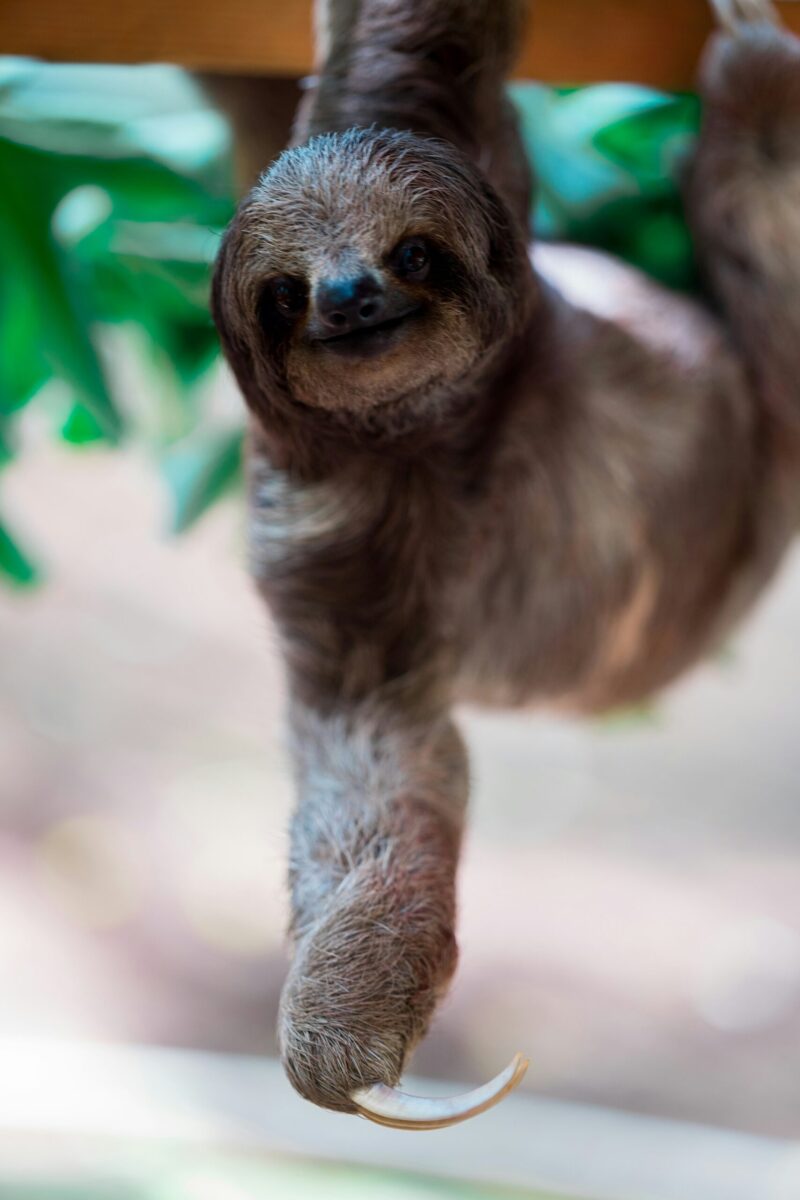
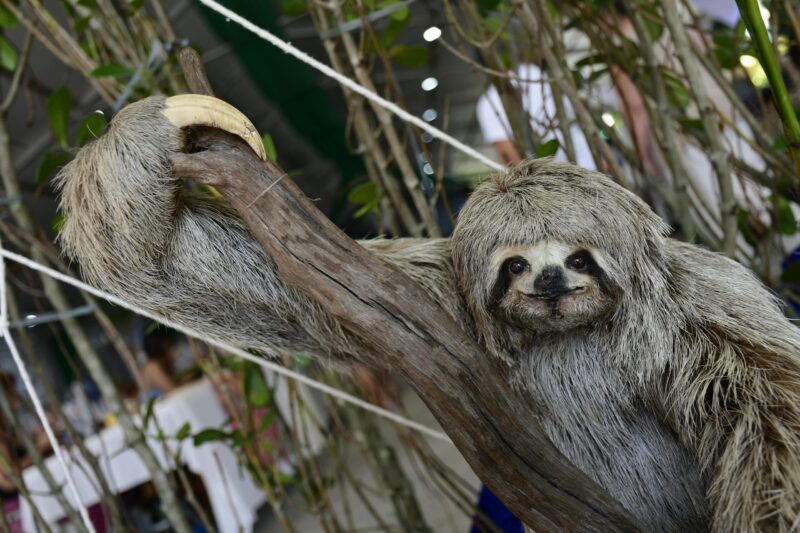
Sloths’ claws are made up of elongated, curved distal phalanx bones. These bones are covered by a sheath of the same material that makes up our nails (keratin).
Thus, sloths’ claws acquire their shape through constant use, by climbing trees. If they break, they can grow back. However, the claws rarely return to their original shape and often grow back deformed. In the wild, this can put the sloth at a major disadvantage, as its claws are vital to life among trees.
In these cases, the underlying bone is the same size, but the nail sheath grows misshapen and is not worn away by climbing, resulting in oversized claws that curl painfully into the pads of their paws, making climbing and feeding very difficult.
Superhuman strength
These mammals measure about 24 inches (60 cm) long and weigh between 11 and 15 pounds (5 and 7 kg). Despite appearing slow and small, in reality an adult sloth is approximately three times stronger than the average human. That’s the result of an intelligent anatomical architecture.
Over a long evolutionary process, sloths have reduced energy consumption in every possible way. Since muscles are heavy and consume more energy, sloths have 30% less muscle mass than other mammals of similar size. However, their strength is condensed!
Additionally, their muscle fibers are organized differently than ours, as they are arranged at an angle rather than parallel to the length of the muscle, making their muscles much stronger than ours.
The muscles themselves contribute to their disproportionate strength. Sloths’ muscles function in a sort of lever system, resulting in an immense volume of force with very little muscle mass and expending very little energy.
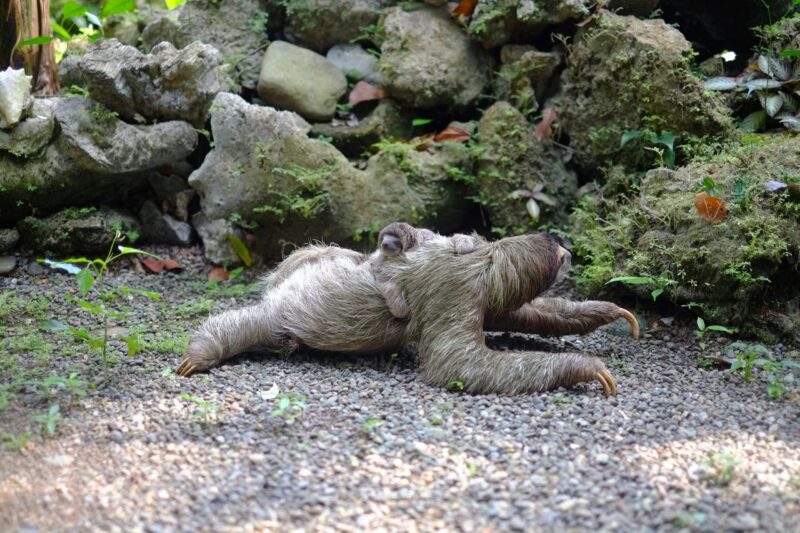
However, their muscles are specialized in pulling, not pushing. That’s why sloths can’t walk on the ground like a quadruped. Also, their claws make moving on the ground very difficult.
They need an enormous amount of energy to move across the ground, energy they cannot afford to lose. Unfortunately, due to deforestation, sloths are forced to leave the safety of the trees and come down to the ground more and more frequently.
More cervical vertebrae than a giraffe
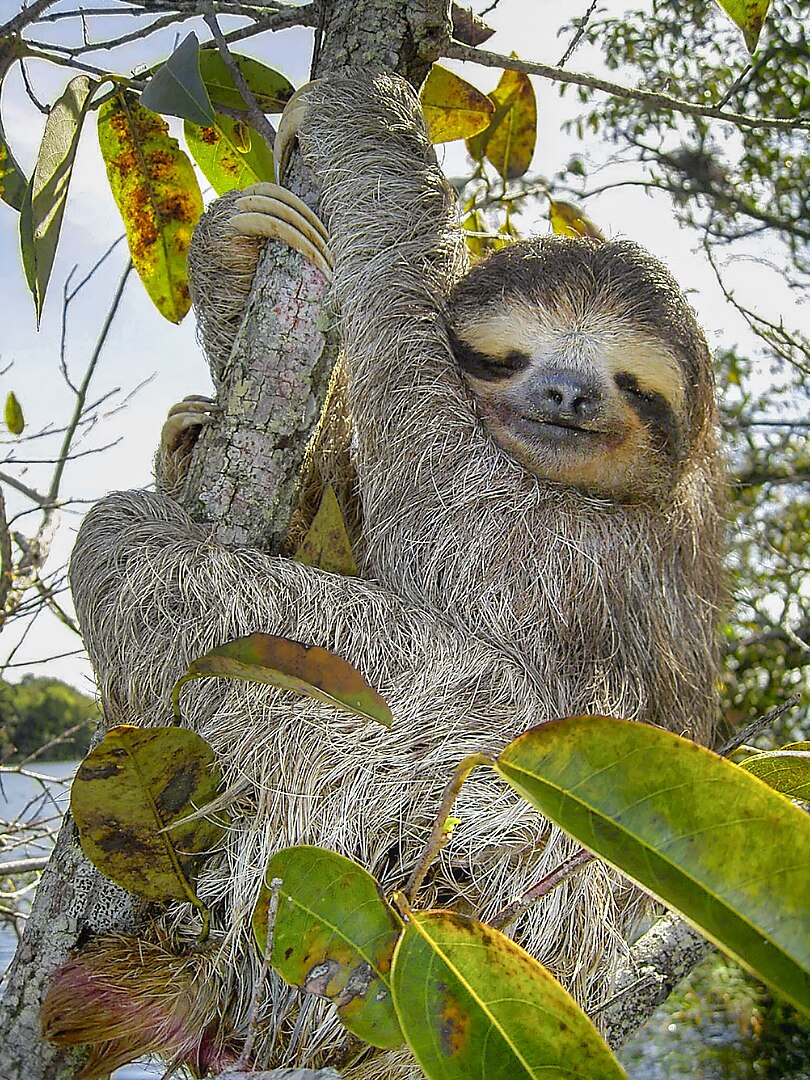
Most mammals have exactly seven vertebrae in their necks. There are only two exceptions: sloths and manatees. Three-fingered sloths have nine cervical vertebrae, while both two-fingered sloths and manatees have only five.
Among the three-fingered sloths, extra cervical vertebrae allow them to turn their heads 270 degrees, which, following sloths’ evolutionary effort to reduce energy consumption whenever possible, is a very smart tactic.
This evolutionary improvement in three-fingered sloths means they can move their heads completely backward. This can be very useful when trying to reach leaves in different directions without having to climb further and expend more energy than necessary.
However, no one is quite sure why two-fingered sloths have only 5 cervical vertebrae.
Ribs record
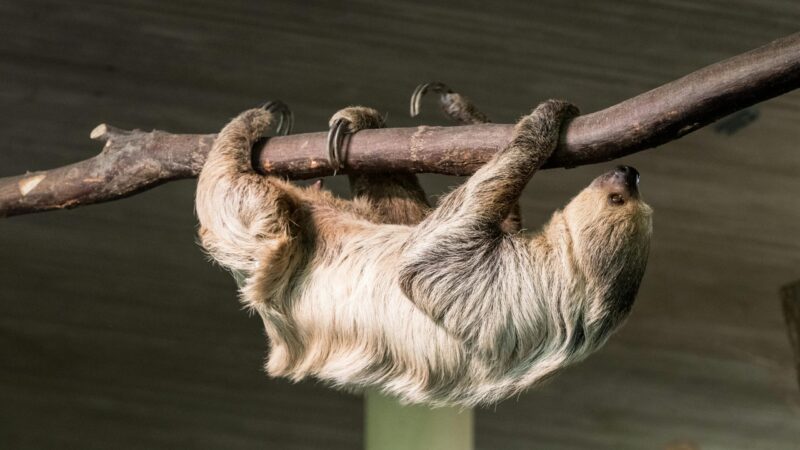
Unlike vertebrae, the number of pairs of ribs in mammals varies between species. If you look at the skeletons of two-fingered sloths, they look like made of only ribs and more ribs: They have 23 pairs! This is the largest number of ribs in any mammal. In comparison, humans have only 12 pairs and whales have nine.
In all animals, the rib cages function to protect internal organs. Sloths’ stomachs are huge; the abdominal contents can represent up to 37% of their body weight. Therefore, such a large stomach needs additional support and protection.
Sloths regularly fall from trees and survive. They can fall from up to 98 feet (30 meters) high without anything happening to them, all thanks to this impressive bone structure.
Three-fingered sloths also effectively anchor their abdominal organs against their lower ribs. These amazing “hangers” support the weight of the sloth’s stomach and intestines while the animal hangs upside down.
They are excellent climbers and swimmers
Sloths move, or rather crawl, at a speed of 1 mile per hour (1.6 kph). And although they move slowly, they are very good climbers. And, surprisingly, they are excellent swimmers. If they have to cross a river, that’s not a problem for them.
These animals are three times faster at swimming than they are at climbing. Swimming is a vital skill due to the abundance of water present in their habitats, which are often flooded forests or mangroves. Three-fingered sloths are especially good at swimming, as their extra cervical vertebrae help them keep their nose out of the water while they swim.
They can even hold their breath for around 40 minutes, since they have a slow metabolism and a very low heart rate.
Additionally, sloths can float thanks to their stomach. The stomach is very large and has four chambers mainly filled with gas from the fermented leaves, which acts as a flotation device.
Black fangs
These animals are hypsodonts, meaning their teeth grow continuously throughout their lives. Just like their nails, their teeth are used constantly so that they don’t grow excessively.
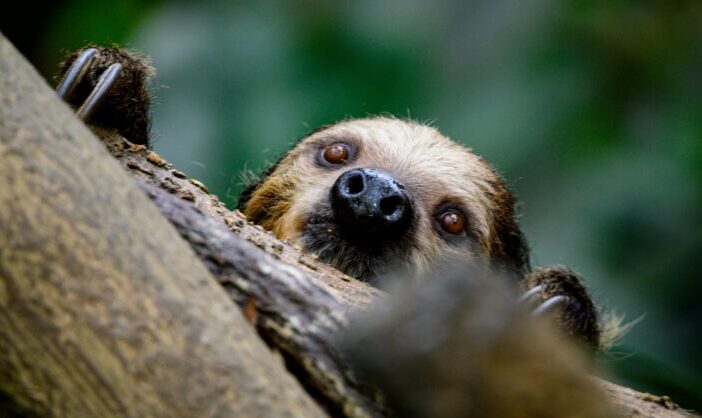
Two-fingered sloths have four sharp fangs, two on top and two on the bottom. A slight overbite causes the upper pair to grow in front of the lower pair, constantly rubbing against each other. Every time a two-fingered sloth opens and closes its mouth, its fangs sharpen.
Since their diet consists of leaves, they also ingest a lot of tannins. Tannins are a substance in leaves that produces a brown color. Since sloths don’t have the protective layer of enamel on their teeth like we do, the high concentration of tannins stains their fangs black.
William Phipps/ Unsplash.
Sloths’ lives
These animals spend their time sleeping among trees, between 15 and 18 hours per day. And if you think this is a lot … Koalas sleep between 18 and 22 hours per day!
Sloths can spend almost 90% of their lives hanging on branches. They have a life expectancy of 20 years in the wild and up to 40 years in captivity.
They are mostly nocturnal animals, although some species can be active during the day.
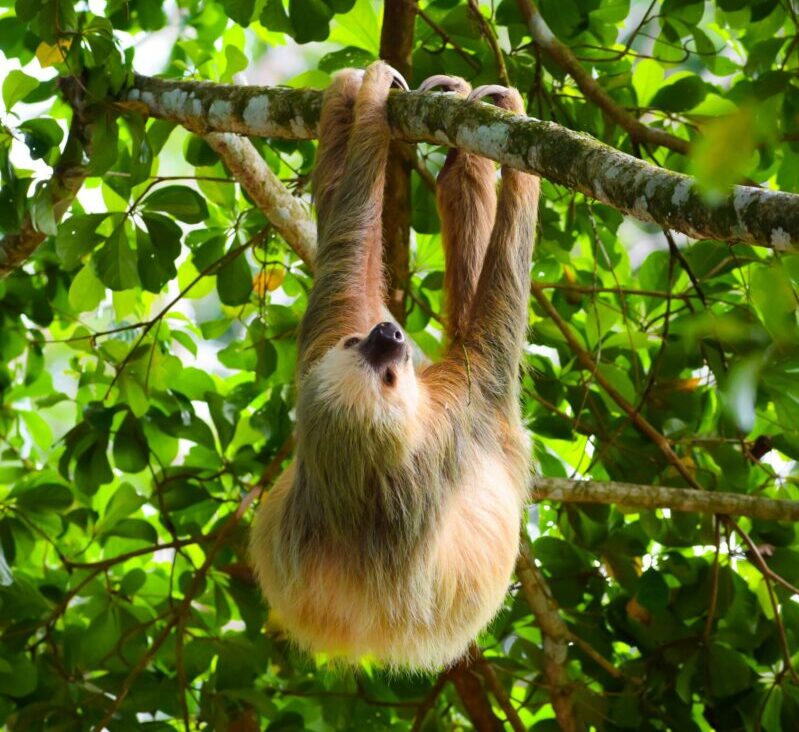
They can use their claws to defend themselves. They are very aggressive toward other individuals of the same sex, so they only usually interact with the opposite sex to mate.
Although their faces express apparent joy through a constant smile, that’s just how their faces look. Sloths become very stressed when people approach them. If you visit these animals, remember you can take photos of them from a distance and observe them without causing them discomfort.
Baby sloths
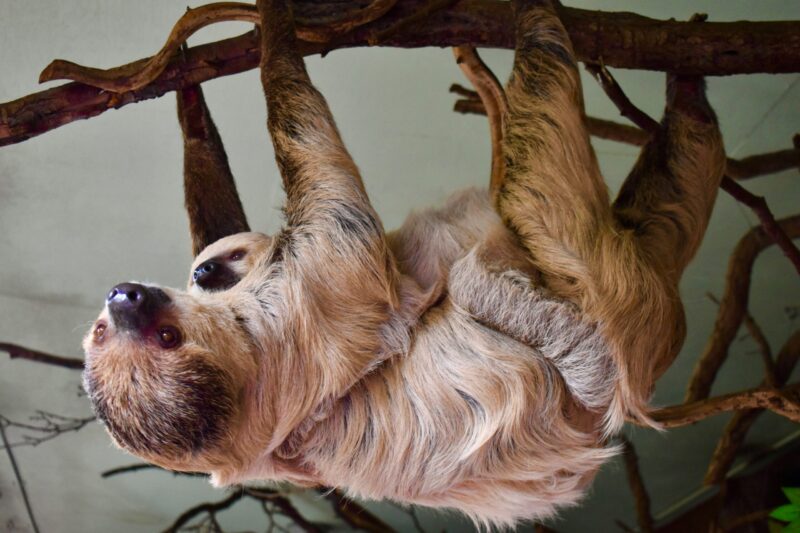
In all species of sloths, a single offspring is born. Females gestate the baby for 11 or 12 months and then carry it for about six or eight months. Although they can reproduce throughout the year, some females take more than a year to find a mate.
When it is time to give birth, the mother usually descends to the lower branches of a tree and gives birth while hanging upside down. In this position, if the baby falls to the ground, it won’t fall from a high height and the mother can go down to quickly retrieve the baby.
Bottom line: Are sloths really as slow as people say? Are they equally slow in all environments? Read slowly to find out more about these calm and smiling animals.
Like what you read?
Subscribe and receive daily news delivered to your inbox.
More from
Cristina Ortiz


Elephant calf reunion melts hearts in Kenya

Will Pluto become a planet again? The ongoing debate