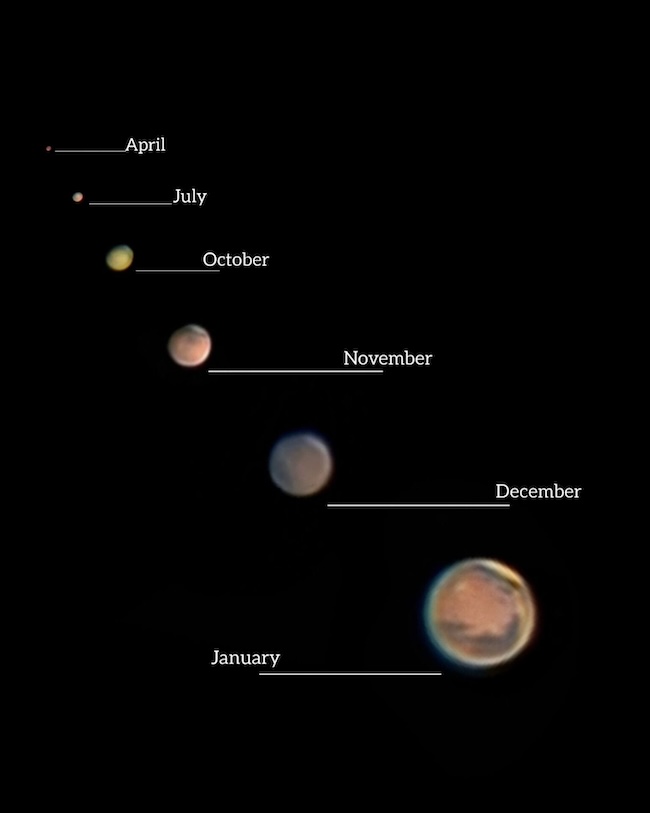
View at EarthSky Community Photos. | Vedant Pandey of India submitted this composite image of Mars racing toward its January 2025 opposition. Vedant wrote: “I used my 5-inch Maksutov telescope and smartphone camera to capture Mars over a period of 10 months.” Thank you, Vedant!
Mars can appear bright or faint in our sky depending on its distance from Earth. It’ll spend 2026 becoming bright again, as Earth catches up to it in orbit around the sun. Mars will be at its brightest again in February 2027.
Mars’ superior conjunction, when it’s most behind the sun from Earth, fell on January 9, 2026. Afterwards, Mars emerged into the morning sky around April or May for the Northern Hemisphere.
By the last few months of 2026 – with Earth hot on its heels in orbit around the sun – Mars will be rapidly brightening, moving over into the evening sky and racing toward its opposition on February 2027.
Mars in 2026
How to see Mars in the sky: Once Mars emerged into the morning sky (late February 2026 for Southern Hemisphere, April or May 2026 for the Northern Hemisphere), it was shining fairly brightly, but not brightly enough to be noticeable. Mars will hang – reddish, somber, not very bright – in the eastern predawn sky for many months of 2026. As the year progresses, Mars will start to brighten and move higher in the sky. Earth will again be catching up to Mars in the race of the planets. And, as a result, Mars will be shifting over into our evening sky. By the time Mars passes close to Jupiter – around November 15, 2026 – it’ll be a sight to behold near the giant planet! Next opposition for Mars will be February 19, 2027. Mars will be in front of Leo the Lion at its 2027 opposition. Next Mars-Earth closest distance will be February 20, 2027. Mars will be about 63 million miles (101 million km) from Earth on that date. Hence 2027 is what’s known as an aphelic opposition of Mars. That is, the planet will reach its aphelion, or farthest point from the sun, on March 2, 2027. So Mars will be about as far from Earth as it can be at this 2027 opposition. Note: Mars reaches opposition about every 26 months, or about every two Earth years.
Mars’ dramatic swings in brightness (and its red color) are why the early stargazers named Mars for their god of war.
Sometimes the war god rests. And sometimes he grows fierce! These changes are part of the reason Mars is so fascinating to watch in the night sky.
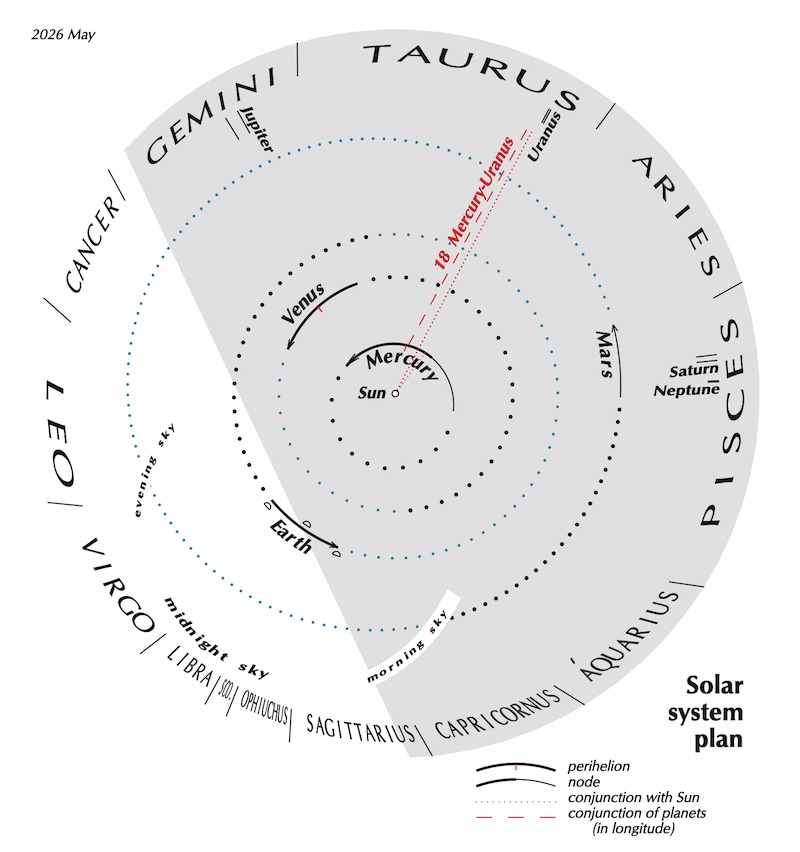
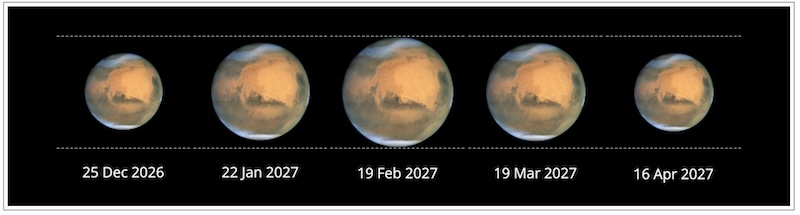
When Mars passes opposition, every 2 years, it appears large and bright for only a few weeks. The panel above shows the change in Mars’ apparent size from December 2026 to April 2027. Mars will appear 13.8 arcseconds wide on February 19, 2027. Image via Dominic Ford/ In-The-Sky.org. Used with permission.As Earth races toward Mars as it heads for its next opposition in February 2027, it grows in apparent size and increases in brightness. Chart via Guy Ottewell’s 2026 Astronomical Calendar. Used with permission.
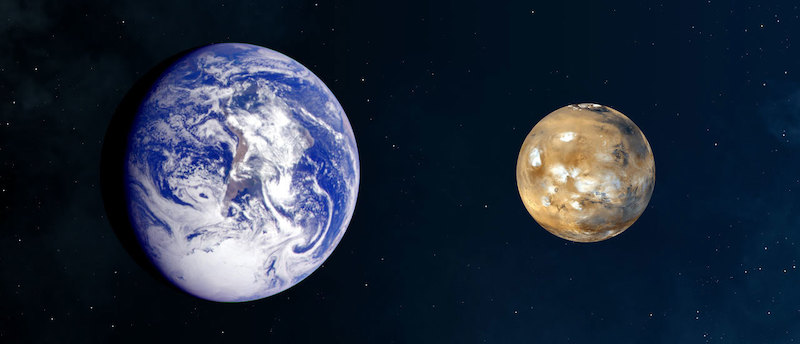
To understand why Mars varies so much in brightness in Earth’s sky, first realize that it isn’t a very big world. It’s only 4,219 miles (6,790 km) in diameter, making it only slightly more than half Earth’s size (7,922 miles or 12,750 km in diameter).
On the other hand, consider Mars in contrast to Jupiter, the biggest planet in our solar system. Jupiter is 86,881 miles (140,000 km) in diameter. As an illustration, more than 20 planets the size of Mars could be lined up side by side in front of Jupiter. Basically, Jupiter always looks bright, because it’s so big.
Not so for little Mars, however. Rather, its extremes in brightness have to do with its nearness (or lack of nearness) to Earth.
Mars isn’t very big, so its brightness – when it is bright – isn’t due to its bigness, as is true of Jupiter. Mars’ brightness, or lack of brightness, is all about how close we are to the red planet. It’s all about where Earth and Mars are, relative to each other, in their respective orbits around the sun. Image via NASA.
2026 Mars finder charts
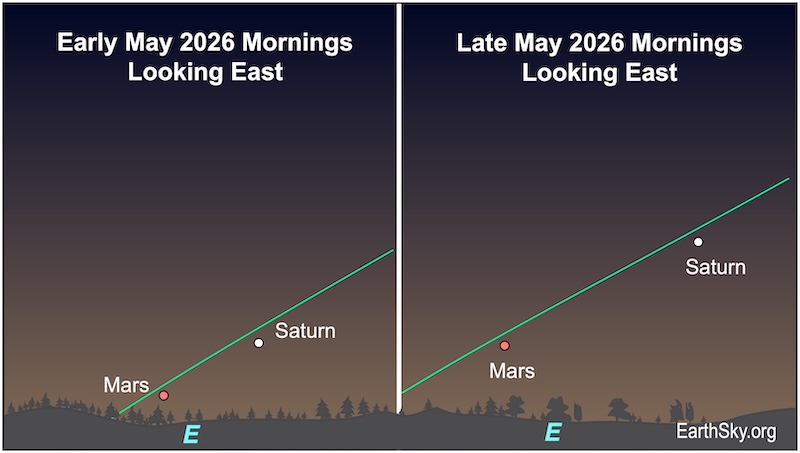
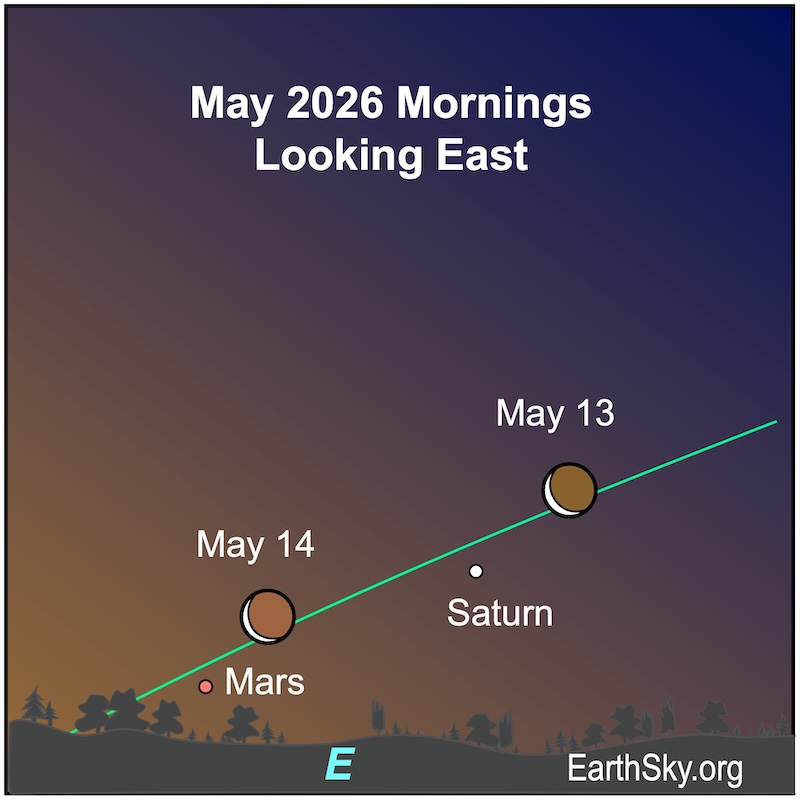
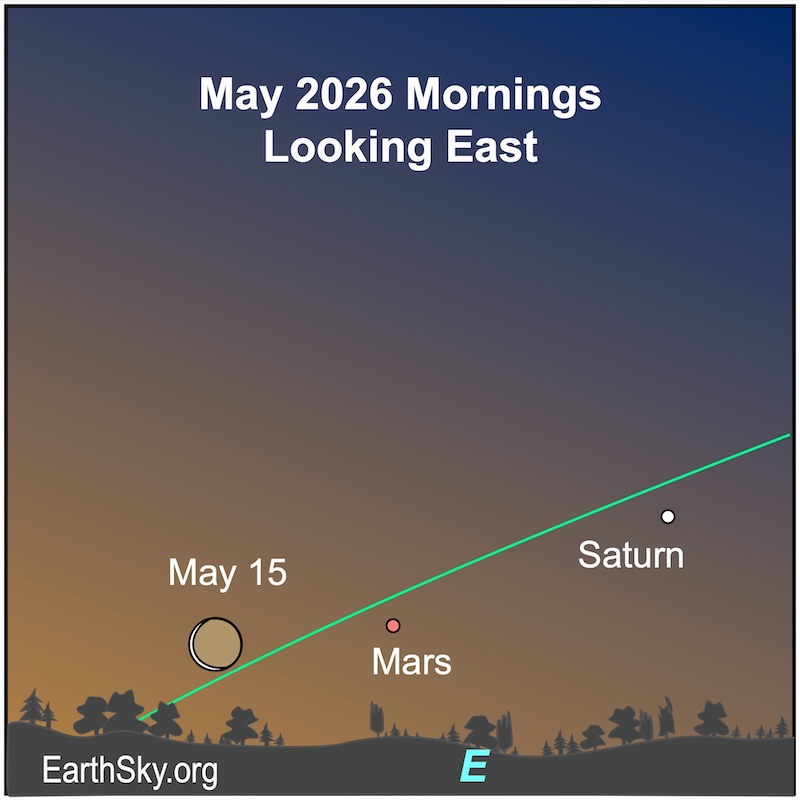
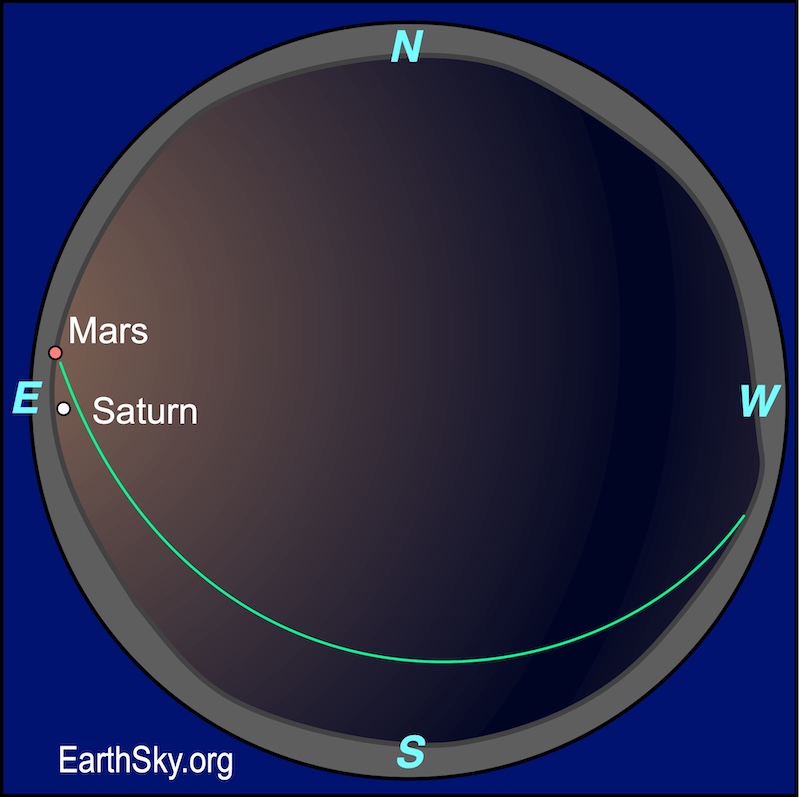
In the first half of May, Saturn will sit low in the bright eastern twilight shortly before sunrise. And, nearby and closer to the horizon, look for the dimmer planet Mars. In the second half of May, Saturn will pull away from Mars, and Mars will slowly climb higher behind it. Chart via EarthSky.On the mornings of May 13 and 14, a thin waning crescent moon will shine near Saturn and Mars. Look for them about 45 minutes before sunrise. Saturn will rise first in the eastern morning twilight. Below it in the bright twilight will be the fainter planet Mars. Chart via EarthSky.On the morning of May 15, about 30 minutes before sunrise, the very thin waning crescent moon will lie above the horizon and near Saturn and Mars. Chart via EarthSky.The all-sky chart shows Mars and Saturn are low in the east shortly before sunrise in mid-May. As the month proceeds, Saturn will rise more quickly than the slowly ascending Mars. This will create a greater distance between them in the morning sky. Note that these planets lie along the path the sun travels in the daytime (the green line on our chart). Chart via EarthSky.
Future Martian oppositions
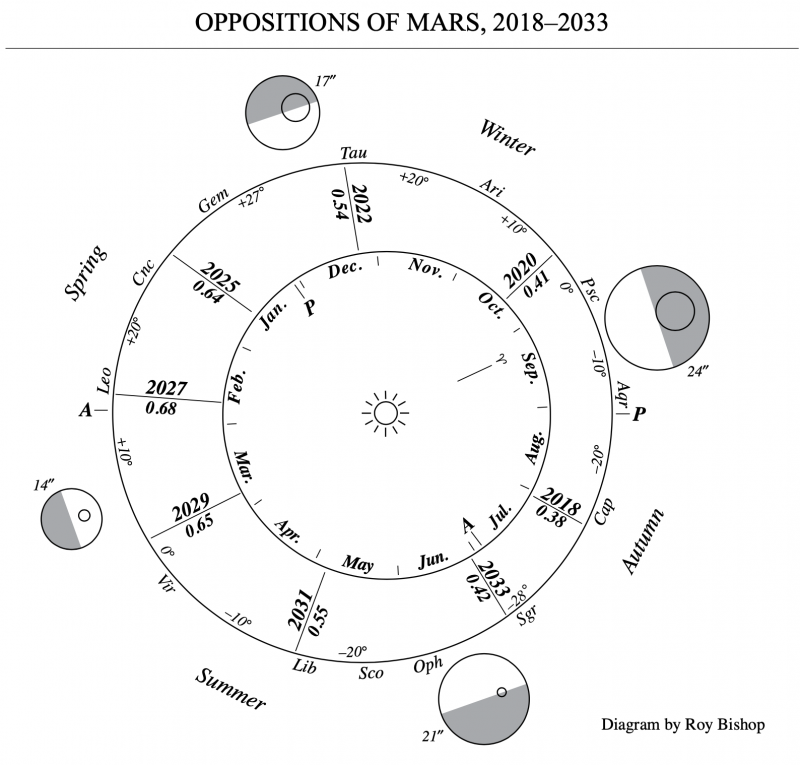
As mentioned above, the next opposition of Mars – when will appear at its brightest in Earth’s sky for that two-year period – will be February 2027. At the 2027 opposition, Mars will not be as big and bright as it was in 2025. Check out the chart at C. Seligman’s Mars oppositions page that lists all oppositions of Mars from 1995 to 2037.
There’s a 15-year cycle of Mars, whereby the red planet is brighter and fainter at opposition. In July 2018, we were at the peak of the 2-year cycle – and the peak of the 15-year cycle – and Mars was very, very bright! In 2020, we were also at the peak of the 2-year cycle; however, Earth and Mars were farther apart at Mars’ opposition than they were in 2018. Still, 2020’s opposition of Mars was excellent. And, in December 2022, Mars had a good opposition but appeared smaller and dimmer than in 2020, since we were farther away from it. And the February 2027 opposition will find Mars smaller and dimmer than Mars was in 2025. Diagram by Roy L. Bishop. Copyright Royal Astronomical Society of Canada. Used with permission. Visit the RASC eStore to purchase the Observer’s Handbook, a necessary tool for all skywatchers.
EarthSky Community Photos
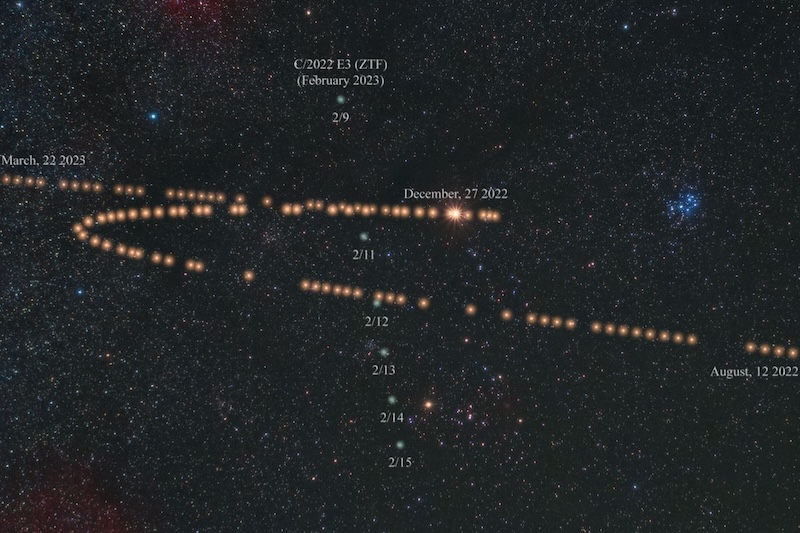
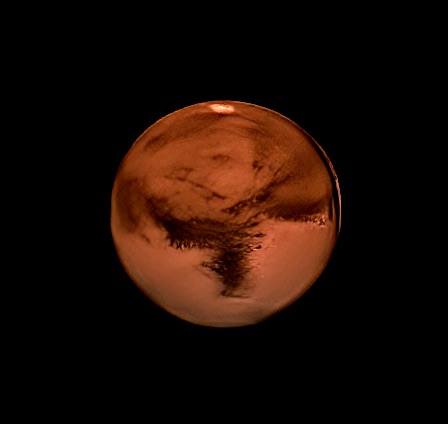
View at EarthSky Community Photos. | Paolo Bardelli of Italy made this composite image and wrote: “On January 16, 2025, Mars was at opposition. The previous one occurred on December 8, 2022, when it became the brightest object in the night sky. During these periods, tracing the apparent motion of the red planet from evening to evening is very interesting, as a real ‘noose’ is created, with a double reversal of its movement. This put ancient sky observers in crisis at the time when the geocentric theory was dominant. Putting things in their place, it turned out to be a simple perspective effect, due to the mutual motion of Earth and Mars. This image is the sum of a sequence taken every useful evening, clouds permitting, from August 12, 2022, to March 22, 2023. The background is the sum of 22 shots of the area of the sky where Mars was located, the rich star field of the constellation Taurus. By coincidence, in February 2023 the path of comet C/2022 E3 (ZTF) crossed the noose.” Thank you, Paolo!View at EarthSky Community Photos. | B Martin in Riverside, California, captured this image of red Mars on December 15, 2024, just 1 month before Earth went between the red planet and the sun, bringing Mars closest for this 2-year period. B wrote: “Mars was around maybe 45 degrees up. I saw it in live view, I knew it was a banger … Bonus, you can see the shadow of the cloud of the ribbon white long cloud stream on the lower left. The shadow is in the direction hugging the right of the cloud. The shadow is dark brown in color as it casts on the Martian sand.” Thank you for sharing, B!
Seeing red
Mars appears as a reddish light in the sky and, therefore, is often called the red planet. Other obvious red dots in the sky are reddish-orange Aldebaran and the famous red supergiant Betelgeuse. So, it is fun to contrast Mars’ color and intensity of red with that of Aldebaran or Betelgeuse.
And then there is red Antares. Antares is Greek for rival of Ares (Ares being the Greek name for Mars). Antares is sometimes said to be the anti-Mars due to its competing red color. For a few months every couple of years Mars is much brighter than Antares. Also, every couple of years Mars passes near Antares, as if taunting the star. Mars moves rapidly through the heavens and Antares is fixed to the starry firmament.
What makes them red?
Surface temperature is what determines the colors of the stars. The hottest stars are blue and the coolest stars are red. In fact, from hottest to coolest, the colors of stars range from blue, white, yellow, orange and red. And while the colors of stars might be hard to detect, some stars – like Aldebaran, Antares and Betelgeuse – are noticeably colorful.
On the other hand, Mars appears red for a different reason. It’s red because of iron oxide in the dust that covers this desert world. Iron oxide gives rust and blood their red color. Rovers on Mars sampled the Martian dust and determined it contains three colors: reds, browns and oranges. So those three colors are what you may see when you gaze upon Mars.
Do you see red when you look at Mars, Aldebaran, Antares and Betelgeuse? Are they the same color? Do you see any other colors of stars?
Bottom line: In 2026, Mars emerged in the morning sky around April and will be visible in the morning sky the rest of the year. Its next opposition – when it will be at its brightest – is in February 2027.
Deborah Byrd (asteroid 3505 Byrd) helps edit EarthSky.org and is a frequent host of EarthSky videos. Deborah created the EarthSky radio series in 1991 and founded EarthSky.org in 1994. Prior to that, she had worked for the University of Texas McDonald Observatory since 1976, and created and produced their Star Date radio series. She has won a galaxy of awards from the broadcasting and science communities, including having an asteroid named in her honor in 1990, a Public Service Award from the National Science Board in 2003, and the Education Prize from the American Astronomical Society in 2020. A science communicator and educator since 1976, Byrd believes in science as a force for good in the world and a vital tool for the 21st century. "Being an EarthSky editor is like hosting a big global party for cool nature-lovers," she says.
Like what you read? Subscribe and receive daily news delivered to your inbox.
Thank you! Your submission has been received!
Oops! Something went wrong while submitting the form.