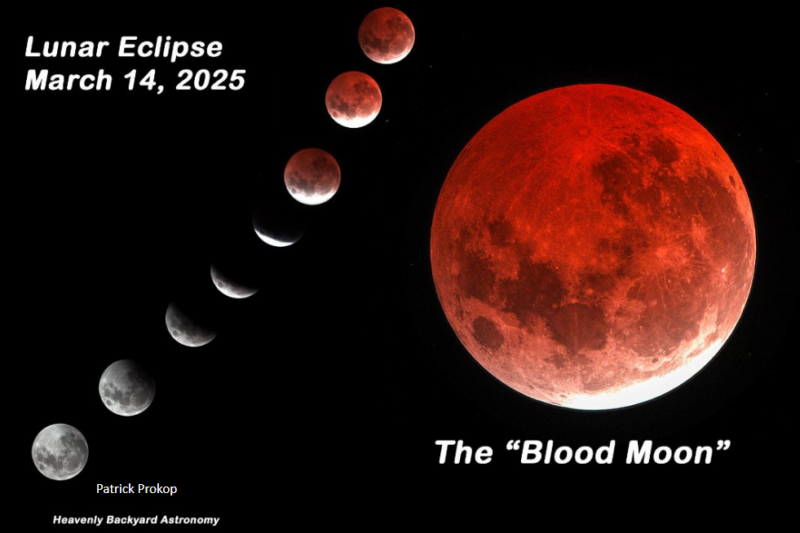
Read more: Total lunar eclipse of March 2-3
During a lunar eclipse, you’ll see the Earth’s shadow creeping across the moon’s face. The shadow appears dark, shaped like a bite out of a cookie, until the shadow completely covers the moon. Then, during the breathtaking time of totality, the shadow on the moon’s face appears red, rusty orange or copper-colored. Why?
Why a lunar eclipse looks red
The reason stems from the air we breathe. During a total lunar eclipse, the Earth lies directly between the sun and the moon. Earth casts its shadow on the moon as a result. If Earth didn’t have an atmosphere, then, when the moon is entirely within Earth’s shadow, the moon would appear black, perhaps even invisible.
However, something much more subtle and beautiful actually happens, thanks to Earth’s atmosphere.
Earth’s atmosphere extends about 50 miles (80 km) above Earth’s surface. During a total lunar eclipse, with the moon submerged in Earth’s shadow, there’s a circular ring around Earth, the ring of our atmosphere. The sun’s rays pass through this ring.
Sunlight contains a range of frequencies
White sunlight consists of a range of different colors, or frequencies. As sunlight passes through our atmosphere, the green to violet portion of the light (electromagnetic) spectrum is, essentially, filtered out. This same effect, by the way, is why our sky is blue during the day. Meanwhile, the reddish portion of the spectrum is least affected.
What’s more, when this reddish light first enters our atmosphere, it’s bent (refracted) toward the Earth’s surface. And it’s bent again when it exits on the other side of Earth. This double bending sends the reddish light onto the moon during a total lunar eclipse. It also explains why sunrises and sunsets look red.
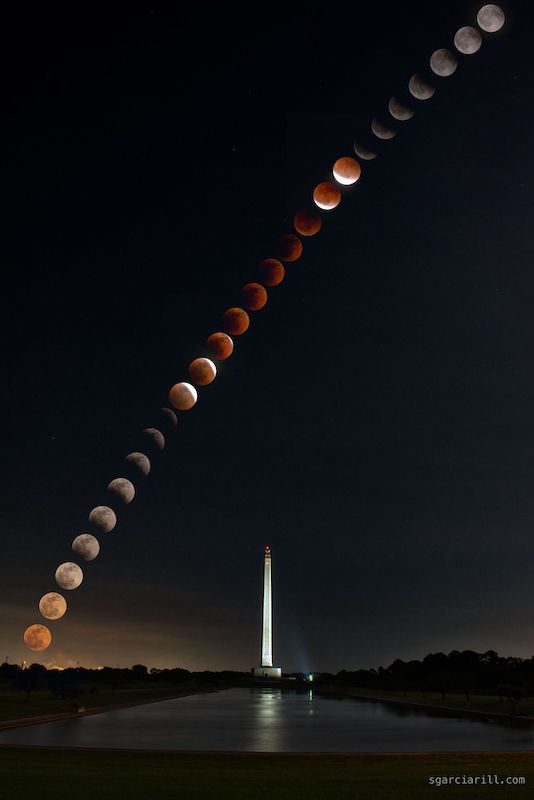
The brightness and color of a lunar eclipse
Depending on the conditions of our atmosphere at the time of the eclipse (dust, humidity, smoke, temperature and so on can all make a difference), the surviving light illuminates the moon with a color that ranges from copper-colored to deep red.
A moon in total eclipse never appears as bright as a full moon, but how dark it gets varies. The totally eclipsed moon was barely visible in December 1992, not long after the eruption of Mount Pinatubo in the Philippines, due to so much dust in Earth’s atmosphere.
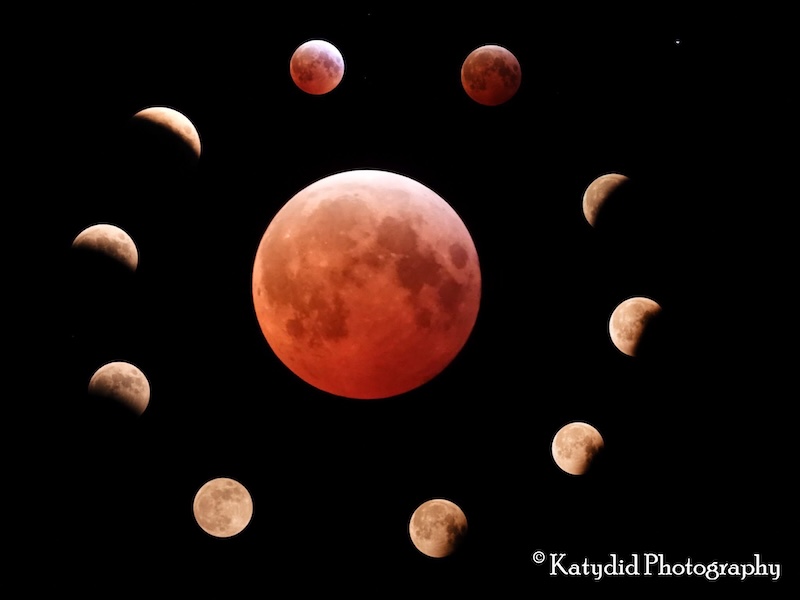

All total lunar eclipses do not look alike
Can anyone know in advance how red or dark the moon will appear during a total lunar eclipse? Not really. Before an eclipse takes place, you’ll hear people speculate about it. That uncertainty is part of the fun of eclipses, so enjoy! And watch for the red moon during a lunar eclipse.

What about that blue band?
Another color to watch for at the beginning and end of totality is a blue band of light along the limb (edge) of the moon. This blue band is light passing through our ozone layer – which absorbs red light – that allows blue light to come through. The blue band is frequently caught in photos but may be hard to see visually.

Bottom line: Coming up … the total lunar eclipse of March 2-3, 2026. At maximum eclipse, the moon will look red. But why? Earth’s atmosphere is the key.
March 13-14, 2025, total lunar eclipse: Astonishing images via EarthSky’s community
Like what you read?
Subscribe and receive daily news delivered to your inbox.
More from
Deborah Byrd


Total solar eclipse August 12, 2026: Best images

How to watch a solar eclipse safely: tips here
Mars Curiosity rover’s 7 minutes of terror 14 years ago
Earthquake in Japan triggers mall collapse in Kumamoto