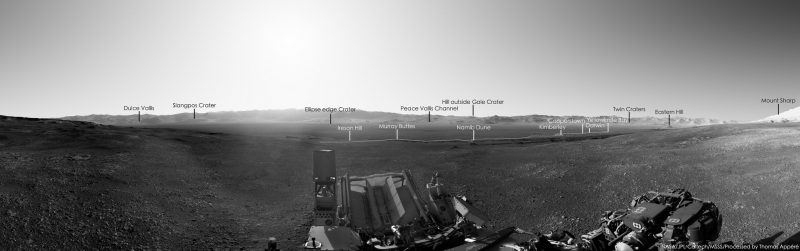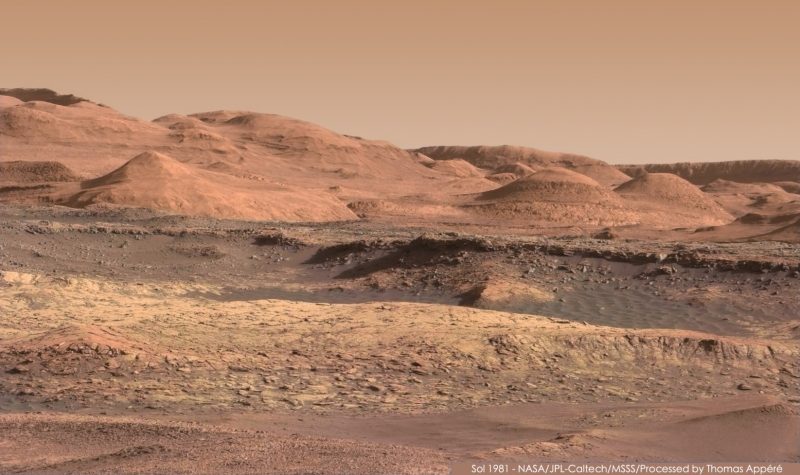
View larger. | The scenic foothills of Mount Sharp on Mars, as captured by NASA’s Curiosity rover on sol 1981, the rover’s 1,981th day on Mars. Image via NASA/JPL-Caltech/ MSSS/ Planetaria. You’ll find a fantastic collection of Mars images from Thomas Appéré on Flickr.
The Curiosity rover has sent back some beautiful new images of the foothills of Mount Sharp in Gale Crater on Mars. The image above is a panorama of the breathtaking view, thanks to processing by Thomas Appéré, who is an Associate Scientist at IPAG (l’Institut de Planétologie et d’ Astrophysique de Grenoble) in Grenoble, France. The rover is still making its way closer to these foothills at the base of the much taller mountain. The mesas and canyons are very reminiscent of the scenery in the American Southwest.
Curiosity has confirmed that Gale Crater used to contain a lake or series of lakes a few billion years ago, and fast-moving streams once emptied into the lake through the crater rim. Whether any life existed is still unknown, but this region was once a lot more habitable than it is today.
Larger high-resolution versions of the panorama with incredible detail, and many more images, are available on Flickr here.
Zooming in on an outcrop of Phyllosilicate Valley with Remote Micro Imager – sols 1957 and 1961. This outcrop may be a future destination of the Curiosity rover. View larger and read more via Thomas Appéré on Flickr.Outcrops and sand ripples, acquired by Curiosity on sol 1959. View larger and read more via Thomas Appéré on Flickr.The foothills of Mount Sharp, acquired by the Curiosity rover on Mars on sol 1959. View larger and read more via Thomas Appéré on Flickr.A clear view of the rim of Gale Crater on Curiosity’s sol 1950, its 1,950th day on Mars. The atmospheric opacity was low, with little dust in the air. “Thus we have a crystal-clear view of the distant rim of Gale Crater with mountains 4 km (2.5 miles) high,” Thomas Appéré said. View larger and read more.
Bottom line: Beautiful new images of the foothills of Mount Sharp in Gale crater on Mars, from the Curiosity rover.
Paul Scott Anderson has had a passion for space exploration that began when he was a child when he watched Carl Sagan’s Cosmos. He studied English, writing, art and computer/publication design in high school and college. He later started his blog The Meridiani Journal in 2005, which was later renamed Planetaria. He also later started the blog Fermi Paradoxica, about the search for life elsewhere in the universe.
While interested in all aspects of space exploration, his primary passion is planetary science and SETI. In 2011, he started writing about space on a freelance basis with Universe Today. He has also written for SpaceFlight Insider and AmericaSpace and has also been published in The Mars Quarterly. He also did some supplementary writing for the iOS app Exoplanet.
He has been writing for EarthSky since 2018, and also assists with proofing and social media.
Like what you read? Subscribe and receive daily news delivered to your inbox.
Thank you! Your submission has been received!
Oops! Something went wrong while submitting the form.