EarthSky // Blogs // Space By Deborah Byrd Jan 21, 2012

Storm from sun to strike Earth on January 21, 2012. Aurora alert.

If your cell phone is acting up today, blame the sun. A solar flare on January 19, 2012 produced a solar storm that should strike Earth on January 21.

Looking for this? Strongest solar radiation storm in 7 years expected January 24

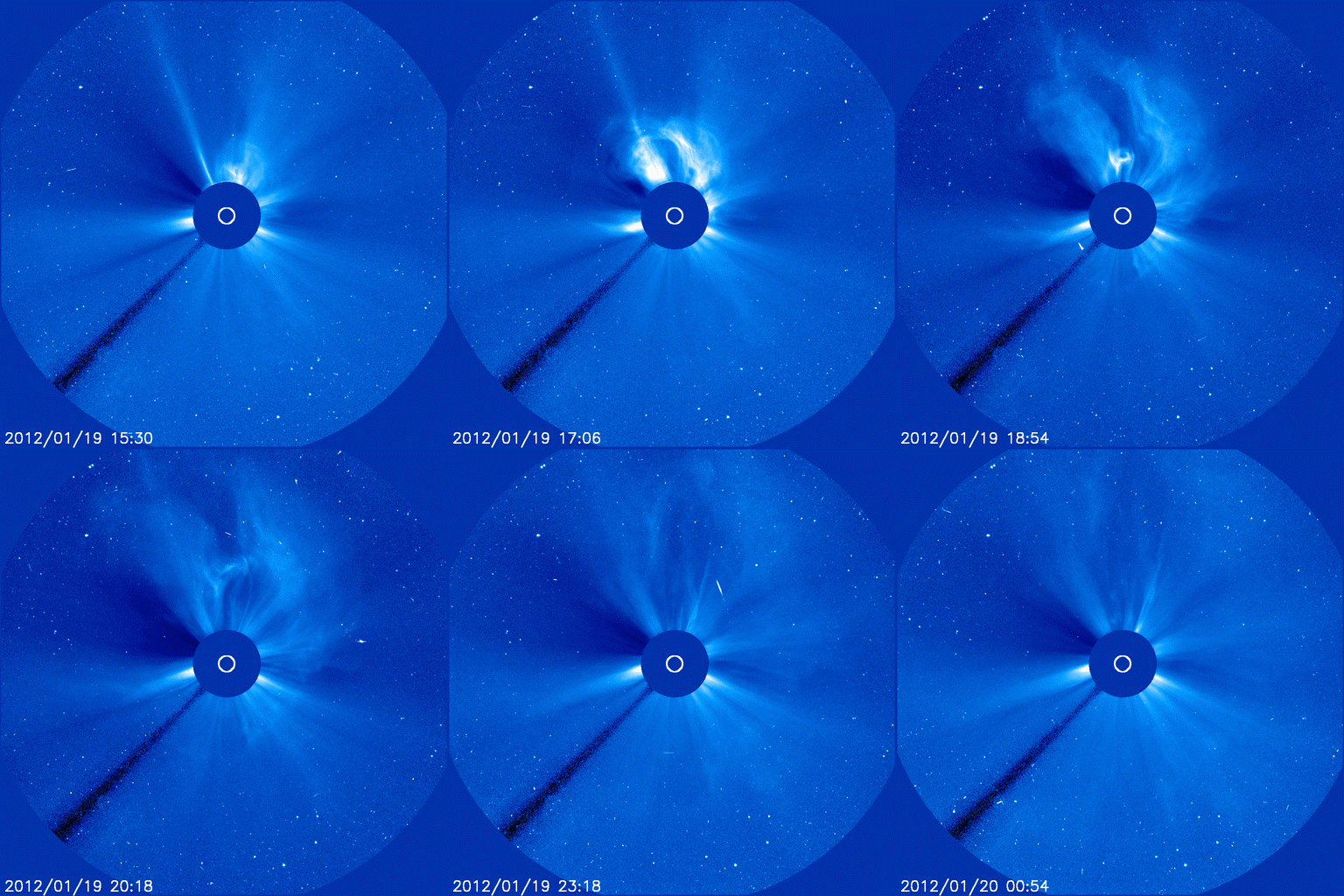
Active sunspot 1401 erupted two days ago, producing an M3-class solar flare and a coronal mass ejection (CME). The CME’s expanding cloud is heading almost directly toward Earth and is due to strike today (January 21, 2012) 22:30 UTC (16:30 CST) +/- 7 hrs. That makes tonight a grand time to look for beautiful aurorae or northern lights. Since Earth and Mars are nearly in alignment now – both on one side of the sun – the expanding cloud is also headed toward Mars, due to strike on January 24.

The eruption took place at January 19, 2012, at around 16:30 UTC (12:30 CST). The image above shows the full-halo CME, or expanding cloud from the sun.

Solar flares are giant explosions on the sun that send energy, light and high speed particles into space. These flares are often associated with solar magnetic storms (coronal mass ejections, or CMEs). When these storms from the sun strike Earth, they can produce geomagnetic storms that affect earthly telecommunications and also satellites in orbit. If your cell phone is acting up today, blame the sun.

This beautiful video, from the Atmospheric Imaging Assembly (AIA) aboard NASA Solar Dynamics Observatory, shows sunspot 1401 and 1402 three days before the solar flare that produced the CME now headed to Earth. The instrument is essentially a series of cameras set up to take images of the sun every few seconds and through a variety of filters. This video is a 11-hour series of data. The video shows activity in AR11401 and AR11402 on January 16, 2012 from 03 to 14 UTC. There are almost 1,100 images used to make the frames for the video, so you’re seeing real time sped up by almost 1,000 times.

And what about the fact that the CME is also headed to Mars? Earth and Mars are on the same side of the sun now, with Earth due to pass between Mars and the sun on March 3, 2012 for the first time in about two years. So solar events that affect Earth now have a chance of striking Mars, too.

Mars at opposition March 3, 2012

Mars Science Laboratory launch

As it happens, we earthlings have a spacecraft on the way to Mars, launched in November 2011. The Mars Science Laboratory – which is carrying a new and advanced Mars rover, called Curiosity, to Mars – is also equipped to study solar storms of this kind. It might be able to detect a change in the energetic particle environment when the CME passes by. Isn’t that cool?

Mars rover Curiosity successfully adjusted trajectory

Bottom line: Sunspot 1401 erupted on January 19, 2012, producing a coronal mass ejection that is due to strike Earth today (January 21, 2012) and Mars on January 24. Disruptions in telecommunications are possible. Watch for the aurora is you are at a high latitude. The Mars Science Laboratory, now en route to Mars, might be able to detect signs of the CME as it passes by.

First-ever movie of comet’s death plunge into sun

Share your comments on Facebook

17 Responses to Storm from sun to strike Earth on January 21, 2012. Aurora alert.

  1. [...] the few highlights of living in the far North, northern lights may be the most delicate. Thursday’s  eruption of active sun spot 1401 has resulted in a huge coronal mass ejection which shall arrive in a couple [...]

  2. [...] the few highlights of living in the far North, northern lights may be the most delicate. Thursday’s  eruption of active sun spot 1401 (click on the picture to see it in detail) has resulted in a huge coronal [...]

  3. DAWN says:

    My son and his friends were in tears because they heard that the world was going to end today. I can now tell him that it was a massive solar eruption and it will make for a great Northern Light show and now to worry too much about it.

    • Deborah Byrd says:

      Gosh, Dawn, that’s awful. No, the world is not going to end today. The sun is in an active part of its 11-year cycle. It’s been sending these CME’s our way frequently over the past year … and over the past billions of years … with no ill effects.

      • HJP says:

        Hopefully they will settle down and listen to mom on this and enjoy the northern lights. My friend is an adult, she went shopping at multiple stores today to stock up on food and stuff because she thinks the world is going to end tonight. No matter what her friends have told her, she thinks we are doomed.

  4. SIR,
    TODAY I GLANCED AT SUN.VERY BEAUTIFUL.BUT I FEARED ABOUT THE SOLAR STORM.
    WILL IT BE HARMFUL TO OUR SOLAR SYSTEM?

  5. SIR,
    I WANT TO KNOW ABOUT THE RETROGRADE MOTION OF THE PLANETS?

  6. randy s cook says:

    It rained last time this occurred

  7. [...] Storm from sun to strike Earth on January 21, 2012. Aurora alert. – Cool. [...]

  8. [...] I write this, there is a coronal mass ejections (CME) – or expanding cloud of solar materials – headed toward the Earth, from a storm on the sun’s surface on January 19, 2012. It might affect satellites in orbit, and [...]

  9. joseph says:

    how will this happen but will the world explode?

  10. john ballestero says:

    nothing to worry guys when you have jesus christ in your life as your savior, he is only the way….and he is only one who knows when the world is come an end.

  11. james says:

    sounds intrestin but little fear at d same time coz if this earth ends, we hv not much time to spend wit our loved ones.

  12. edwin collazo says:

    my wife’s church is getting ready for a solar storm some time in 2013.
    they are purchasing mylar roles to protect each persons homes, car,food,computers etc.
    they are sving water,food,and all sort of stuff for this event.
    they claim everything will be effected and scarce.
    is this something to worry about so intensively?

  13. THE OPPOSITION OF MARS IS BEAUTIFUL.I THINK IT IS FROM ONE MONTH BACK.
    WHEN IT OCCURS IN FUTURE?

Share your comments on EarthSky

Your email address will not be published. Required fields are marked *

*

You may use these HTML tags and attributes: <a href="" title=""> <abbr title=""> <acronym title=""> <b> <blockquote cite=""> <cite> <code> <del datetime=""> <em> <i> <q cite=""> <strike> <strong>