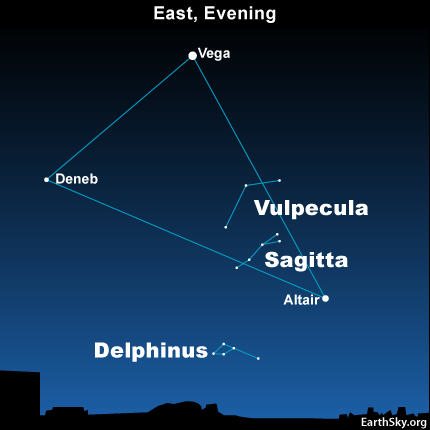
Tonight, look eastward during the evening hours, and it’s hard to miss the season’s signature star formation, the asterism called the Summer Triangle. Its stars – Vega, Deneb and Altair – are the first three to light up the eastern half of the sky after sunset, and their bright and sparkling radiance is even visible from light-polluted cities or on a moonlit night.
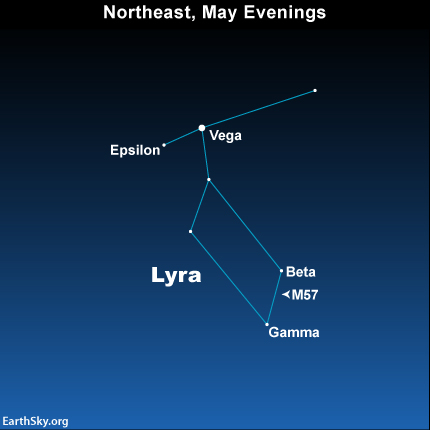
Try looking first for the most prominent star in the eastern sky, which is Vega in the constellation Lyra the Harp. Vega is blue-white in color. It’s sometimes called the Harp Star. It’s about 25 light-years away. Many people recognize its constellation, Lyra, as a triangle of stars connected to a parallelogram.
It’s hard to gauge the humongous size of the Summer Triangle by looking at our little chart. A 12-inch (1/3 meter) ruler, when placed at an arm’s length from your eye, spans the approximate distance from Vega to the star Altair. And an outstretched hand more or less fills the gap between Vega and Deneb.
More than any other month, July is the month of the Summer Triangle. At mid-northern latitudes, the Summer Triangle’s stars – as if a trio of school kids on vacation – stay out from dusk till dawn, dancing amid the stars of our Milky Way galaxy. As our Earth turns tonight, Vega, Deneb and Altair travel westward across the sky. The Summer Triangle shines high overhead in the middle of the night, and sparkles in the west as the rose-colored dawn begins to color the sky.
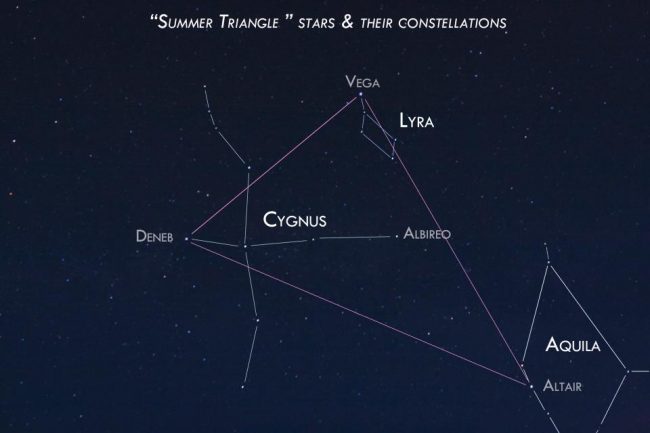
Our Summer Triangle series also includes:
Part 2: Deneb and its constellation Cygnus
Part 3: Altair and its constellation Aquila
Bottom line: The Summer Triangle consists of 3 bright stars in 3 different constellations. The brightest is Vega in the constellation Lyra.
EarthSky astronomy kits are perfect for beginners. Order yours today.
Like what you read?
Subscribe and receive daily news delivered to your inbox.
More from
Deborah Byrd


Visible planets and night sky guide for October

Cassiopeia and Perseus on October evenings
Orionid meteor shower 2026: All you need to know
See brightest star, Sirius, in your morning sky