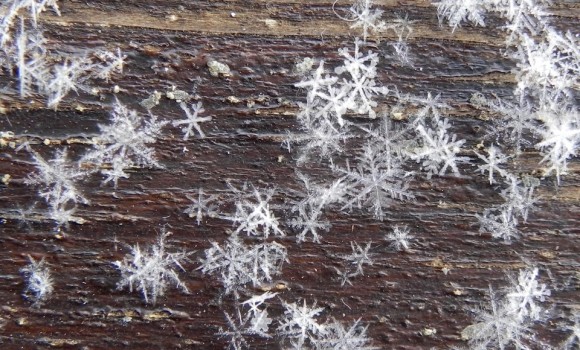
Here are some great pics of snowflakes: Best snowflake photos from EarthSky friends
EarthSky friends are the best photographers! Submit your photos to EarthSky.
Snow crystals have a brief existence, from the time they form in clouds to when they softly land on the ground or melt on your face. But its fleeting beauty can be permanently captured in a photograph, if you have the the right lens on your camera.
Most of the time, snowflakes fall to earth as loose clumps of small irregular ice crystals. But when temperatures are cold enough, individual symmetrical snow crystals can reach the ground intact to reveal a stunningly beautiful diversity of six-sided symmetrical forms.
Snowflakes start out as supercooled (below the freezing point) liquid water droplets in clouds. At around -10 degrees Celsius (or 14 degrees Fahrenheit), the droplets gradually begin to freeze. This triggers a complex chain of events; when a droplet freezes to become an ice crystal, some of its neighboring supercooled liquid droplets evaporate to release water vapor into the surrounding air. Those water molecules freeze onto the ice crystal, more water molecules freeze over it, and a snowflake begins to grow.
How does snow form inside clouds?
The amazing variety of snow crystal shapes are determined by temperatures in the clouds. All snow crystals have one thing in common: a six-sided symmetry. That’s because water molecules in ice crystals form hexagonal lattices. Therefore, the six-sided symmetry of the progenitor ice crystal guides the growth of the snow crystal outwards into a symmetrical six-sided snow crystal. On rare occasions, you may encounter a 12-sided snowflake. These are ‘twin’ six-sided snow crystals!
The photographs in this post were taken using a 35 mm SLR (single-lens reflex) camera, specifically a Nikon D90 digital camera. Attached to it was a 90 mm micro lens manufactured by Tokina. Micro lenses are designed to focus on objects at a very close distance. (These types of lenses are also marketed as ‘macro’ lenses.)
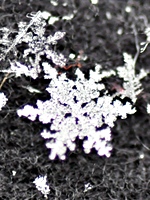
These snowflakes were part of the second blizzard that hit the mid-Atlantic states, on February 10th, 2010. Since cameras should not be exposed to the cold for too long, I decided not to work outdoors, but instead, by an open window in the relative comfort of my living room.
A black fleece scarf seemed like a good backdrop for the snow crystals, with the added benefit that its fibers trapped snow crystals in place, keeping them from being blown away by the wind. For stability, I placed several rocks on the fleece scarf to keep it from flapping in the wind or being blown away.
To create a cold working surface, the scarf was chilled by placing it in a plastic bag and hung out the window for about 30 minutes or so. The cold scarf did not prevent the snowflake from melting, but slowed it down long enough to be photographed.
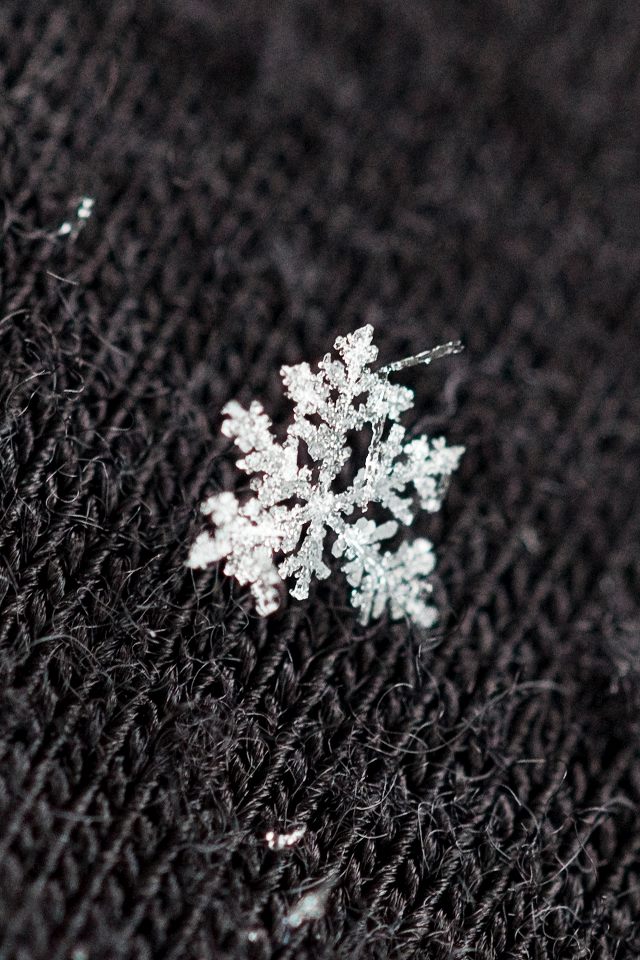
At my location in Baltimore, Maryland, most of the snow, during the day, fell as clumps of irregular ice crystals. But there was a brief window of time that afternoon when the snowflakes appeared smaller. And sure enough, for about 45 minutes, I was treated to a delightful show of stunning snow crystal designs; many had broken ‘limbs’ from the strong winds, but every so often, one arrived intact.
My Nikon D90, like most other SLR cameras, comes with several pre-programmed exposure settings. I used the camera’s ‘macro’ setting, and since it was an overcast day, the camera’s built-in flash helped illuminate the snow crystals. Since I had to work fast, most of the best photos were obtained using the auto-focus setting. The best images were cropped, digitally enlarged, with minor image enhancements — color balance adjustments and minimal digital filter sharpening — applied using image processing software. (I used iPhoto on my Mac and a free software package called ‘Gimp.’)
My photographs were taken using readily-available equipment that most amateur photographers already have in their camera bags. While that setup is adequate for capturing the overall shapes of snow crystals, there isn’t enough resolution to capture finer microscopic details.
 Physicist and snow crystal enthusiast Kenneth Libbrecht has devised an ingenious way to produce stunning photographs of the very fine micro-details in snow crystals using an insulated camera (because he works outdoors) attached to a microscope. At Libbrecht’s website, he provides a description of his custom-created microscope camera for others who wish to pursue this more high-end version of snowflake photomicrography. Many exquisitely-beautiful snowflake photos from around the world, taken by Libbrecht, are featured at his website.
Snowflake photomicrography was first pioneered by Vermont farmer Wilson Bentley (1865-1931), who first captured breathtaking snow crystal images using a camera and microscope; his work can be viewed at here.
Try it yourself! With a little preparation and a good camera and with a macro lens, you can take your own photos of snowflakes.
EarthSky’s friends are the best photographers! Share your photos with EarthSky on Facebook, or email them to images@earthsky.org.
Like what you read?
Subscribe and receive daily news delivered to your inbox.
More from
Shireen Gonzaga


Black hole Cygnus X-1 has fast, powerful dancing jets

Ancestors of mammals laid eggs, says new fossil evidence
Native Americans played dice more than 12,000 years ago