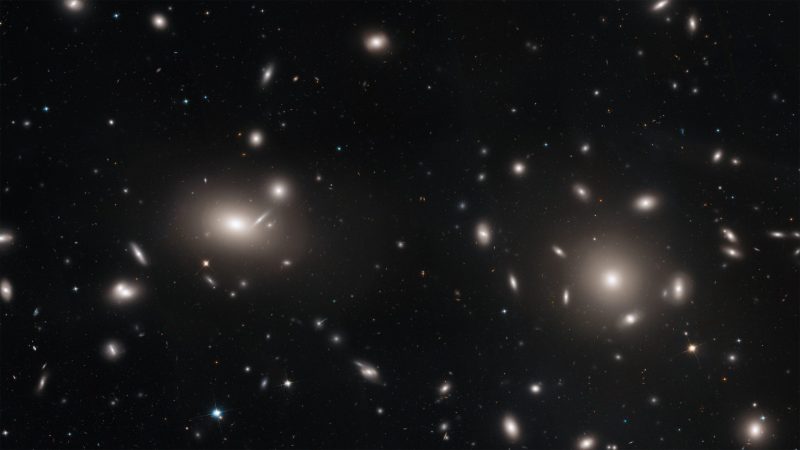
The Coma Berenices galaxy cluster
Galaxies with their billions of stars are the building blocks of our universe. But galaxies aren’t spread homogeneously throughout space. Instead, they collect in clusters. From Earth, one of the most massive and famous of the galaxy clusters is the Coma Berenices galaxy cluster. It’s located in the direction to the constellation Coma Berenices. And it’s best viewed in the evening in April and May.
It’s hard to get an exact count of the number of galaxies in this cluster. Counts vary based on how small or faint the galaxies are, and how big the telescopes are that are doing the counting. Scientists estimate the cluster contains over 1,000 confirmed member galaxies, with many additional faint dwarf galaxies bringing the total into the thousands.
Indeed, there are more individual galaxies in this cluster than there are stars visible to the unaided human eye on a clear, dark night.
The center of the Coma Berenices galaxy cluster lies about 320 million light-years away. And the cluster itself spans about 20 million light-years of space. That’s in contrast to our home galaxy, the Milky Way, which is about 100,000 light-years wide. And it’s in contrast to our own Local Group of galaxies, which is about 10 million light-years wide and contains about 50 galaxies.
An old – but beautiful – name for this region of sky is the Realm of the Galaxies. Writing an article by that name for Frosty Drew Observatory in the year 2000, the late Leslie Coleman, a previous director of Frosty Drew, explained:
Even in the eyepiece of the 16″ [40 cm], many of the galaxies in this area overlap each other! There simply isn’t room enough in this region of the sky to fit them.
It occupies a small area of sky
The large Coma Berenices galaxy cluster is one of the most distant galaxy clusters visible through telescopes, so it occupies a relatively small area of the sky. Its central region covers a roughly circular area about 1 1/2 degrees across, but the full cluster may extend farther across the sky.
Numerous other galaxy clusters, both nearer and more distant, are also found in this same region of the sky. This part of the sky is also the location of the famous open star cluster known as the Coma Berenices star cluster. To observe either the star cluster or the galaxy cluster, dark skies are required.
It contains thousands of galaxies
So the constellation Coma Berenices appears to the eye as a cluster of stars. But a telescope reveals a vast region of distant galaxies in this part of the sky. The chart below gives you an idea of the number of galaxies in that region of the sky.
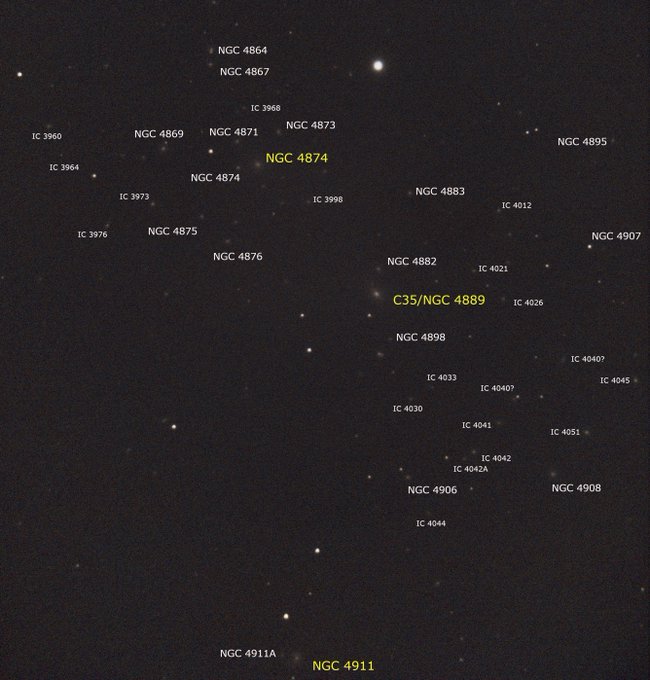
How to find the Coma Berenices galaxy cluster
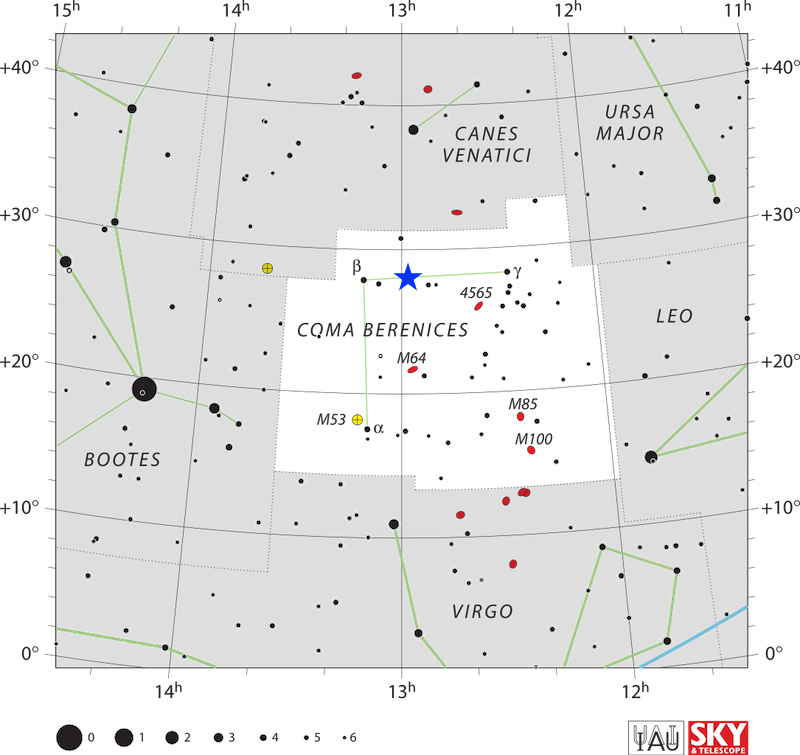
The constellation Coma Berenices lies between the constellations Leo the Lion and Boötes the Herdsman.
The galaxy cluster is near the northern border of the constellation Coma Berenices.
A myriad of galaxies
So the center of the Coma Berenices galaxy cluster is about 320 million light-years away. And it’s not getting any closer! In fact, the entire cluster is flying away from us at the rate of about more than 15 million mph (24 million kph)!
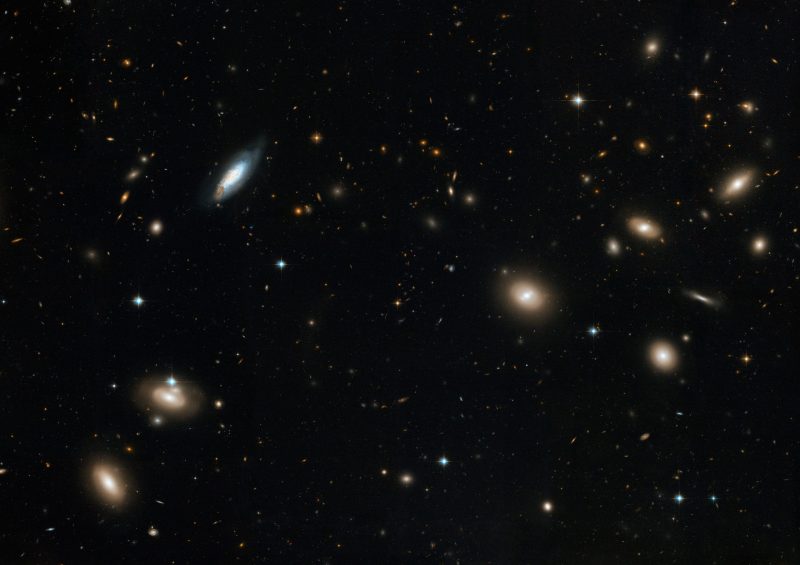
The Coma Berenices galaxy cluster is filled with galaxies in all shapes and sizes, from giant ellipticals to spirals to irregular dwarf galaxies.
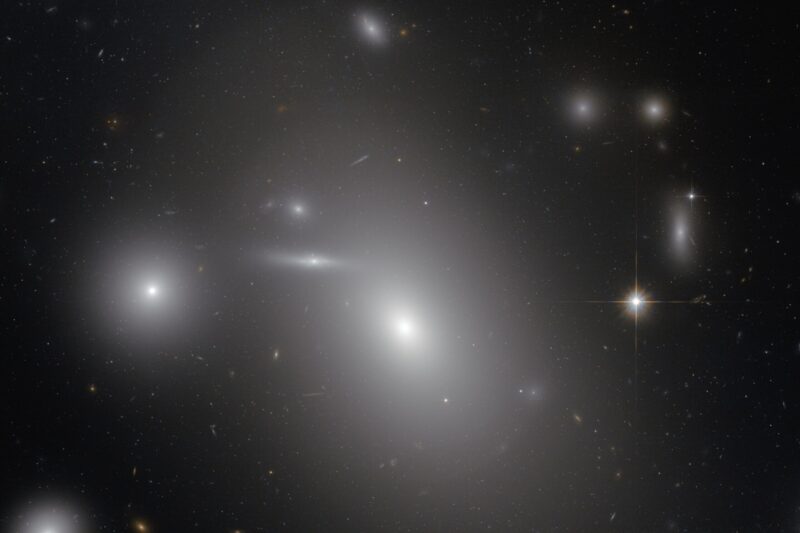

Coma Berenices galaxy cluster in science
Most galaxies in the central part of the cluster are giant ellipticals, the result of galaxy mergers. The two brightest members – both giant ellipticals – are NGC 4889 and NGC 4874. Each one is at least two to three times larger than our own Milky Way galaxy. Farther out from the center are several spiral galaxies.
But most galaxies in the Coma Berenices galaxy cluster are dwarf galaxies. They resemble the Milky Way’s companions, the Large and Small Magellanic Clouds.
Coma Berenices galaxy cluster in history
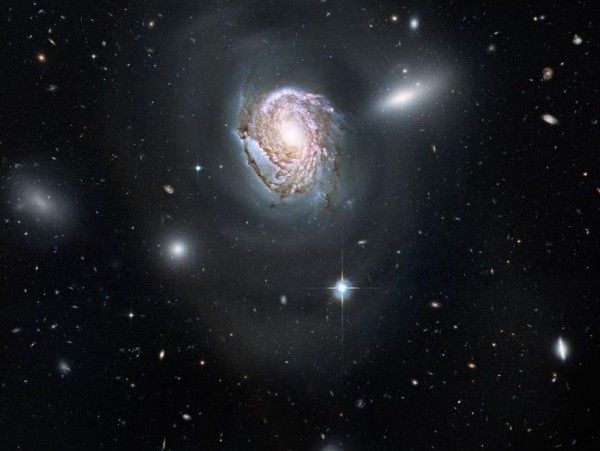
The earliest stargazers couldn’t have seen the galaxy cluster. It’s too faint for viewing by the human eye (or binoculars and even small telescopes). So it has no associated mythology. But it still has an interesting history.
In fact, it helped lead to our discovery of dark matter in the universe. Dark matter was unknown and unsuspected until a Swiss-American astronomer, Fritz Zwicky, announced he had discovered it in the Coma Berenices galaxy cluster in the 1930s.
Zwicky tallied up the visible galaxies in the cluster and estimated their masses. Then, he observed the motions of galaxies near the edge of the cluster, which are determined by the total gravity (and hence mass) of the cluster. He found the mass derived from the latter method greatly exceeded that from visual inspection.
Zwicky knew that if the law of gravity is correct – and there’s no reason to doubt it – the only answer could be an additional source of mass, which he called dunkle Materie in German.
Today, scientists believe they see the imprint of dark matter throughout the universe. They think it’s at least five times more prevalent than the more familiar visible matter, such as the stars and galaxies we can see. Unseen and mysterious, this matter greatly increases the total mass and gravitational strength of the universe, affecting its evolution and fate.

Coordinates of the Coma Berenices galaxy cluster
The center of the Coma Berenices galaxy cluster is located at approximately RA: 12h 59m, dec: +27° 59′.
Bottom line: Myriads of galaxies – in all shapes and sizes and visible only in telescopes – shine in the Coma Berenices galaxy cluster.
Like what you read?
Subscribe and receive daily news delivered to your inbox.
More from
Larry Sessions


Why can’t I find the Big Dipper in September?

Fomalhaut is the Loneliest Star once again
Summer Triangle star: Altair is variable and spins fast!
Summer Triangle star Deneb is distant and luminous