EarthSky // Tonight // Brightest Stars By Larry Sessions and Deborah Byrd Apr 13, 2012

Spica is a whirling double star

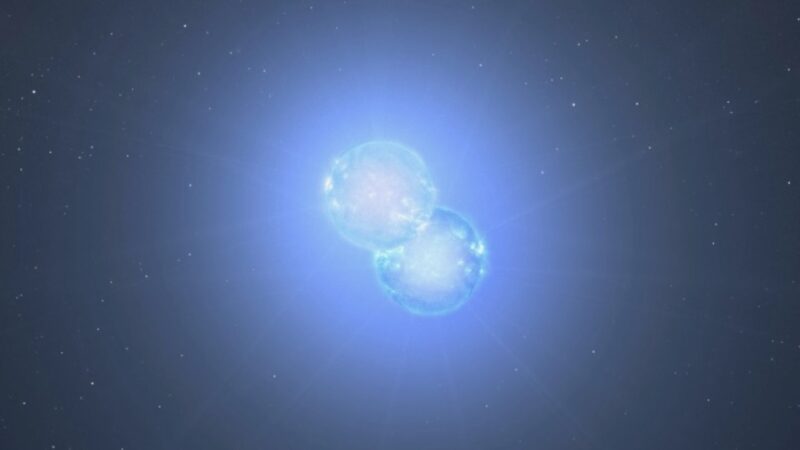
Spica is a binary star, with two stars larger and hotter than the sun, telescopically indistinguishable from a single point of light.

DownloadEmbed
close

Copy the following code to embed this player

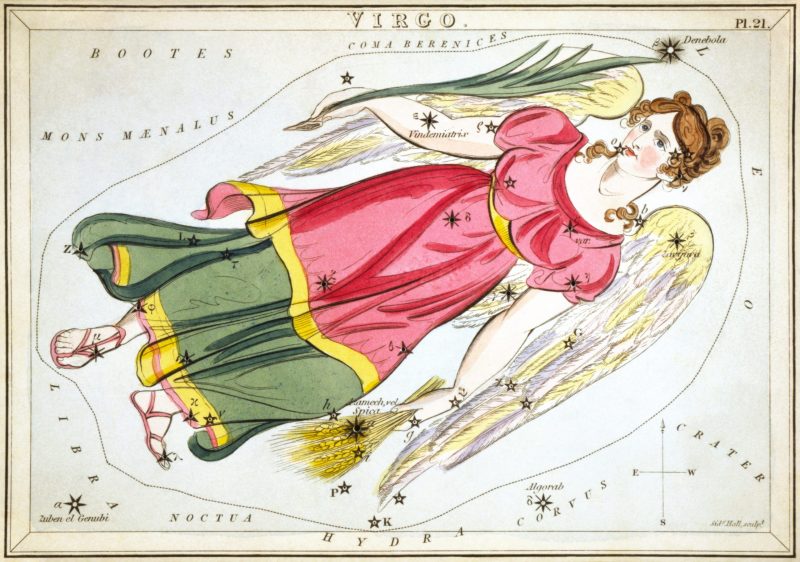
The image above is from Glyphweb.com

Spica looks like one star, but it is at least two stars, both larger and hotter than our sun, orbiting only 18 million kilometers (11 million miles) apart. That’s in contrast to 150 million kilometers for Earth’s distance from our sun. Their mutual gravity distorts each star into an egg shape, with the pointed ends facing each other as they whirl around, completing a single orbit in only four days.

See Spica tonight: Drive a spike to Spica – and Saturn – in springtime 2012

How to see it

The best evening views of Spica come from spring to late summer when this star arcs across the southern sky. Spica rises in the east-southeast as the sunset glow fades in mid-April. At that time, it is visible most of the night. Two months later it beams at its highest point to the south in early evening.

By the end of August, Spica can be viewed only briefly in the west-southwestern sky as darkness falls.

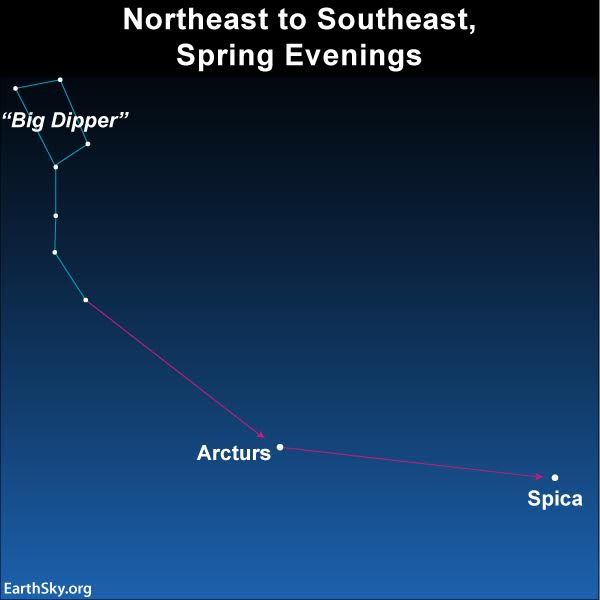
Follow the arc to Arcturus, and speed on to Spica.

Here’s how you can speed on to find Spica. First look for the Big Dipper in the northern sky. The Dipper is highest in the sky in spring and summer. Notice that the Big Dipper has a bowl and a long, curved handle. Find the Dipper, and then follow the curve of its handle outward, away from the Dipper itself. The first bright star you come to is orange Arcturus, but if you continue past it in the curving path, the next bright star is Spica. Scouts and stargazers remember this trick with the saying: Follow the arc to Arcturus, and speed on to Spica.

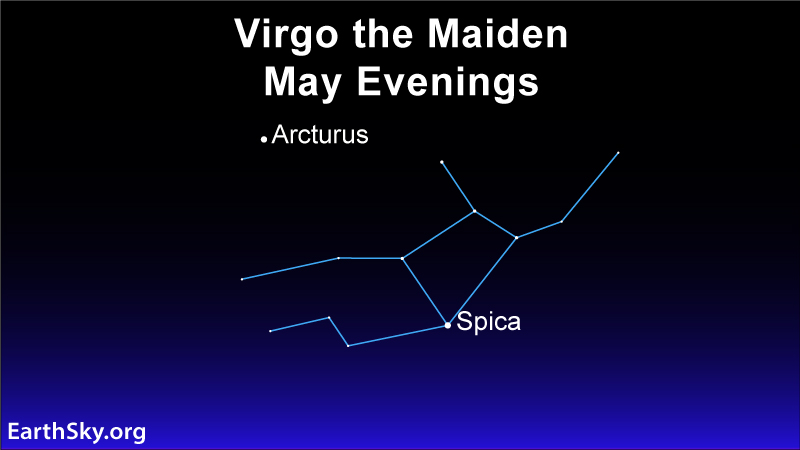
Virgo? Here’s your constellation

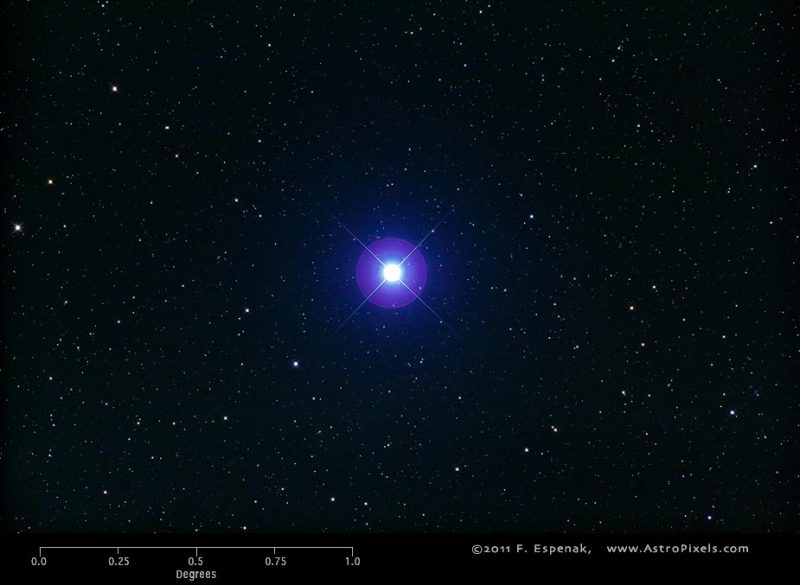
Spica is the brightest light in the constellation Virgo the Maiden, and it is the 15th brightest star visible from anywhere on Earth. It’s virtually the same brightness as Antares in the constellation Scorpius, so sometimes Antares is listed as the 15th and Spica as the 16th brightest. No matter. Identify this beautiful blue-white star, and – with the Big Dipper’s help to spot it in the sky – it’ll be your friend for life.
History and Myth

Spica is from the Latin word for “ear,” and the general connotation is that it refers to an “ear of wheat.” Indeed, the star and the constellation Virgo itself were sometimes associated with the Greek goddess of the harvest, Ceres.

There are many names and stories for Spica’s constellation – Virgo – in mythology, and by association with Spica as well. Fewer stories refer to Spica independently. Many classical references refer to Virgo’s stars as a goddess or with some association with wheat or the harvest. In Greece and Rome she typically was Astraea, the very personification of Justice; or Persephone, daughter of Ceres. In Egypt, Virgo was identified with Isis, and Spica was considered her lute bearer. In ancient China, Spica was a special star of spring known as the Horn.

One Arabic name was Azimech, derived from words meaning Defenseless One or Solitary One. This title may be in reference to Spica’s solitary status with no other bright stars nearby. But Spica is not the most solitary star. That honor goes to Fomalhaut, sometimes called the Autumn Star.
Science

Spica is about 262 light-years away, based on data from the Hipparcos Space Astrometry Mission of the 1990s.

Spica is a binary star, with two stars which are telescopically indistinguishable from a single point of light. The dual nature of this star was revealed only by analysis of its light with a spectroscope, an instrument that splits light into its component colors. Both stars in the Spica binary system are larger and hotter than the sun, with the larger of the two, in fact, a blue giant or subgiant. The surface temperatures are estimated at 22,400 K and 18,500 K for the larger and smaller components, respectively. This compares to about 5,800 K for the sun. (“K” stands for “kelvins”, a degree on the absolute scale. At high values, each kelvin is about 5/9ths the corresponding Fahrenheit degree, so these two stars are about 40,000 F and 33,000 F, compared to 10,000 F for the sun.)

Separated by just less than 18 million km (about 11 million miles), Spica’s two stars orbit a common center of gravity in only 4 days. The resulting forces on these stars are so great that they are probably distorted, more egg-shaped than spherical. Although this cannot be visually seen, even through a telescope, slight magnitude variations may be evidence for such a distortion. The magnitude changes could be the result of the stars showing more or less surface area as they move through different orientations in their orbits.

The light from these two stars taken together is, on average, more than 2200 times brighter than the sun. Their diameters are estimated to be 7.8 and 4 times the sun’s diameter.

Spica is one of several bright stars that the moon can occult (eclipse). Based on observations of how the star’s light is extinguished when the moon passes in front, some astronomers think that it may not just be a spectroscopic binary star. Instead, they feel that there may be as many as 3 other stars in the system. This would make Spica not a single or even a double, but a quintuple star!

Spica’s position is RA: 13h 25m 12s, dec: -11° 09′ 41″

Share your comments on Facebook

20 Responses to Spica is a whirling double star

  1. [...] watching tonight’s moon team up with the star Spica and the planet Saturn tonight. Spica is the brightest star in the constellation Virgo the [...]

  2. Djana says:

    I love your article. Spica is a very important point in my chart and it seems it is highlit by this transit. (?) (?)

  3. Djana, thank you for your comment. But if you are talking about astrology and horoscopes, I am afraid that I have nothing to say, except that.there is no scientific evidence whatsoever that the postiions of distant stars has any effect on humans except for the meanings we invent.

  4. pcanh says:

    Good article this did not know it was a a double star, spica good for finding saturn.

  5. Thanks Pcanh. Although Spica is a double star or binary, the two stars are too close to be seen as individual points in a telescope. Also, the use of Spica for finding Saturn will not always be easily possible, since Saturn moves slowly against the backdrop fo the stars. Right now it is approaching Spica, and in fact will pass it even more closely in about one year, then slowly move away.

  6. Mirai says:

    Thanks for all the articles Q u Q It’s nice to learn about stars Scientifically.

  7. Mirai, thanks for your comment and glad you enjoyed it!

  8. Kate, who discovered what?

  9. [...] oldest of the old sheep.” Thank goodness Saturn is fairly close to Virgo’s brightest star, Spica now. If you see two bright objects close together on the sky’s dome, one of them might be [...]

    • Deb says:

      April 13, 2012 at 6:30 pm
      thanks so much for teaching me so much about the sky!! I love it and try to absorb as much as I can, now that in life I have time. Please tell me what is the best mid-range binoculars to purchase, ( I did not win the lottery). also where can I find a pronounciation sheet of the Stars, I think I could rememeber them better if I could pronounce them.
      I have the FCPS Planetaria Starfinder Constellations; but has few stars on it. Is there a site that list the brightest stars and their pronounciation? thanks for your help. Deb

  10. Deb says:

    thanks so much for teaching me so much about the sky!! I love it and try to absorb as much as I can, now that in life I have time. Please tell me what is the best mid-range binoculars to purchase, ( I did not win the lottery). also where can I find a pronounciation sheet of the Stars, I think I could rememeber them better if I could pronounce them.
    I have the FCPS Planetaria Starfinder Constellations; but has few stars on it. Is there a site that list the brightest stars and their pronounciation? thanks for your help. Deb

  11. Hi, Deb. Glad you are enjoying it. We can’t make specific brand endorsements, but when you are looking for binoculars, I suggest that are not to heavy to hold up for extended periods of time. Those that are labeled “7 X 50″ or “8 X 50″ are popular. The first number signifies the magnifying power, and the second signifies the diameter of the large objective lens (opposite the lens you look through). I would also suggest that you stick with a well-known brand. There are actually two types. The first is just two small, cheap telescopes fixed together. Each has a straight tube (although some have riduculous bulges at the side intended to deceive). These are called “field glasses.” True binoculars normally are of better quality, and have a true “dog leg” offset of the tube — that is, each side is not a straight tube, but the bottom part is offset. You can find out more from this page on EarthSky:
    http://earthsky.org/astronomy-essentials/top-tips-for-using-ordinary-binoculars-for-stargazing

    Now, as for pronunciation, I am sorry but I cannot find the page we used to have here. However, here is a pretty guide in PDF format from the Astronomical League:
    http://www.astroleague.org/files/astronotes/07anote%20PronounceGuide1.pdf

    Actually, there are many variations. For Fomalhaut, for example, here on EarthSky we use FOH-mul-oh, where as elsewhere it may be described as foh-mul-HOWT or FO-mal-ought. Likewise, Betelgeuse can be Beetle-juice, Be-TELL-juice or Be-tell-Jeez.

    Larry S.

    • There is no “set-in-stone” pronunciation. Language is fluid and dynamic. I had three years of Latin in High School, and we learned classical pronunciation, which would demand SPEE-kuh instead of SPY-kuh. However, “Latin is a dead language… as dead as it can be. First it killed the Romans, and not it’s killing me.”

      Tthe proper pronunciation is what the majority of people use, and the vast majority (at least in my experience) use SPY-kuh over SPEE-kuh. Take your pick. the important thing is simply to be consistent. In America, the predominant pronunciation is BEETLE-juice rather than BeTELL-jewz or any other variant. Use what feels good to you. There are some guidelines, of course, but I personally suggest that you should simply pick one pronunciation that sounds good to you, and stick to it..

  12. JK says:

    I too was going to ask about pronunciation! Thanks for the resources! I’ve been calling Spica “speeka” for years, because I heard someone on TV say it that way, but “drive a spike” indicates a different vowel sound. Larry, thanks for the awesome list–but from the end of your comment I get the impression that there aren’t firm answers on pronunciations. I have a botanist friend whom I’ve asked about plant pronunciations, and he says that because the botanical names are Latinized, and Latin is not a spoken language, no one knows for sure how they should be pronounced–it’s sort of a “your guess is as good as mine” situation. It seems like their should be rules, though–with plants, it seems like Latin rules should apply, and with stars, shouldn’t it depend on the rules of the language of origin? In the Fomalhaut example, doesn’t the “oh” vs. “owt” ending depend on the language that was used to name it?

    I have said “Beetle-juice” all my life, but it turns out it has a ton of pronunciations. At any rate, I have been LOVING these blog posts that have been teaching me lesser-known stars. My favorite line in this particular post is “it’ll be your friend for life.” I couldn’t agree more. The brightest stars have been my friends since I first learned them at age 16, and now I am getting to know the names of new friends for life. Because of one of your recent posts, I now know the names of seven stars in Leo, whereas I used to know only Regulus. Even if I’m not exactly sure how to pronounce them, knowing their names makes it so much more rewarding to look up and see them.

    So, thanks!!’

    Chertan….would that be “shirt-an” or “churt-an”, or “share-tan”, or… :-)

    • Deborah Byrd says:

      JK, you might notice there’s an audio file available at the top of this post. We include audio files at the top of all our Brightest Stars posts giving pronunciations. http://earthsky.org/brightest-stars

      We don’t give ALL pronunciations, however. On this post, we say “SPEE-ka” as you do. Many others do call it “SPY-ka.”

      As to “follow the arc to Arcturus and drive a spike to Spica,” we’ve heard this phrase various ways as well. Some say, “follow the arc to Arcturus and speed on to Spica.”

      There’s no right and wrong here! It’s stargazing, and it’s all just for fun.

      Enjoy,

      Deborah

  13. JK says:

    Thanks Larry and Deborah. I heard the lady on NPR’s “Star Date” program say “spike-a” today, so you’re right, you do just have to pick a pronunciation and go with it!

    Thanks for the great topics–I love this blog.

    • Deborah Byrd says:

      Thanks for stopping by JK!

      • JK, be sure to listen to EarthSky’s broadcasts as well. Deborah is too modest to note it, but she is the one who started “Star Date” years ago, and has since founded and continues to spearhead the efforts of EarthSky to be a “Clear Voice for Science.” You can hear her and other Earthsky voices on various radio stations, as well as through podcasts such as the “EarthSky 22″: http://earthsky.org/team/earthsky22
        Larry Sessions

Share your comments on EarthSky

Your email address will not be published. Required fields are marked *

*

You may use these HTML tags and attributes: <a href="" title=""> <abbr title=""> <acronym title=""> <b> <blockquote cite=""> <cite> <code> <del datetime=""> <em> <i> <q cite=""> <strike> <strong>