This Halloween night, look up at Algol … if you dare.
Algol the Demon Star
Get ready to meet the scariest star in the sky! Its name is Algol, and it lies in the constellation Perseus the Hero. Early astronomers nicknamed it Algol the Demon Star. A demon star looking down from above … Creepy! But how did this star get this name?
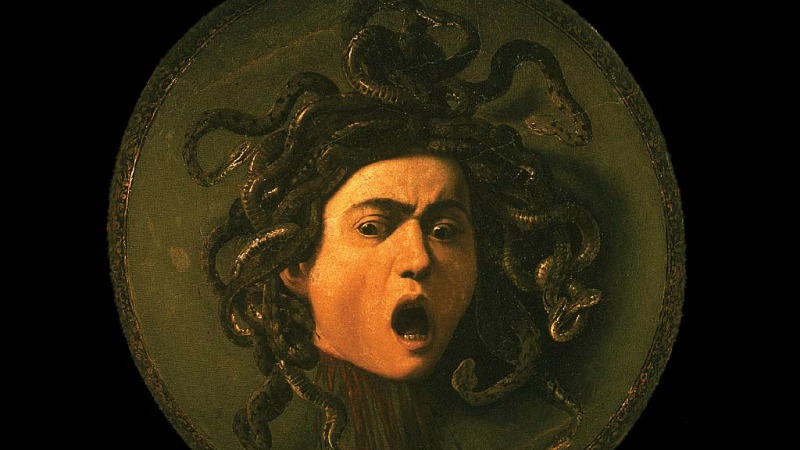
When you look at Algol, it doesn’t appear any scarier than any other star. But, in skylore, the star is associated with a mythical scary monster – the legendary Gorgon Medusa – who had snakes in place of hair. It’s said that her appearance was so terrifying that anyone who looked at her would turn to stone.
The star name Algol comes from an Arabic word meaning the Demon’s Head or, literally the Ghoul.
It represents the terrifying snaky head of the Medusa monster.
But why? Why did the early stargazers associate the star Algol with the Gorgon Medusa? It seems the ancients might have associated this star’s variable brightness with the evil, winking eye of the Medusa.
What’s so scary about it?
In skylore, Perseus was a great hero, often depicted mounted on Pegasus the Flying Horse. In the mythology of the skies, Perseus slew Medusa. Then, he used Medusa’s head to his advantage. In a struggle with Cetus the Whale, he pulled Medusa’s head from a bag … and turned the whale to stone.
These stars and constellations – the Hero, the Flying Horse, the Whale and the Gorgon Medusa’s winking eye – are all in the sky at this time of year.
And here’s the secret to Algol’s name. This star is what’s known as a variable star. It waxes and wanes in brightness.
The early stargazers surely knew about its brightness change. Scholars believe that Algol’s variability led these stargazers to name the strangely-behaving star for a mythological demon.
Algol is a variable star
Nowadays, there are many variable stars known throughout the heavens. But Algol is one of the most famous. That’s in part because the Demon Star brightens and dims with clocklike regularity. It completes one cycle in 2 days, 20 hours and 49 minutes.
Plus, you can view its entire cycle with your eye alone.
At its brightest, Algol shines about three times more brightly than at its faintest. When it reaches maximum brilliance, Algol matches the brightness of the nearby 2nd-magnitude star Almach.
At minimum, Algol’s light output fades to that of the star Epsilon Persei.

Modern-day astronomy has unlocked the secret of Algol’s mood swings. It’s a triple star system (Algol A, B, and C) where Algol A is regularly eclipsed by Algol B every 2.87 days. So those two stars are what’s known as an eclipsing binary. In other words, the single star we see as Algol is really two stars, which revolve around each other.
From Earth, we see the orbital plane of this binary star almost exactly edge-on. And when the dimmer of the two stars swings in front of the brighter star, we see Algol at minimum brightness.

How to find Algol the Demon Star
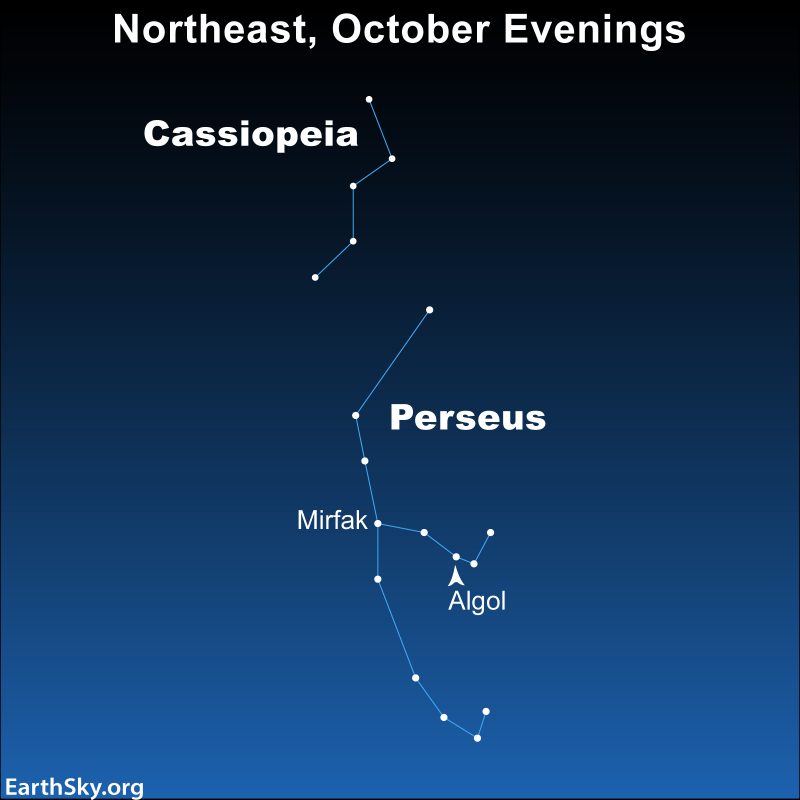
Want to see it? The Demon Star is easy to find. Our sky chart shows the northeastern sky for autumn evenings, especially around All Hallows’ Eve – October 31 – what we now call Halloween.
To find Algol, first look for the conspicuous W or M-shaped constellation Cassiopeia the Queen. You can starhop from there to Algol’s home constellation, Perseus the Hero. Look below Cassiopeia toward the horizon to spot Perseus. Algol is one of the brightest stars in Perseus.
When to see it
At mid-northern latitudes, the Demon Star appears for at least part of the night all year round. But it’s best seen in the evening sky from autumn to spring. It’s visible in the northeast sky in autumn, shines high overhead in winter, then swings to the northwest sky by spring.
Visit Sky & Telescope to calculate Algol’s minimum brightness for your location.

Bottom line: What’s the scariest star in all the heavens? It’s Algol the Demon Star, and you can see it on autumn evenings. Learn the secret of Algol’s creepiness!
Like what you read?
Subscribe and receive daily news delivered to your inbox.
More from
Editors of EarthSky


Are day and night equal on the equinox? Not exactly

The equinox sun rises due east and sets due west
Venus brightest in the evening sky this week
See Venus in the daytime: Here are 3 tips