EarthSky // Tonight // Brightest Stars By Larry Sessions Mar 05, 2012

Acrux is brightest star in Southern Cross

Blue Acrux shines as the brightest star in the constellation Crux the Southern Cross.

How to see it

Bluish Acrux, otherwise known as Alpha Crucis, is the brightest star in the constellation Crux the Southern Cross. It is the 13th brightest star in all the sky. Because it is located far to the south of the sky’s equator, this star cannot be seen from much of North America. Observers north of central Florida or south Texas are out of luck. Observers in Hawaii sometimes tell us they’ve spotted it. You have to be in the Southern Hemisphere to see Crux in all its glory. Therein lies much of its magic and mystery.

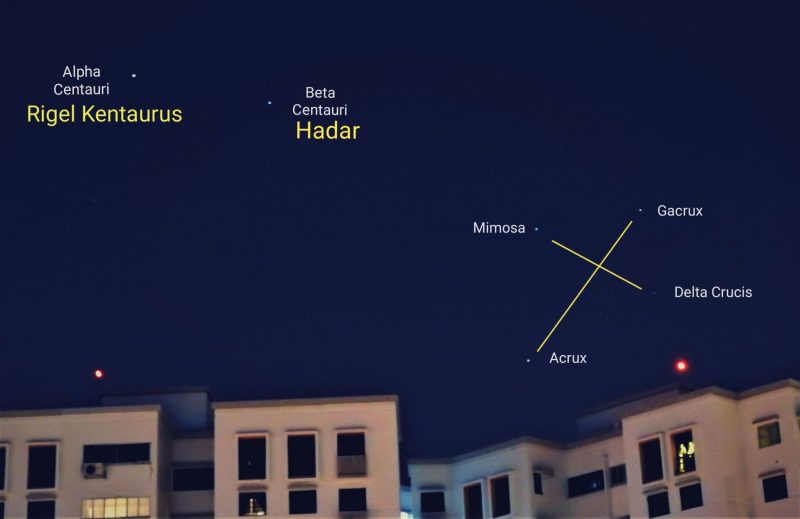
Constellation Crux photo by Christopher J Picking in New Zealand. Acrux is at the bottom of the Cross. More information about this photo here. Used with permission

For anyone south of about 27 degrees north latitude, Acrux and the Southern Cross exhibit their midnight culmination (highest elevation above the southern horizon) in late March amd early April. The farther south the better, and from approximately the latitude of Brisbane, Australia, the star becomes circumpolar and can be seen every night of the year.

The star Acrux marks the bottom of the Southern Cross, when you are facing south. For an observer facing south, Acrux is the star nearest the horizon. At magnitude 0.77, Acrux is the most southernly first magnitude star. Nearby Mimosa, or Beta Crucis, at magnitude 1.25, is the 19th brightest star in all the heavens.

Two nearby and brighter stars, Alpha Centauri and Beta Centauri (Hadar), are known as the Southern Pointers. A line drawn from Alpha through Beta, at about 3 times the distance between them, leads to the top of the Southern Cross, Theta Crucis.

History and Myth

Unlike many star names, which are Arabic, Latin or Greek proper names, Acrux is simply a combination of “A” (for Alpha) and Crux as the name of the constellation. Not of classical derivation at all, it was a name coined by Elijah Hinsdale Burritt, a Connecticut farm boy turned celestial cartographer, circa 1835.

While little if any mythology is known to be associated with this star, and not much more with the entire constellation, the reputation of the Southern Cross is widespread. That might be because early sailors, moving southward on Earth’s globe, thrilled to the sight of it.

The Northern Cross, an asterism of the main stars of Cygnus, the Swan, is larger and better shaped as a Christian Cross, although it contains no stars as bright as Acrux. Interestingly, however, the brightest star in Cygnus, Deneb, is virtually the same apparent magnitude as Mimosa, the second brightest star in Crux. Both are bright blue stars of magnitude 1.25, ranking as the 19th (Mimosa) and 20th (Deneb) brightest stars in the sky.

Samuel Langhorne Clemens (1835 – 1910), better known as Mark Twain, in the year 1902. Although Twain was unimpressed with the Southern Cross and its brightest star Acrux, many have thrilled to seeing this constellation in southern hemisphere skies. Image via the State Historical Society of MissouriSamuel Langhorne Clemens (1835 – 1910)

Many point out that Crux, of which Acrux is the primary star, does not look exactly like a cross. They say it is as exaggerated as were the rumors of Mark Twain’s death well before his actual demise. In fact, Twain wrote of the Southern Cross, viewed for the first time and reported in his book, Following the Equator:

We saw the Cross to-night, and it is not large. Not large, and not strikingly bright. But it was low down toward the horizon, and it may improve when it gets up higher in the sky. It is ingeniously named, for it looks just as a cross would look if it looked like something else. But that description does not describe; it is too vague, too general, too indefinite. It does after a fashion suggest a cross — a cross that is out of repair – or out of drawing; not correctly shaped. It is long, with a short cross-bar, and the cross-bar is canted out of the straight line.

It consists of four large stars and one little one. The little one is out of line and further damages the shape. It should have been placed at the intersection of the stem and the cross-bar. If you do not draw an imaginary line from star to star it does not suggest a cross – nor anything in particular.

One must ignore the little star, and leave it out of the combination – it confuses everything. If you leave it out, then you can make out of the four stars a sort of cross – out of true; or a sort of kite – out of true; or a sort of coffin-out of true.

Despite Twain’s reluctance to be impressed, many love the Southern Cross, and today this constellation is used as a symbol on the flags of several nations in the southern hemisphere.

Image Credit: Wikimedia Commons

Science

Using data from the Hipparcos mission. Acrux is classified as B0.5 IV. meaning that it is hotter, brighter, larger and more massive than our sun. The designation “IV” indicates that Acrux is a “sub giant” star, not big enough to be considered a giant, but one that has left the realm of normal stars (the “main sequence”) and has entered the terminal phases which ultimately will end up as a white dwarf star.

The star Acrux, aka Alpha Crucis, appears single to the eye. But a telescope reveals it to be two stars orbiting around each other. Image via Starfield Observatory

Acrux is about 321 light-years from Earth, and in fact it is not one star but two nearly identical B-class stars. These can be resolved in a small telescope, making Acrux a nice double, but they appear as a single star to the unaided human eye. The brighter of the two — call it Alpha-1, is magnitude 1.33 and the dimmer — call it Alpha-2 –1.73, with a resultant magnitude of 0.77. Alpha-1 is a subgiant, whereas Alpha-2 appears to still be on the main sequence, rather oddly termed a “dwarf” star. (All stars on the main sequence are technically considered “dwarf stars” to distinguish them from subgiants and giants — there are no “normal” stars!) According to Dr. James Kaler, the subgiant boasts a temperature of about 25,000 Kelvin at its surface, whereas the smaller star is also cooler, about 16,000 Kelvin.

To make things even more complicated, it appears that Alpha-1 is in fact a double star, whose components’ combined masses are about 24 times that of the sun. Alpha-2 is a single star about 13 times as massive as the sun.

Acrux’s position is RA: 12h 26m 35s, dec: -63° 05′ 57″.

Southern Cross: Signpost of southern skies

Mimosa is second-brightest star in Southern Cross

Share your comments on Facebook

15 Responses to Acrux is brightest star in Southern Cross

  1. June Brereton says:

    Other sources state that Acrux is the twelfth brightest star in the sky, and your article contradicts this. Would you please justify your data to me?

  2. Larry Sessions says:

    Well, I do not know about justifying anything, but the bottom line is that it is a matter of definition and protocol. Acrux is a multiple star, whose brightest component alone would be (individually) the 20th brightest star in the heavens. Many older references considered only this one component, even though the actual visual appearance of Acrux is the result of at least two stars’ contributions. As such, in some older catalogs, Acrux (just the one brightest component) was listed as the 20th brightest star. However, most modern references use the integrated magnitude of all components in the Acrux system, which gives it a combined visual apparent magnitude of 0.77, just one one-hundredth of a magnitude fainter than Altair, the 12th brightest star. Thus, Acrux is the 13th brightest star visually seen from Earth.

    In addition, there have always been some slight controversies over specific magnitudes, including for example that of Betelgeuse, which is variable. At any rate, authorities such as Dr. James Kaler of the university of Illinois, and the modern Hipparcos catalog, list Acrux as the 13th brightest visual star.

    Some references — such as Wikipedia — still list outdated information. Keep in mind that we are considering only visual apparent magnitudes — how bright the star appears to the human eye on Earth. In reality, there are stars much brighter than Acrux, but which appear dimmer due to much greater distance.

  3. ken kirschner says:

    Dear Mr Sessions
    I am especially interested in Acrux-13 since it is the star associated with the year I was born 1945. If you count the number of letters in the alphabet you get the number 13 is M. What I have done with the twenty-eight brightest stars is to connect them with the calendars. Since our calendar has a twenty-eight year cycle you can place all the years in a cycle and use the alphabet to make it easy to identify your own star. It is easy if you know the starting year for each cycle. Let me know if you are interested in finding out what star is associated with your birth year.
    Respectfully yours
    Ken Kirschner

  4. Ken,
    Thank you for your offer. It appears that you have put a lot of thought into it. It is a good mental exercise, especially looking for or developing patterns and relationships. In fact it is an absolutely essential part of science. There is little doubt that it is an integral aspect of human nature, hardwired into our brains. Especially when I was younger, I experienced things such as David DeSalvo discusses in his blog entry here: http://trueslant.com/daviddisalvo/2010/04/12/im-a-pattern-youre-a-pattern-wouldnt-you-like-to-be-a-pattern-too/

    On the other hand, EarthSky exists to be a “clear voice for science,” and calendrical associations such as you describe really have nothing to do with science, as far as I can tell. In fact, I would be concerned that some people might associate it with astrological-style or supernatural significance, which is just exactly opposite of what science strives for. As a hobby, it can be fun (I’ve always enjoyed reading about the Chinese astrology — I was born in the “Year of the Rabbit” for example — and other forms of supernatural or paranormal claims. While I try to remain open-minded, I regret to say that I see no convinced data or even argument in favor of any of it). That said, I commend you on your search for patterns, but I do not see any validity of associating stars with particular dates. Perhaps if you could give me a logical, scientific basis for this, I would be more positive, but as for now I will pass. Still, thanks for contacting me and please feel free to ask questions.

    Larry Sessions

  5. Deborah says:

    I could not help but notice the Southern Cross and acrux – a remarkable “star” reflecting many hues – the instant I set eyes on the Southern sky for the first time in Mauritius.

    I am curious now as to how close in proximity the stars are that form acrux. Are they part of a shared system?

    Wonderful article.

  6. Deborah, the stars in Crux are generally several hundred light years away from Earth, and not, as far as I know, part of a system or gravitationally bound together. However, several of the bright stars (Alpha, Beta and Gamma), due bear similarities in terms of motion and age, and could well have been formed at about the same time from the same large cloud of gas and dust, which likely also spawned many other of the stars we see in this region. This is known as the Scorpius-Centaurus OB Association. “Scorpius-Centaurus” signifies the two larger constellations in which most of the stars of a large “OB Assocation” are located. The “OB” means that they are hot, young, blue or white stars.

  7. Deborah says:

    Thanks for the reply. I suspected as much that although they appear close, there’s no gravitational relationship. Although you are correct that the reputation of the Southern Cross is a bit exaggerated, the “twinkling” effect resulting from the visual overlapping of these hot stars is remarkable and unique. I appreciated your comments as well about the OB Association stars and their age – a very nice footnote about the geography of the stars in the region.

  8. Samuel says:

    I noticed a very bright light in the South and in an area where we have constant airplane and helicopter activity so I thought at first this was a plane of some kind; but the “plane” did not move at all and I was stunned by the brightness of this object which I think is Acrux or part of The Southern Cross. I am not an astronomer so I do not know what this object is but it is gorgeous, clear and extremely bright. I have now seen this star on two nights at 5:00a.m. in California

  9. Samuel,
    Sorry, but you can’t see Acrux or the Southern Cross from anywhere in California. However, at that time the planet Venus is in the southeastern sky and is very bright as you describe.
    Larry Sessions

  10. Steve McGee says:

    I live in Hawaii and the Southern Cross is visible from here part of the year. It seems to have a beauty all its own. CSNY wrote a song about it, as have I. It is the subject of much poetic expression. Right now it rises at about 2330 and sets at 0330. At the end of April it rises about 2030 and sets just after midnight. As an avid observer of double stars, I have logged Acrux with my C925. It is listed as Dun 252 and has a separation of about 4 arc seconds, position angle of 112º. Two other stars of the four are double stars: Beta or Mimosa and Gamma or Gacrux. It is a truly beautiful constellation and I am glad I moved to Hawaii so I can see it every year when it returns.

  11. Robert Vose says:

    This may seem somewhat off topic, but Acrux could also be the Star of Bethlehem.
    The reasoning is rational and easy to verify with planetarium software such as Stellarium.
    The Southern Cross is not visible from Jerusalem today, but it was visible in the southern sky from Jerusalem about 2000 years ago. Bethlehem is south of Jerusalem, so for about a month the Southern Cross would have risen in the east and then moved west until it was no longer visible at sunrise. Looking south from Jerusalem, the star Acrux would have been directly over the town of Bethlehem, and only just above the horizon when it was last visible in the dawn. For an observer in Jerusalem during early December about 2000 years ago the star would have STOPPED being visible over Bethlehem. The Magi would have traveled to a mountain range to get a better view of the star they knew was slowly disappearing out of sight. The mystery of the Star of Bethlehem is due to a cultural misunderstanding in Herod’s court. It’s a nice theory and it does actually work, and of course, rational astronomers are most welcome to try to disprove it.
    For more info about this idea please see: http://becrux.net/starofbethlehem/
    This comment is most relevant to your Star of the Week Acrux – which could also possibly be The Star of Bethlehem…

  12. My immediate thought regarding the “Star of Bethlehem” is that there is no need to prove or disprove it. From an astronomical standpoint, no one single object would even appear and move as described in the New Testament. To a believer whose test of veracity is purely faith, no rational explanation is desired. As for it being Acrux, I suppose that is as likely as any explanation, but it would have been visible for many years in the same way, so it seems to me that a recurring observation that had been possible for years and would continue to be possible for years would not strike that much attention.

    • Robert Vose says:

      Hi Larry, I appreciate your points about faith in the Star of Bethlehem and that there is no need to identify or prove a rational explanation for the phenomena.
      There has still been many attempts to provide a rational explanation for the Star as described in the New Testament. One of the most widely discussed theories is that the Star was a planetary conjunction.
      One of the points about the Star of Bethlehem is that the people in Herod’s court failed to see the Star that the Magi were trying to point out to them. They were not aware of the star before the visit by the Magi – so it was a recurring observation that the Magi were describing. The Magi might have tried to provide an empirical description of the Star, but without success.

      The people in the court misunderstood the Magi and thought they were announcing the birth of a rival king. They didn’t see the Star that the Magi were describing and felt they were missing something – it was a mystery to them. This would have been discussed in the community and the misunderstanding also led to the murder of the innocents. The cultural understanding of the sky was that it was like a large dome, so that they could imagine a star descending from ‘heaven’ to be stationary just above a particular town, or even for a star to fall from the sky to the ground (somewhat like in the movie “The Trueman Story”).

      The narration in the Bible weaves together a number of stories – an empirical description of an observed star, the cultural misunderstandings in Herod’s court and the link that was made between this expedition by the Magi to observe the Star and the birth of Jesus. The Star of Bethlehem has remained a mystery, and it will remain so into the future…

  13. I actually am fairly familiar with the story, having first written about it (a planetarium script) about 40 years ago, and other pieces since. The bottom line is that no one astronomical event, nor in fact no astronomical event of any kind, can be fully reconciled with the specific (and somewhat limited) description in the New Testament. Perhaps an assemblage of different events, coupled with a figurative or fanciful description on the ancient writer’s part, and a non-insistence on literal interpretation by the modern reader, can provide a satisfying explanation. Even many religious people today are open to interpretations of Biblical events as allegory or metaphor. My point is simply that from an astronomical standpoint, the literal description as a “star” and the motions attributed to it, simply do not wash. If it was intended as a literal story, it is out of alignment with what we know about stars. If it was intended to be allegorical, then there is no real need to look further for answers. It’s fun to consider what it might have been, as a sort of detective story, but I do not think that there is any likelihood of profound truths either about astronomy or religion.

  14. [...] via Star of the Week: Acrux is brightest star in Southern Cross | Brightest Stars | EarthSky. [...]

Share your comments on EarthSky

Your email address will not be published. Required fields are marked *

*

You may use these HTML tags and attributes: <a href="" title=""> <abbr title=""> <acronym title=""> <b> <blockquote cite=""> <cite> <code> <del datetime=""> <em> <i> <q cite=""> <strike> <strong>