Venus and Jupiter – the sky’s 2 brightest planets – are shining together in the west after sunset. They were closest on June 8 and 9. But June overall offers your best opportunity to see them together. This video shows you where to look, when to look, and what you’ll see as these 2 bright planets undergo their spectacular conjunction. EarthSky’s Deborah Byrd is host. Submit your Venus-Jupiter photo to EarthSky’s community page! Watch the video in the player above, or on YouTube.
See the Venus-Jupiter conjunction
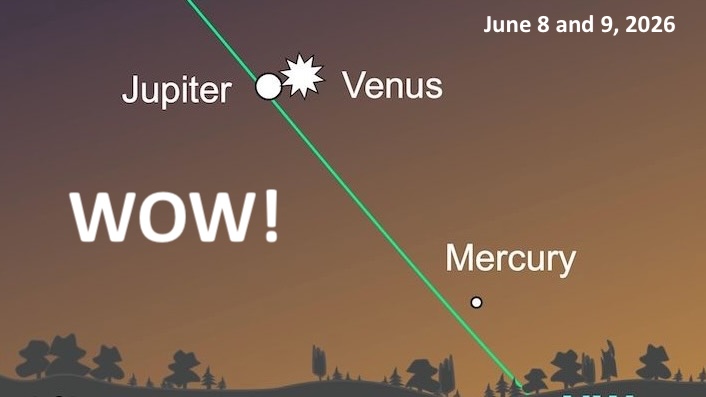
An amazing whole-Earth event is happening in the evening twilight sky. The brightest planets visible from Earth – Venus and Jupiter – look very close together. Maybe your friends and family have already asked you, “What are those two bright stars after sunset?” You can tell them they aren’t stars at all, but Venus and Jupiter!
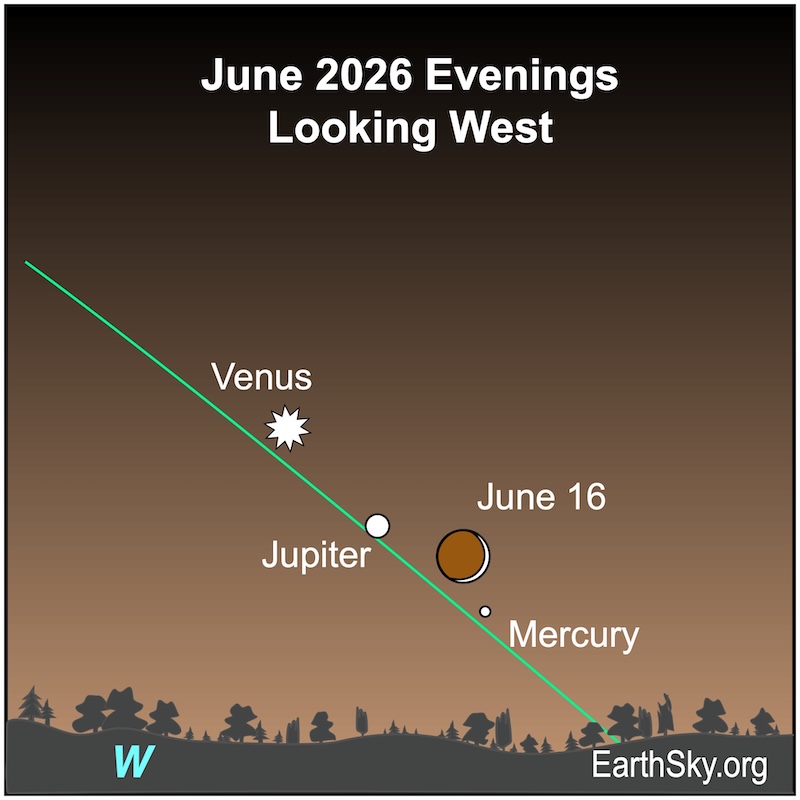
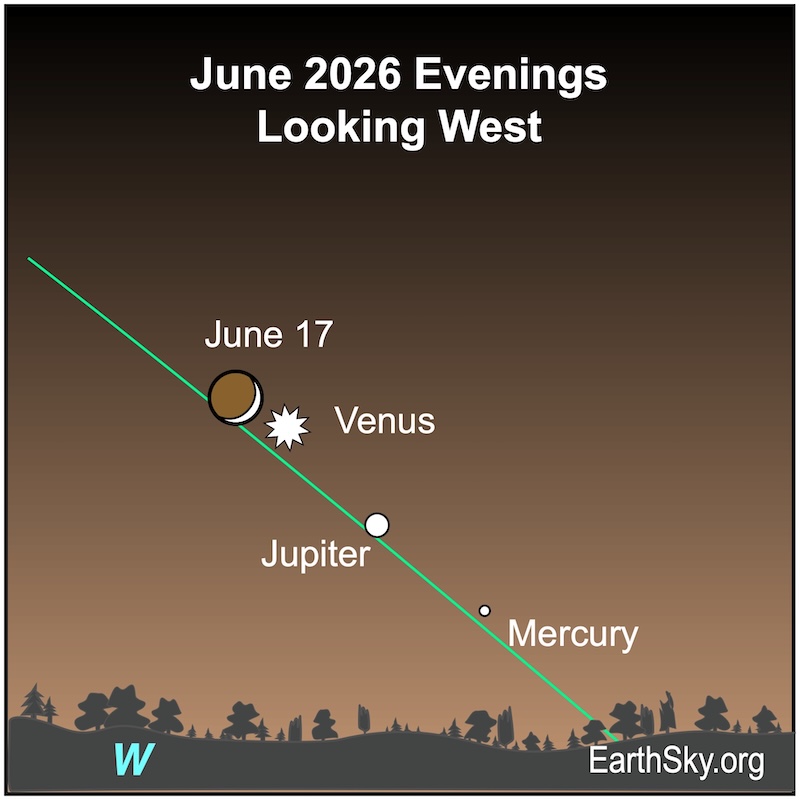
They had their closest pairing, or conjunction, on June 8 and 9. But they’re still close together and making a beautiful sight. Plus, the moon will join the scene for a more dramatic view on June 16 and 17.
Read more: Venus-Jupiter conjunction 2026. Wow! Best photos here
How to see them
Haven’t seen them yet? Here’s what to do. Just look west after sunset. Venus will pop into view first. Jupiter – only slightly fainter than Venus – will appear next. Over the past few weeks, Venus was lower while Jupiter was higher above the horizon, but now they’ve passed each other and switched. In early June, as seen from Earth’s Northern or Southern Hemisphere, the planetary pair will set more than two hours after sunset.
On June 16, a thin crescent moon will make a triangle with Jupiter and Mercury. And on June 17, the moon will be just a bit higher than Venus. Use binoculars to look between the moon and Venus in order to spot a pretty star cluster known as the Beehive. This cluster buzzing with stars lies in the constellation Cancer the Crab.
Venus-Jupiter conjunction: What else to watch for
While watching for the Venus-Jupiter pairing, you might also notice a second, fainter pair of objects nearby. They aren’t planets. They’re distant stars.
They are the two brightest stars in the constellation Gemini the Twins. The brighter one is called Pollux, and its fainter “brother” is called Castor. They’re not nearly as bright as Venus and Jupiter. But they’ll mimic the “doubleness” of the two planets. So they’ll be noticeable if your sky is dark enough.
And lower down, closer to the horizon, you might spot another planet, elusive Mercury. It should be fairly bright, but not nearly as bright as Venus and Jupiter.
Optical aid will enhance the view
You definitely don’t need binoculars or a telescope to see Venus and Jupiter. They’ll outshine all the stars!
But ordinary binoculars will give you an enhanced view. When closest, Venus and Jupiter will easily fit into your binoculars’ field of view. Look for a subtle color difference, with Venus piercing white and Jupiter slightly creamier or yellowish.
With a tripod or steady hand (or by leaning against a wall or fence), your binoculars might show you one or two of Jupiter’s four largest moons. These are the famous Galilean satellites (Io, Europa, Ganymede and Callisto). They’ll look like tiny pinpricks of light, in a line bisecting the planet.
Meanwhile, a telescope will reveal more. Venus is currently in a gibbous phase, between half and fully lit. Didn’t know Venus shows phases? It does!
Brightest vs. biggest
Jupiter and Venus look roughly the same size in our sky. But, if you could see them side by side in space, you would find Jupiter about 12 times wider than Venus. Also, you could fit over 1,000 Venuses inside Jupiter. So why does Venus look brighter to us?
For one, Venus is much closer to us than Jupiter. Right now the two planets might look close together in our sky, but in reality, they are quite far apart. Venus is currently about 111 million miles (180 million km) from Earth. And Jupiter is much farther away at 560 million miles (900 million km) from Earth.
And here’s reason number two why Venus looks brighter. It’s covered with thick clouds that are good at reflecting sunlight. Venus reflects about 70% of the sunlight that strikes it. Meanwhile, Jupiter reflects about 52% of the sunlight that strikes it.
Read more: Why is Venus so bright in our Earth’s sky?
What will the planets do next?
Venus will appear each evening a little farther from the sunset point than Jupiter. Its greatest elongation, or greatest apparent distance from the sun in the twilight sky, will fall on August 14-15, 2026. Afterwards, Venus will drop sunward. It’ll pass between us and the sun in October 2026, and afterwards emerge in the east before dawn.
Meanwhile, Jupiter will continue dropping steadily toward the sunset point. It’ll pass into the sun’s glare in July 2026, moving behind the sun from Earth. It’ll emerge in the east before dawn after about mid-August.
Here’s the view over many weeks, from Wyoming
EarthSky’s Marcy Curran and her husband Martin have been capturing images of Venus and Jupiter with an all-sky camera since early April, at their WyoAstro Observatory near Cheyenne, Wyoming. Thank you, Marcy and Martin!
Bottom line: Did you see the Venus-Jupiter conjunction? The planets are still close together and putting on a show in the west after sunset.
Read more: New evidence of lava tube on Venus found in old radar data
Read more: Lightning on Jupiter is 100 times more powerful than Earth’s
Like what you read?
Subscribe and receive daily news delivered to your inbox.
More from
Kelly Kizer Whitt


Is the Mars Grand Canyon still tectonically active?

Visible planets and night sky guide for October
Why does anything exist? New theory emerges
Euclid was mapping the universe. Then it found a comet