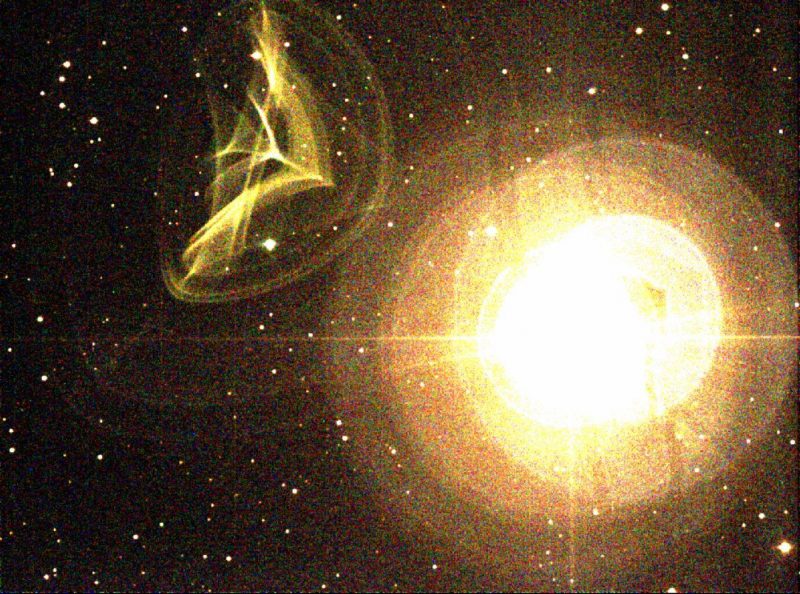
Sometimes lens flares can make an interesting image. That’s the case with this image by Richard Berry. It’s an over-exposed image of Mars and Neptune, captured December 6, 2018. The excess light isn’t in outer space. It’s just collected, in this case in a rather graceful way, on the photo.
Richard Berry – a former editor of Astronomy magazine – caught this fanciful image of Mars (big red blob) and Neptune (bright white dot at about 10 o’clock) on December 6, 2018. It’s a fun pic! Just know that the excess light in this photo isn’t in outer space. It’s caused by the over-exposure, just extra light bouncing around in Richard’s optical system.
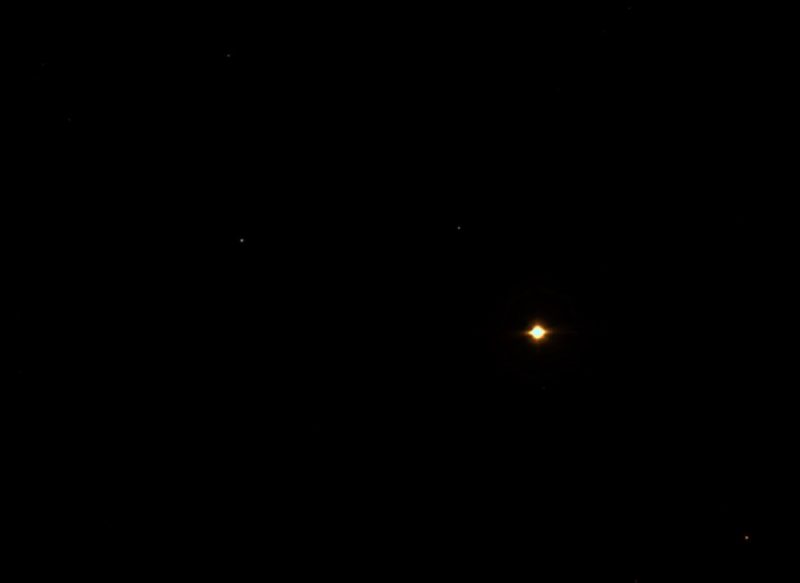
Look below for another photo from Richard, a more realistic approximation of what Mars and Neptune look like now, in our sky, as seen through a telescope.
View larger. | The little blue dot middle left is Neptune. Mars is the bright orange ball in the middle right. Photo taken December 6, 2018 by Richard Berry.
Bottom line: Two photos of Mars and Neptune on December 6, 2018.
Deborah Byrd (asteroid 3505 Byrd) helps edit EarthSky.org and is a frequent host of EarthSky videos. Deborah created the EarthSky radio series in 1991 and founded EarthSky.org in 1994. Prior to that, she had worked for the University of Texas McDonald Observatory since 1976, and created and produced their Star Date radio series. She has won a galaxy of awards from the broadcasting and science communities, including having an asteroid named in her honor in 1990, a Public Service Award from the National Science Board in 2003, and the Education Prize from the American Astronomical Society in 2020. A science communicator and educator since 1976, Byrd believes in science as a force for good in the world and a vital tool for the 21st century. "Being an EarthSky editor is like hosting a big global party for cool nature-lovers," she says.
Like what you read? Subscribe and receive daily news delivered to your inbox.
Thank you! Your submission has been received!
Oops! Something went wrong while submitting the form.
If EarthSky has ever helped you discover something new, prepare for an eclipse, spot a planet, or simply inspired a moment of wonder, today is the perfect day to give back. Your donation helps keep trusted science news, expert night sky guides, and independent science journalism free for everyone.
Please help keep EarthSky going by donating today!
Please help keep
EarthSky going!
If you've already donated, we apologize for the popup and greatly appreciate your support.