



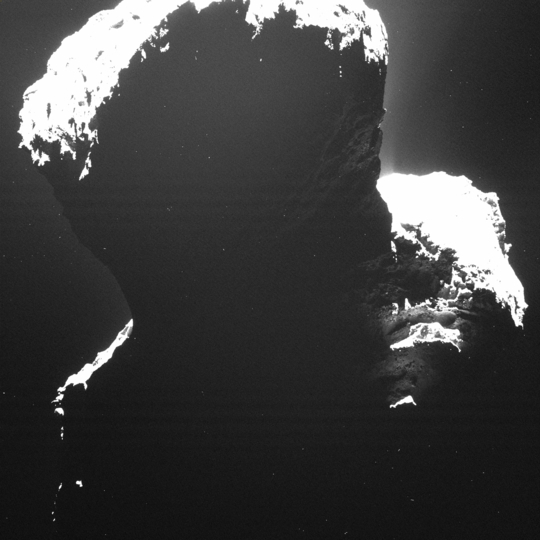
Since the European Space Agency’s Rosetta spacecraft arrived at Comet 67P/Churyumov-Gerasimenko in August, 2014 – and began moving side-by-side with it in orbit around the sun – its cameras have mapped most of the comet’s surface and provided us with some of the most stunning imagery of any space mission so far. Now we know that comets can have steep ravines, sharp cliffs and many boulders. What the spacecraft’s robot eyes were not able to see at first, though, was the comet’s southern side. That side was shrouded in continuous darkness, which, ESA says, is:
… comparable to the weeks of complete darkness in Earth’s polar regions.
Recently, that southern side has begun to be revealed. The images on this page were made possible by sunlight backscattered from dust particles in the comet’s coma, which is growing larger and more active as the comet nears the sun.
In other words, as a comet approaches the sun, as 67P is doing now, it grows warmer. Some of the ices that compose it heat up and become gas, releasing the dust grains that were trapped in the ice. This dusty gas from the nucleus or core of the comet forms the coma, a glowing cloud around the comet. The backscatter of light from 67P’s coma is now illuminating the comet’s dark side and revealing a hint of surface structures, as these images show.
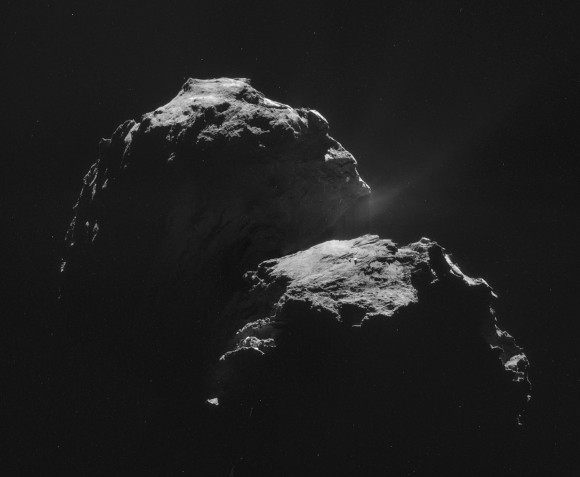
Scientists say this polar night on Comet 67P/Churyumov-Gerasimenko will end in May 2015, and then they’ll get a good look at this part of the comet. That’ll be just a few month’s before the comet’s July 2015 perihelion, or closest point to the sun. So … lots of cool imagery to come in ESA’s outstanding Rosetta mission.
And you don’t even have to wait until May for the next amazing image from Rosetta. On Wednesday of this week, the Rosetta spacecraft will try to place a lander on the comet!
To understand how very difficult that will be, watch this video.
Or check out this article about Wednesday’s attempt to land on a comet.
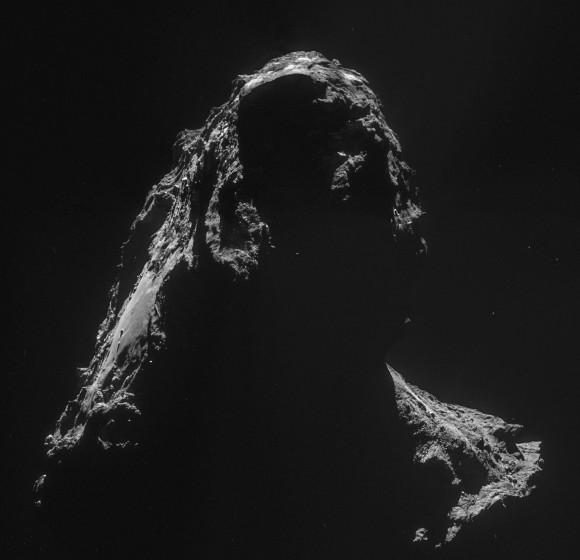
Bottom line: Backscatter of sunlight from the dusty coma now surrounding Comet 67P/Churyumov-Gerasimenko has let the spacecraft’s cameras give most of us stunning images of the nightside of a comet.
Like what you read?
Subscribe and receive daily news delivered to your inbox.
More from
Deborah Byrd


Cassiopeia and Perseus on October evenings

Visible planets and night sky guide for October
Orionid meteor shower 2026: All you need to know
See brightest star, Sirius, in your morning sky



