



Sun news April 30: Solar wind could disturb Earth’s magnetic field
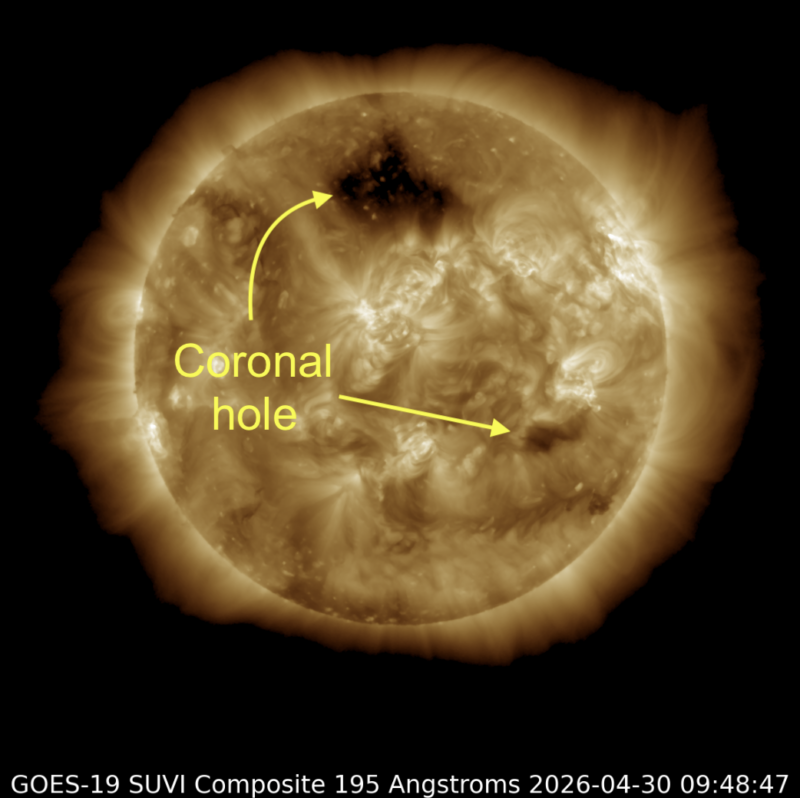
Today’s top story: A large coronal hole – a cooler, less dense region in the sun’s outer atmosphere – is now positioned just above the center of the Earth-viewed sun. It’s located too far north for the fast solar wind it produces to head directly to Earth, but some might reach us over the coming days. Meanwhile, fast solar wind from a smaller coronal hole that was facing Earth a couple of days ago is set to reach Earth later today. This should disturb our magnetic field, possibly triggering G1 (minor) geomagnetic storming and even sparking auroras at northerly latitudes.
Past 24 hours of sun news
(11 UTC April 29 – 11 UTC April 30)
Flare activity
Solar activity returned to low levels with the production of C-class (common) flares only. Over the past day the sun fired 15 C flares, compared to yesterday’s tally of 20 C flares and 3 M flares.
- Strongest flare: C5.1 from active region AR4424 in the solar northwest, peaking at 0:31 UTC on April 29.
- Lead flare producer: AR4420 remains the top flare producer. This sunspot region blasted 8 C flares out of the 15.
Sunspot regions: key players
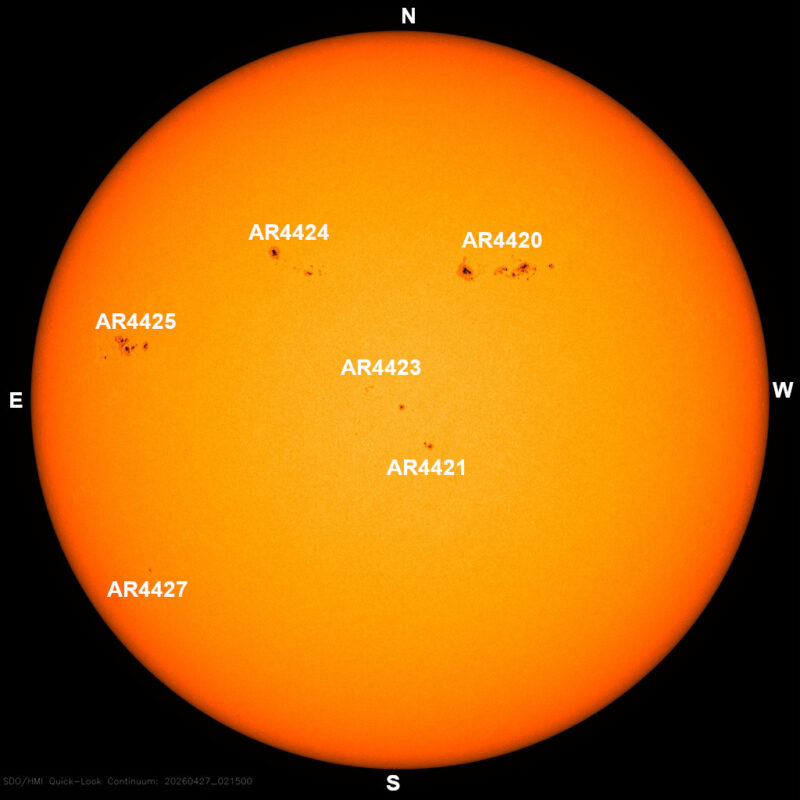
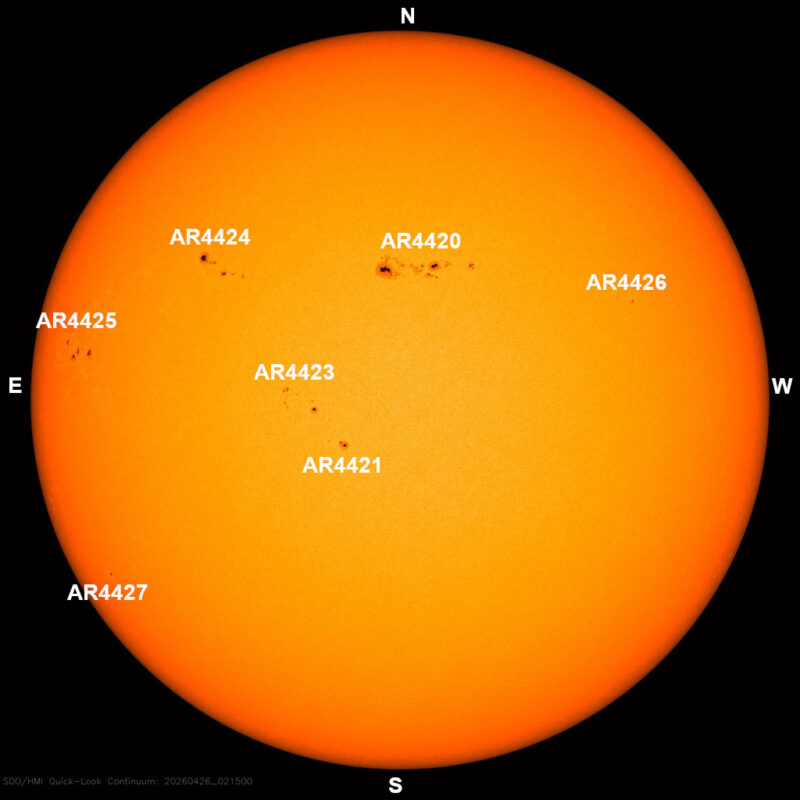
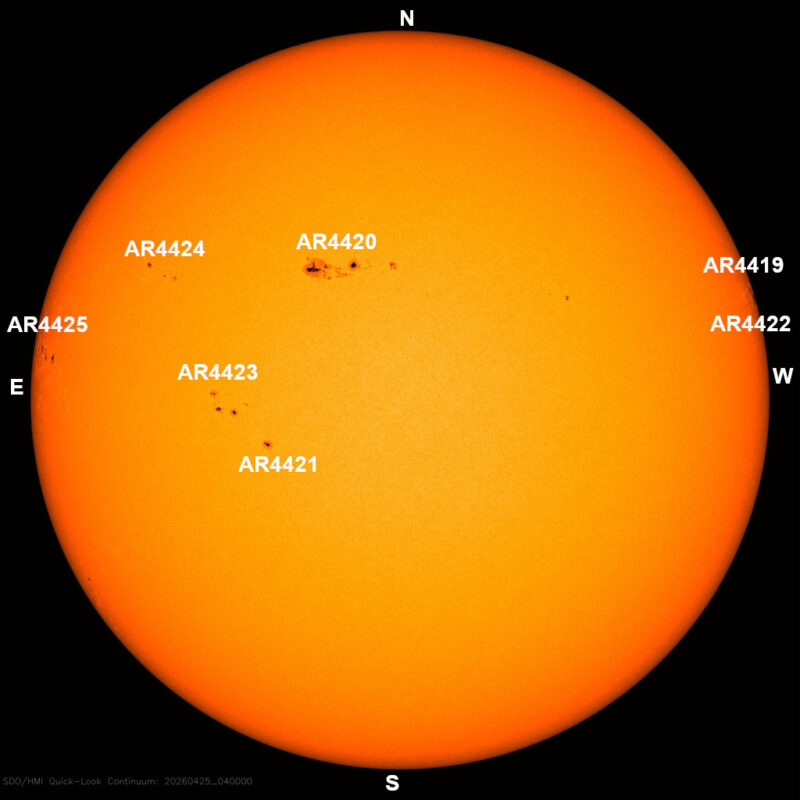
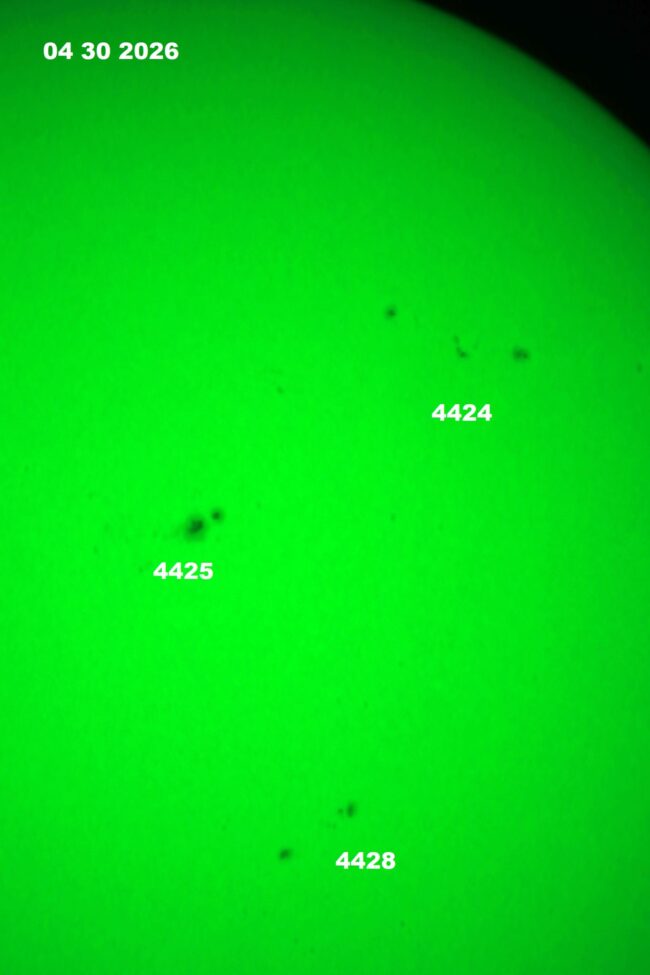
Currently the side of our sun we see from Earth shows 5 numbered active regions. Two continue to dominate:
AR4420 (beta-gamma-delta) retained its overall magnetic complexity, but showed some signs of decay.
AR4425 (beta) lost its delta configuration. That means it’s lost some flare potential.
Blasts from the sun?
No Earth-directed coronal mass ejections (CMEs) were observed during the period.
Past 24 hours in space weather
Solar wind
Solar wind speeds averaged at mostly normal levels during our observation period. The total interplanetary magnetic field (IMF) stayed weak overall.
Bz and magnetic coupling
The Bz component kept shifting from south to north over the past day. This morning, the Bz component turned southward. A southward Bz is favorable for auroras.
Earth’s magnetic field
Earth’s magnetic field was quiet over the past day (Kp 0–2). At the time of this writing the Kp index sits slightly above level 1.
What’s ahead? Sun–Earth forecast
Flare activity forecast
Forecasters expect low-to-moderate levels through April 30. Chances for C-Class flares stay high at 99%. A slight reduction of chances for M flares was noted from 70% yesterday to 65% today. X-class flares dropped to 10% from 20% chance yesterday. All this reflects AR4425 losing its delta and AR4420 showing signs of decay.
Geomagnetic activity forecast
- April 30 (Thursday): Quiet-to-unsettled levels may continue early today, but late during the day an increase to active levels is anticipated (Kp 5). That’s because a stream of high-speed solar wind from a coronal hole should start to arrive. G1 (minor) geomagnetic storm are possible.
- May 1 (Friday): Unsettled-to-quiet conditions may return as fast solar wind from a coronal hole starts to wane.
- May 2 (Saturday): Mostly quiet conditions anticipated.
Sun news April 29: Activity surges with 3 M flares!

Sun activity has picked up over the past day, with an impressive 23 flares fired in 24 hours. And three of those were M flares! These came within just 2 hours, and all from the same sunspot region: AR4420. This region has a complex beta-gamma-delta magnetic setup, meaning it has the potential to unleash strong M or even X (strong) flares. This is certainly the region to watch. Stay tuned!
Past 24 hours of sun news
(11 UTC April 28 – 11 UTC April 29)
Flare activity
Solar activity jumped back up to moderate, thanks to a trio of M flares. Overall flare production also increased; we saw 23 flares (3 Ms plus 20 C-class flares) compared to just 15 C-class flares the day before.
- Strongest flare: M1.6 from AR4420, peaking at 13:53 UTC on April 28. R1 (minor) radio blackout was observed affecting an area over the west coast of Africa.
- Other M flares: Also from AR4420: M1.0 at 12.23 on April 28, causing an R1 (minor) radio blackout over Mauritania. M1.1 flare at 14:07 UTC on April 28, causing an R1 (minor) radio blackout over the Atlantic Ocean west of Africa.
- Lead flare producer: AR4420 continued to lead flare production. It fired 18 of the 23 flares of this period, including the three strongest. Meanwhile, AR4425 contributed 4 flares.
Sunspot regions: key players
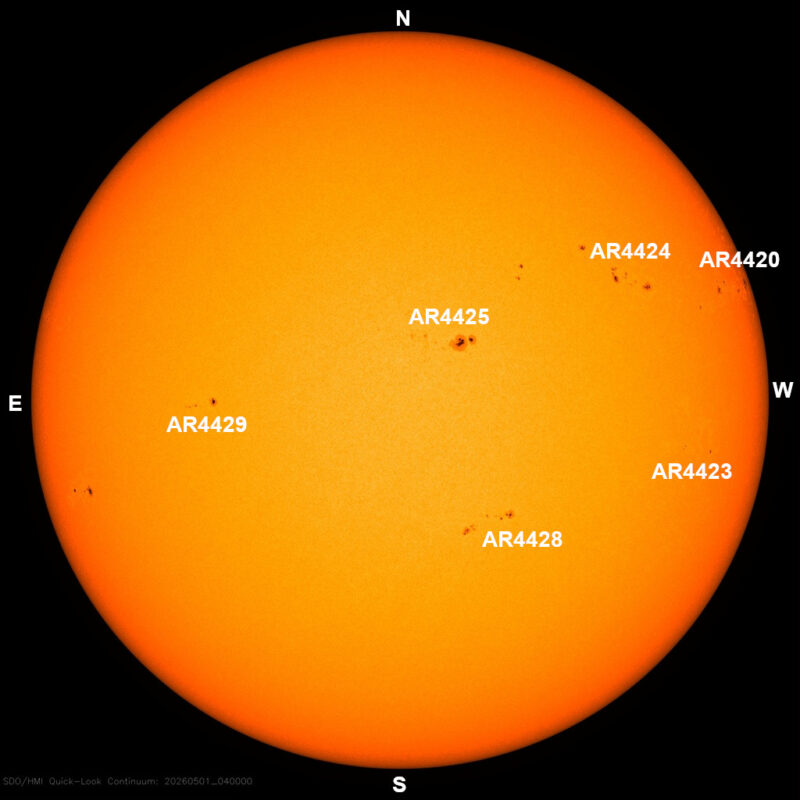
The Earth-facing solar disk showed 7 numbered active regions. Two continue to dominate:
AR4420 (beta-gamma-delta) retained its magnetic complexity.
AR4425 (beta-delta) lost its gamma configuration but keeps its delta. That means it’s lost some potential, but could still stir interesting activity.
Blasts from the sun?
No Earth-directed coronal mass ejections (CMEs) were observed during the period.
Past 24 hours in space weather
Solar wind
Solar wind speeds averaged near normal levels. The total interplanetary magnetic field (IMF) stayed weak overall.
Bz and magnetic coupling
The Bz component was mostly oriented north over the past day. But at 3:30 UTC this morning it turned southward and stayed there up to the time of this writing. A southward Bz is favorable for auroras.
Earth’s magnetic field
Over the past day, Earth’s magnetic field was very quiet (Kp 0–1). The Kp index sits slightly above level 0 at the time of this writing.
Sun news April 28: Activity dips, but sunspot regions look potent
The sun dialed its activity back a notch over the past 24 hours. Sunspot regions AR4420 and AR4425 traded volleys of C-class (common) blasts, but no flare made it over the M-flare (moderate) threshold. But don’t let this lull fool you! Both AR4420 and AR4425 still carry complex beta-gamma-delta magnetic setups, meaning they have the potential to unleash strong M or even X (strong) flares. Stay tuned.
Past 24 hours of sun news
(11 UTC April 27 – 11 UTC April 28)
Flare activity
Over the past day, solar activity dropped to low levels. In total, the sun fired 15 C-class flares.
- Strongest flare: C9.0 from AR4420, peaking at 9:23 UTC on April 28.
- Lead flare producer: AR4420 dominated the period. It fired 9 of the 15 flares, including the two strongest. Meanwhile, AR4425 contributed 5 flares.
Sunspot regions: key players
The Earth-facing solar disk showed 7 numbered active regions. Two continue to dominate:
AR4420 (beta-gamma-delta) remained the top flare producer. Slight decay appeared in its middle spots. Its delta setup has weakened somewhat. Even so, significant complexity persists. Two delta spots remain, keeping this region capable of strong eruptions as it moves through the northwest quadrant.
AR4425 (beta-gamma-delta) was the second most active region. It showed moderate growth and consolidation. The region features at least two delta spots. Notably, its position in the northeast means any sun-stuff it sends into space will likely come our way.
Blasts from the sun?
No clearly Earth-directed coronal mass ejections (CMEs) were confirmed during the period.
Past 24 hours in space weather
Solar wind
Solar wind speeds held near normal levels. The total interplanetary magnetic field (IMF) stayed weak overall.
Bz and magnetic coupling
The Bz component fluctuated between north and south, but pointed mostly northward. As a result, Earth’s magnetic shield stayed closed and aurora activity remained subdued.
Earth’s magnetic field
Over the past day, Earth’s magnetic field ranged from quiet to unsettled (Kp 1–3).
Sun news April 27: Powerful M6 flare caps day of high activity

The sun fired off a powerful M6 flare late yesterday, capping a busy 24-hour stretch that pushed activity to high levels. In total, our star fired 4 M-class (moderate) and 17 C-class (common) flares over the past day. That is a relentless barrage, driven primarily by two complex sunspot regions: AR4425 and AR4420. AR4420 was responsible for the M6 eruption, which peaked at 22:51 UTC. Forecasters are determining whether this blast fired any sun-stuff into space. If so, the solar material would have a decent chance of reaching Earth, since AR4420 fired the flare from near the center of the solar disk. Stay tuned!
Past 24 hours of sun activity
(11 UTC April 26 – 11 UTC April 27)
Flare activity
Over the past day, solar activity reached high levels. In total, the sun fired 21 flares: 4 M-class and 17 C-class.
- Strongest flare: M6.0 from AR4420 at 22:51 UTC on April 26. It triggered an R2 (moderate) radio blackout, degrading high-frequency radio over the sunlit Pacific and East Asia.
- Other M-class flares: M2.2 from AR4425 at 19:54 UTC on April 26. M1.7 from AR4420 at 19:18 UTC on April 26. M1.0 from AR4425 at 6:39 UTC on April 27.
- Lead flare producer: AR4420 dominated the period. It fired 14 of the 21 flares, including the M6.0 and one additional M-class event. Meanwhile, AR4425 contributed 6 flares, including two M-class blasts.
Sunspot regions
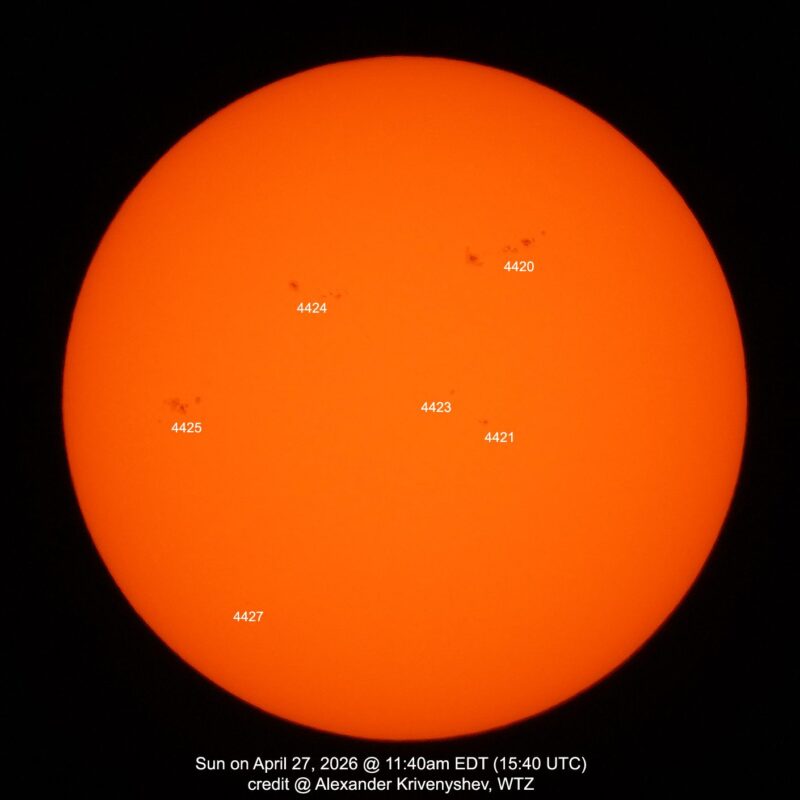
The Earth-facing solar disk currently shows 7 numbered active regions. Two stand out:
AR4420 (beta-gamma-delta) is the dominant region. Its complex delta setup and ongoing evolution keep it firmly in the spotlight.
AR4425 (beta-gamma-delta) continued to grow. It appears to have developed multiple delta setups. However, its position on the eastern edge of the solar disk makes a full assessment difficult.
Blasts from the sun?
No Earth-directed coronal mass ejections (CMEs) were confirmed during the period.
Past 24 hours in space weather
Solar wind
Solar wind speeds were slightly elevated, thanks to a waning coronal hole high-speed solar wind stream. The total interplanetary magnetic field peaked at moderately strong levels but averaged at normal levels.
Bz and magnetic coupling
The Bz component was highly variable, swinging between deep northward and southward peaks. Each southward dip opened the door for solar particles to flow into Earth’s atmosphere, bringing enhanced geomagnetic activity.
Earth’s magnetic field
Over the past day, Earth’s magnetic field ranged from quiet to active levels. The active intervals were enough to produce minor aurora enhancements at high latitudes.

The sun in recent days
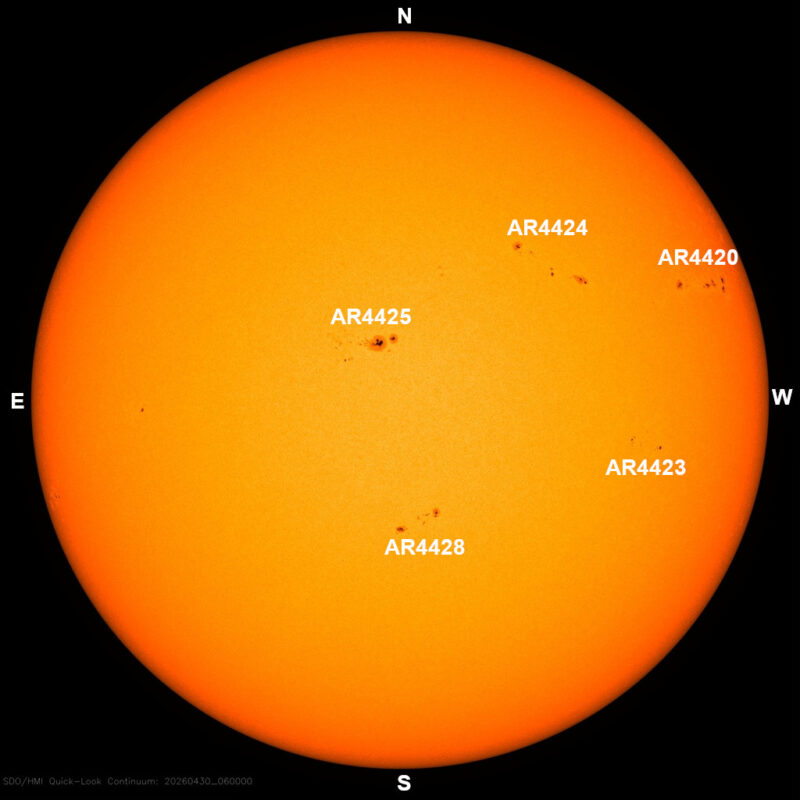
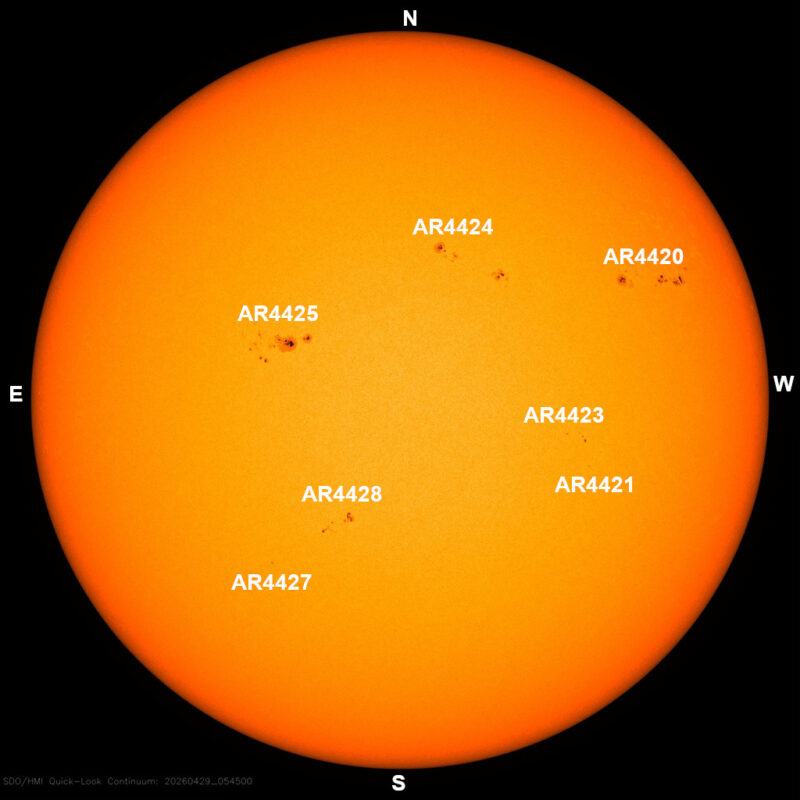
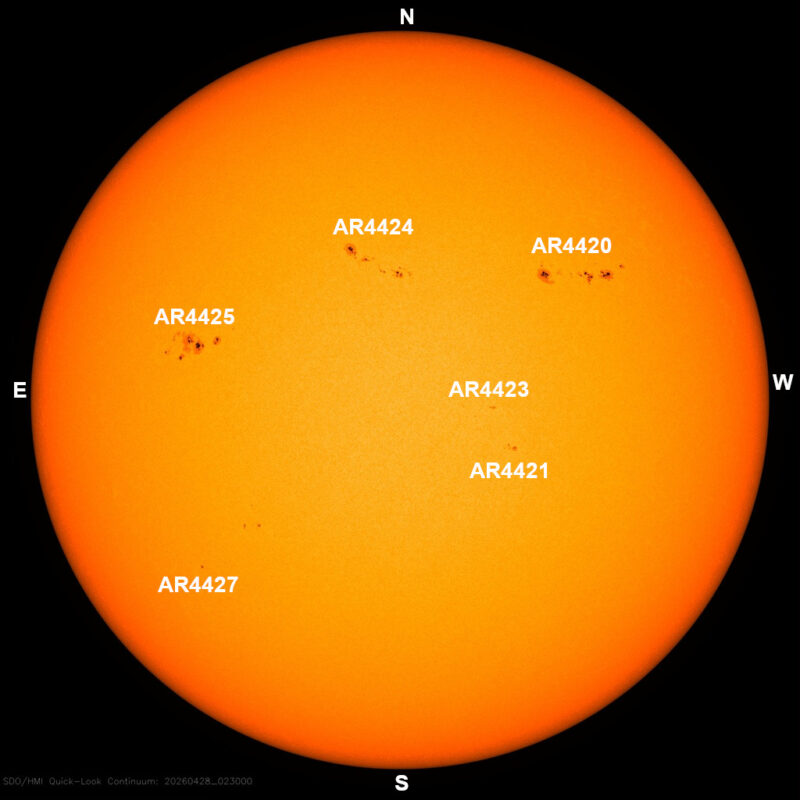
Earlier sun images
Sun images from our community
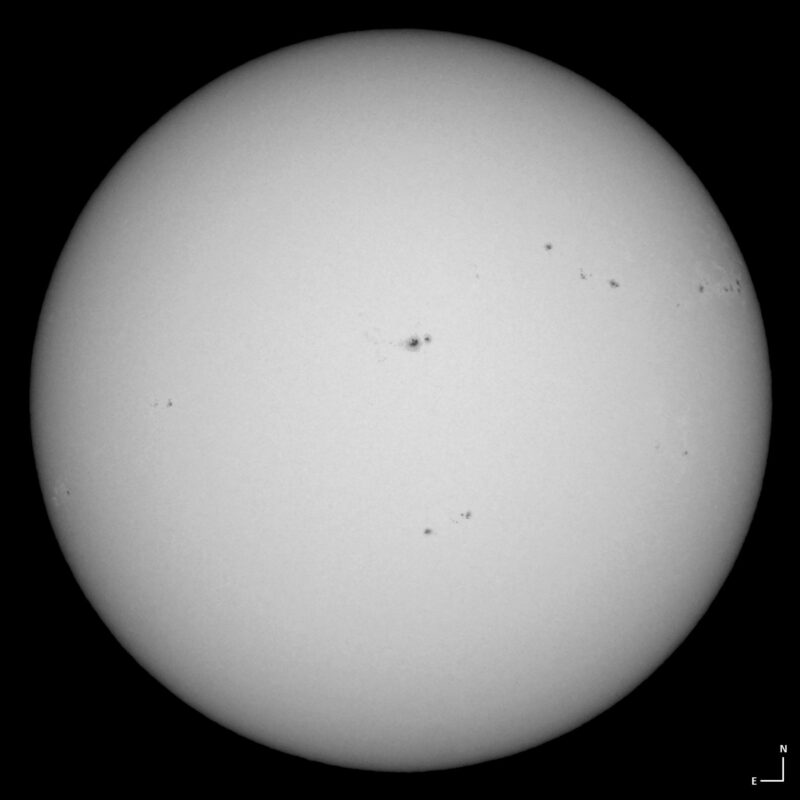
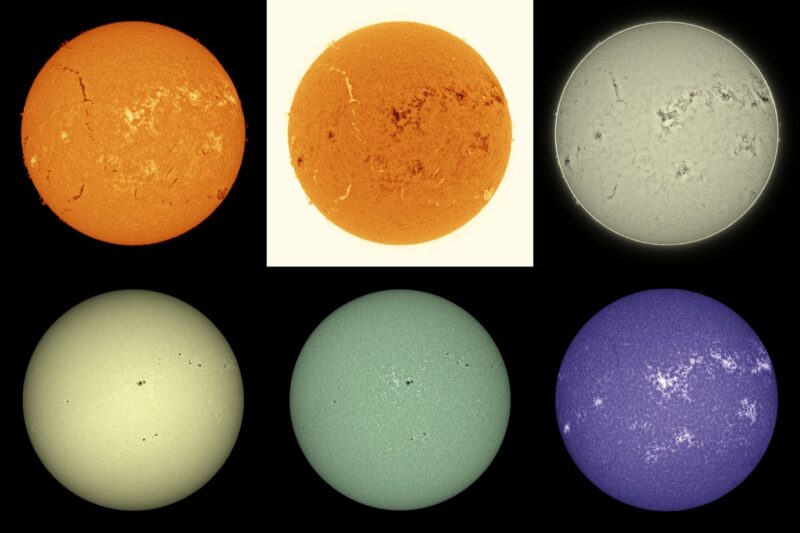
More sun images from our community
We sometimes feature sun images obtained using hydrogen-alpha filters. Read why.
Bottom line: Sun news for April 30, 2026: Fast solar wind from a coronal hole could bring G1 (minor) geomagnetic storms tonight. Auroras are possible at high latitudes.
Like what you read?
Subscribe and receive daily news delivered to your inbox.
More from
C. Alex Young


Sun activity archive for April 2026

Sun activity archive for March 2026
Sun activity archive for February 2026


