




Sun news October 26: The Halloween Storms of 2003!
Today’s top story: Twenty-three years ago, the sun looked a lot like it does now. Solar Cycle 23 was winding down, and few expected fireworks. Suddenly, three monster sunspot regions appeared and unleashed some of the most powerful solar storms of the space age. They’re known today as the Halloween Storms of 2003.
And they started quietly. Around October 18, 2003, sunspot region AR10484 rotated onto the sun’s northeast limb. It grew fast into one of the cycle’s biggest sunspot groups. Next, AR10486 announced itself from behind the sun’s limb with an M9.9 (moderate) flare on October 22. And the next day, it fired an X5.4 (strong) flare with a large coronal mass ejection (CME). It would become the largest sunspot group of Solar Cycle 23. On October 25, a third region, AR10488, began emerging near the disk center.
Then, 23 years ago today — on October 26, 2003 — the sun fired a double shot. AR10486 launched an X1.2 flare, which sent a huge wave through the sun’s corona. That evening, AR10484 answered with its own X1.2. And the biggest blasts were still to come. Follow along this week as we relive the Halloween Storms, day by day!
Past 24 hours on the sun
(11 UTC October 25 – 11 UTC October 26)
Flare activity: Solar activity stayed low over the past day. Observers recorded 10 flares: 4 C-class (common) and 6 B-class (weak).
- Strongest flares: Three C1.5 flares tied for the top spot. AR4560 fired one at 19:42 UTC on October 25 and another at 01:34 UTC on October 26. Then AR4551 matched them with a C1.5 at 05:44 UTC on October 26.
- Other notable flares: AR4551 also produced a C1.3, peaking at 03:55 UTC on October 26.
- Lead flare producer: AR4560 generated 7 of the 10 flares, including 2 C-class events. AR4551 contributed the other 3, also including 2 C-class events.
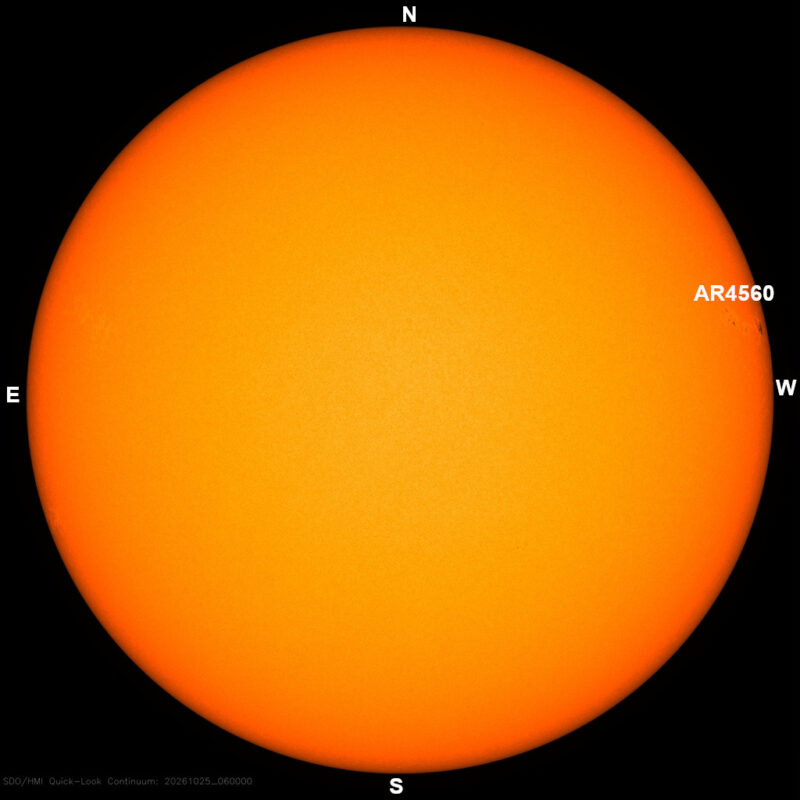
Sunspot regions: Two numbered sunspot regions sat on the visible disk during the past day, while a third rotated out of view. In addition, observers spotted two regions of emerging flux in the southwest and southeast quadrants. Neither has received a number yet.
- AR4560 (beta): This moderately sized region was the period’s most prolific flare producer. It now sits right at the western limb, rotating out of view. So its activity should fade as it disappears around the edge.
- AR4551 (beta): This southern hemisphere region produced three flares, including one of the period’s three C1.5 flares. It keeps a simple beta configuration.
- AR4557: According to the SIDC, this region has rotated behind the west limb and is no longer visible. Its sunspot group had decayed into plage.
Blasts from the sun? Observers spotted 2 CMEs on October 25. Neither should impact Earth.
- The first CME appeared in SOHO LASCO imagery starting at 03:15 UTC on October 25. It likely came from a prominence eruption over the east limb. Analysts estimated its speed at about 360 km/s.
- A second, slower CME appeared starting at 05:36 UTC on October 25, at an estimated 275 km/s.
- Meanwhile, a CME from October 21 (SIDC CME 733) may still deliver a glancing blow early on October 26. However, forecasters assign this scenario low confidence, and no model runs predict a definite Earth impact.
Past 24 hours in space weather
Solar wind: Solar wind speeds stayed slow, varying between about 330 and 420 km/s. Density ran below average.
Bt, Bz and magnetic coupling: The total interplanetary magnetic field (Bt) stayed weak, at or below 6 nT. Meanwhile, the north-south component (Bz) varied weakly between about +4 and -4 nT, with no significant sustained southward intervals.
Earth’s magnetic field: Geomagnetic activity stayed quiet, with the Kp index ranging from 0 to 2. No geomagnetic storms occurred. Aurora displays stayed limited to the typical high-latitude ovals.
Energetic particles: The greater than 2 MeV electron flux reached high levels, peaking at 2,864 pfu at 18:20 UTC on October 25. Meanwhile, the greater than 10 MeV proton flux remained at background levels. No solar radiation storms occurred.
What’s ahead? Sun–Earth forecast
Flare activity forecast: Forecasters expect very low to low activity through October 28. A slight chance exists for isolated M-class (R1-R2) flares on October 26. However, those odds shrink as AR4560 rotates off the disk. C-class flares remain likely, at 50% or greater per the SIDC.
- October 26: Expect very low to low levels, with a slight chance of an M-class flare. As AR4560 rotates beyond the west limb, its geoeffectiveness fades. Meanwhile, AR4551 could produce more low-level C flares.
- October 27: Very low to low levels should continue. C-class flares are possible from AR4551 and the two unnumbered emerging regions, if they develop further.
- October 28: Activity should stay subdued, at very low to low levels, with no complex regions on the disk.
Geomagnetic activity forecast:
- October 26: Expect mostly quiet conditions (Kp 0-2). However, a possible glancing blow from the October 21 CME, plus the possible onset of a coronal hole high-speed stream, could briefly push conditions to unsettled or active levels (Kp 3-4). So aurora watchers at high latitudes should keep an eye out, just in case.
- October 27: Quiet conditions (Kp 0-2) should prevail under nominal solar wind.
- October 28: Expect quiet conditions (Kp 0-2), with no significant drivers in sight.
The sun in recent days
Sun images from our community
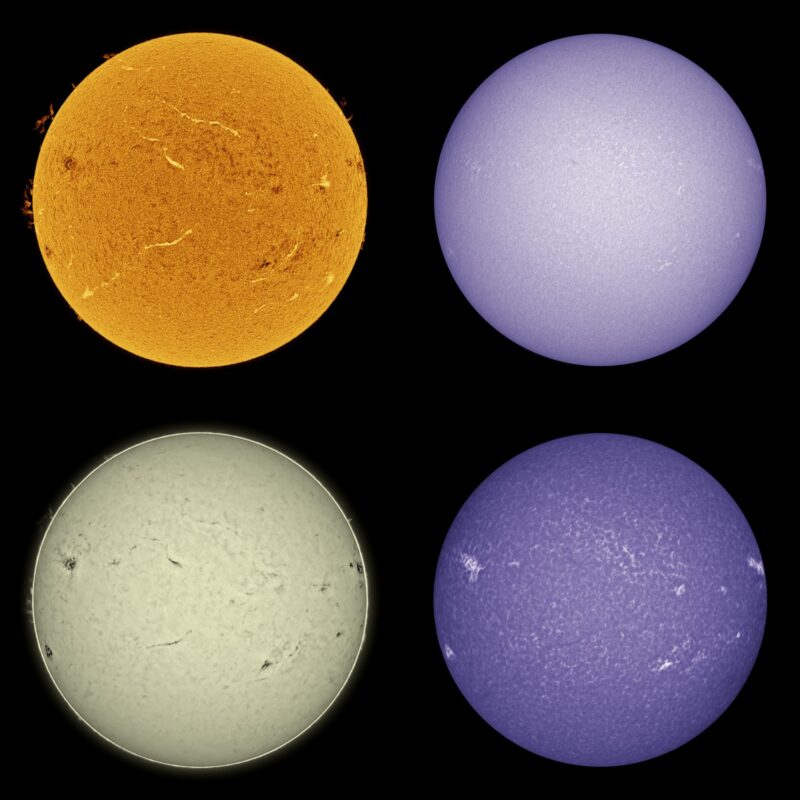
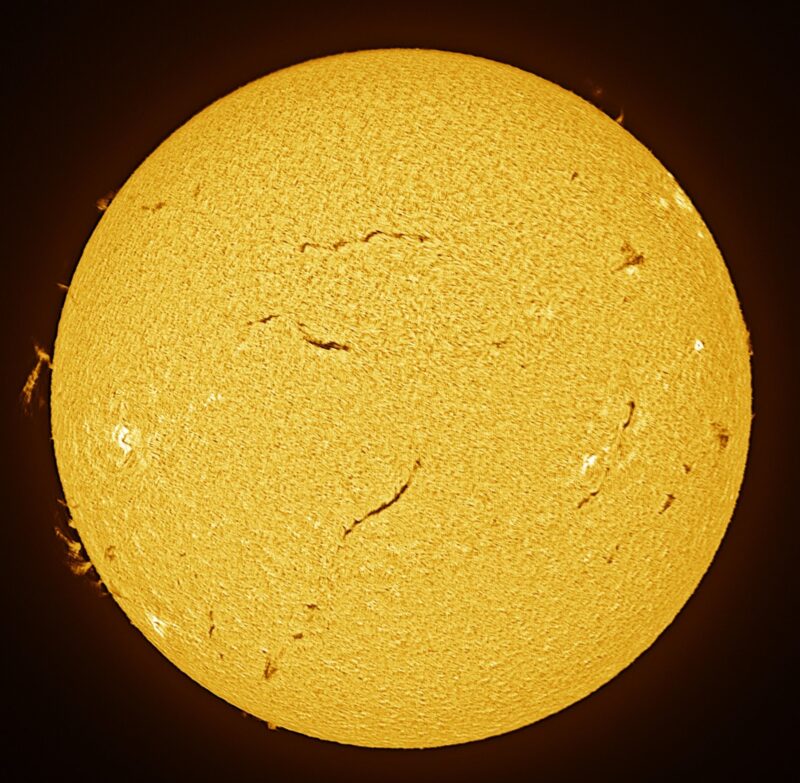
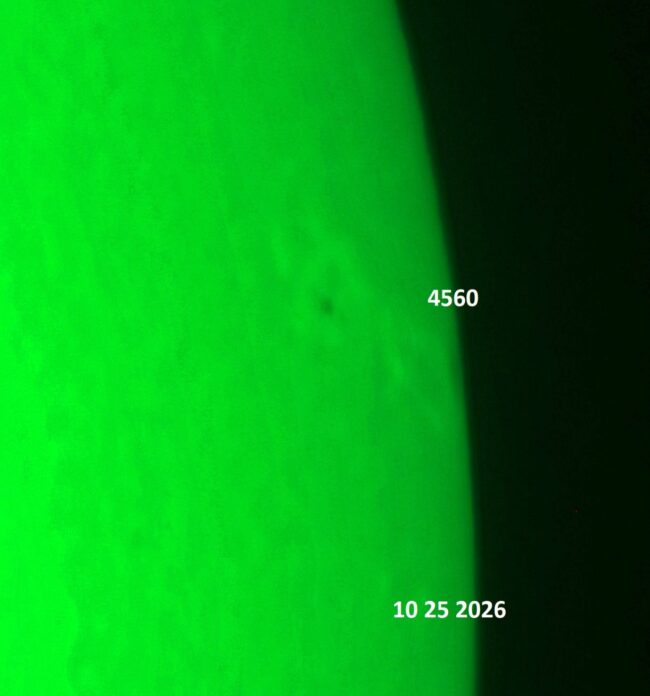
We sometimes feature sun images obtained using hydrogen-alpha filters. Read why.
Bottom line: Sun news October 24, 2026: On this date in 2003, the sun fired 2 X flares as monster sunspots grew. The 2003 Halloween Storms were just getting started!
Like what you read?
Subscribe and receive daily news delivered to your inbox.
More from
C. Alex Young


Yes, there’s an aurora season, and it’s here

Sun activity archive for September 2026
Sun activity archive for August 2026
Sun activity archive for July 2026



