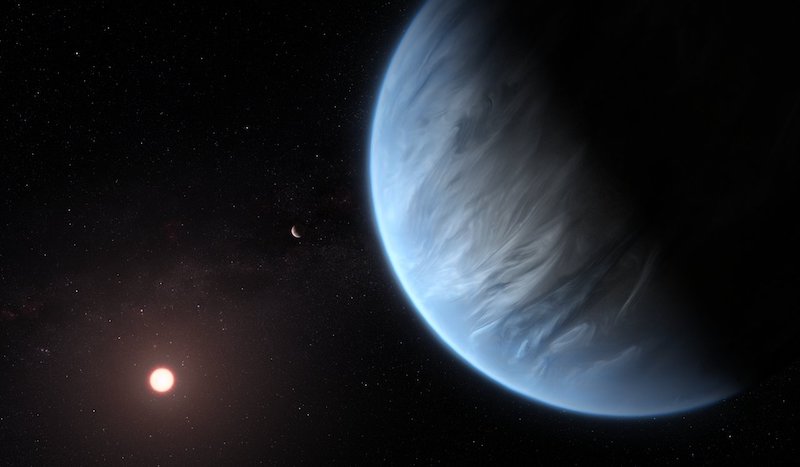
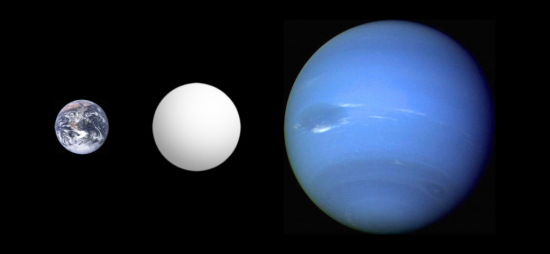
- Super-Earths are rocky planets orbiting distant stars. They’re much larger and more massive than Earth, but smaller than Neptune.
- Astronomers have found over 1,800 super-Earths out of the more than 6,000 confirmed exoplanets so far.
- There are no super-Earths in our own solar system. But many other distant star systems have them!
Super-Earths are the most common exoplanets
We know that – among populations of stars in our Milky Way galaxy – the small stars vastly outnumber the larger ones. Likewise, studies suggest that small planets outnumber big ones. Interestingly, the most common planets appear to be those just a bit larger than Earth but smaller than Neptune — the so-called super-Earths.
Astronomers would like to know … what are super-Earths made of? And what are they like on the inside?
Knowing what these worlds are like geologically might help us search for life on super-Earths. We have no evidence yet that such life exists. But nothing rules it out, either. Some super-Earths might even be excellent places for life. That’s why scientists want to learn as much about them as possible.
Are super-Earths solid on the inside?
The most recent study of the composition of super-Earths is from researchers at Princeton University in New Jersey, on July 18, 2026. The research suggests that many super-Earths might have mantles that are solid deeper down. This would be due to certain minerals that take on unusual forms in the heat and pressure inside super-Earths, at those depths.
This could include minerals such as magnesium orthosilicate (Mg2SiO4), bridgmanite and ferropericlase. Those minerals could resist the heat and pressure, remaining solid instead of melting. As explained in an Eos article from August 6, 2026:
One of these high-pressure forms is called the spinel phase, aka the spinel group, which is found in Earth’s mantle. At even higher pressures, this phase breaks down into two different minerals: bridgmanite, the most abundant mineral phase in Earth, and ferropericlase, a magnesium-rich oxide.
But, under the far more extreme pressures expected inside super-Earths, Mg2SiO4 becomes stable again in an entirely new crystal structure called post-post-spinel.
Scientists predict that this ultrahigh-pressure phase of Mg2SiO4 is one of the dominant minerals in the deep mantles of super-Earths, making its melting behavior important for understanding how these planets form and evolve.
Various possibilities
Not all super-Earths necessarily have solid mantles though. There might be various kinds of super-Earths. We tend to think of super-Earths as just larger versions of Earth. But it’s not quite that simple. A super-Earth could be a bigger version of our own Earth; mostly rocky, with an atmosphere. Or it could be a mini-Neptune, with a large rock-ice core encapsulated in a thick envelope of hydrogen and helium. Or a super-Earth might be a water world … a rocky core enveloped in a blanket of water and perhaps an atmosphere composed of steam (depending on the temperature of the planet). These would be worlds completely covered by oceans.
Heather Knutson is an assistant professor of planetary science at Caltech. She and her students use space-based observatories like the Hubble and Spitzer Space Telescope to learn more about super-Earths. Knutson said:
It’s really interesting to think about these planets because they could have so many different compositions, and knowing their composition will tell us a lot about how planets form.
Water worlds
For example, because planets in this size range acquire most of their mass by pulling in and incorporating solid material, water worlds initially must have formed far away from their parent stars, where temperatures were cold enough for water to freeze. Most of the super-Earths known today orbit very close to their host stars. If water-dominated super-Earths turn out to be common, it would indicate that most of these worlds did not form in their present locations but instead migrated in from more distant orbits.

Characterizing super-Earths
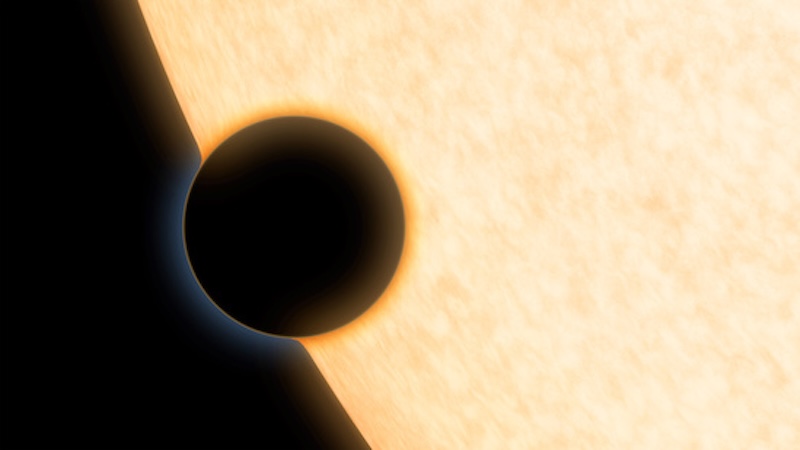
Knutson and her team use orbiting telescopes to analyze the starlight filtering through exoplanet atmospheres. They caught the planets as they passed in front of their stars, as viewed from Earth. In this way, the team was able to characterize nearly two dozen of the gas giant exoplanets known as hot-Jupiters, showing that these sorts of worlds have water, carbon monoxide, hydrogen, helium and potentially carbon dioxide and methane in their atmospheres.
But what about the super-Earths? So far, only a few are close enough and orbiting bright enough stars for astronomers to study them with currently available telescopes and techniques.
Studying the atmosphere of GJ 1214 b
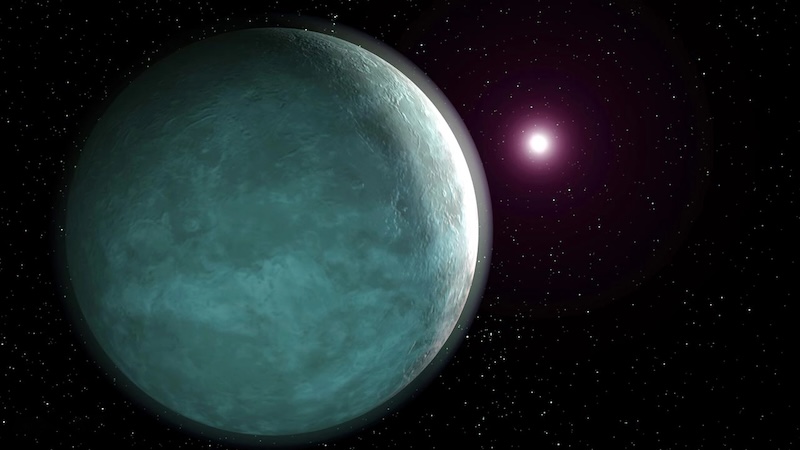
The first super-Earth targeted by astronomers for atmospheric studies was GJ 1214 b, in the direction to our constellation Ophiuchus the Serpent-Bearer. Based on its average density (determined from its mass and radius), astronomers believed from the start this planet was not entirely rocky. But its density could be equally well matched by either a primarily water composition or a Neptune-like composition with a rocky core surrounded by a thick gas envelope.
Information about the atmosphere could help astronomers determine which one it was: a mini-Neptune’s atmosphere should contain lots of molecular hydrogen, while a water world’s atmosphere should be water dominated.
GJ 1214 b has been a popular target for the Hubble Space Telescope since its discovery in 2009. Disappointingly, after a first Hubble campaign led by researchers at the Harvard-Smithsonian Center for Astrophysics, the spectrum came back featureless. There were no chemical signatures in the atmosphere. After a second set of more sensitive observations led by researchers at the University of Chicago returned the same result, it became clear that a high cloud deck must be masking the signature of absorption from the planet’s atmosphere. Knutson said:
It’s exciting to know that there are clouds on the planet, but the clouds are getting in the way of what we actually wanted to know, which is what is this super-Earth made of?
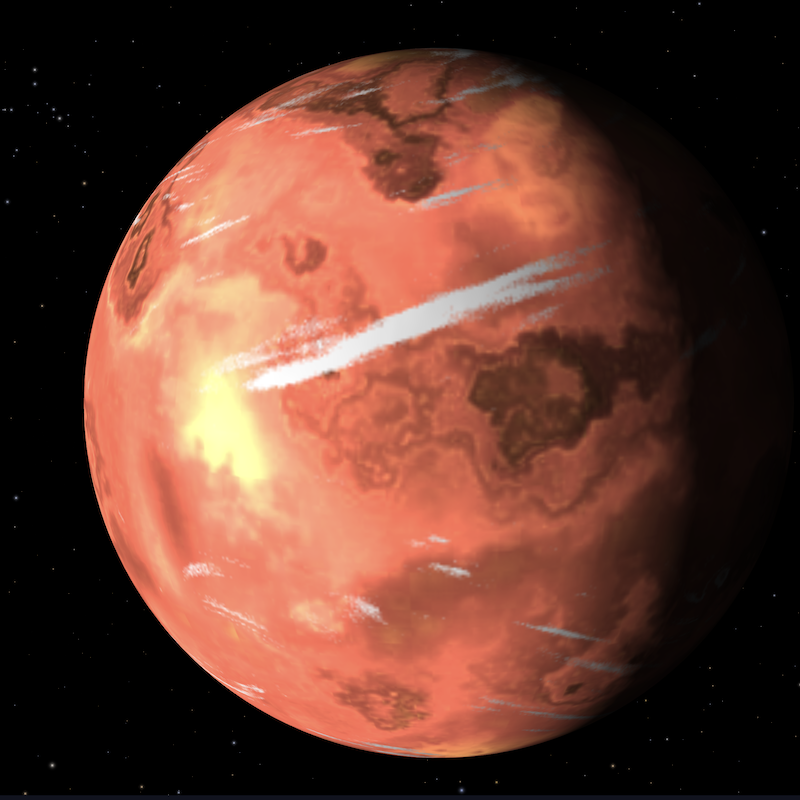
HD 97658 b
Knutson’s team has also studied a second super-Earth: HD 97658 b, in the direction of the constellation Leo the Lion. They report their findings in the current issue of The Astrophysical Journal. The researchers used Hubble to measure the decrease in light when the planet passed in front of its parent star over a range of infrared wavelengths in order to detect small changes caused by water vapor in the planet’s atmosphere.
However, again the data came back featureless. One explanation is that HD 97658b is also enveloped in clouds. But, Knutson says, it’s also possible that the planet has an atmosphere that is lacking hydrogen. Because such an atmosphere could be very compact, it would make the telltale fingerprints of water vapor and other molecules very small and hard to detect. She said:
Our data are not precise enough to tell whether it’s clouds or the absence of hydrogen in the atmosphere that’s causing the spectrum to be flat. This was just a quick first look to give us a rough idea of what the atmosphere looked like. Over the next year, we will use Hubble to observe this planet again in more detail. We hope those observations will provide a clear answer to the current mystery.
Many more discoveries to come
In the future, new surveys, such as those from the Nancy Grace Roman Telescope, will find many more super-Earths and other exoplanets. NASA’s extended Kepler K2 mission and the Transiting Exoplanet Survey Satellite (TESS), have already identified a large sample of new super-Earth targets.
Of course, she says, astronomers would love to study exoplanets the size of Earth. But these worlds are just a bit too small and too difficult to observe with Hubble and Spitzer. NASA’s James Webb Space Telescope has provided the opportunity to study more super-Earth and other worlds. She commented:
Super-Earths are at the edge of what we can study right now. But super-Earths are a good consolation prize. They’re interesting in their own right, and they give us a chance to explore new kinds of worlds with no analog in our own solar system.
Bottom line: Astronomers struggle to learn about super-Earths – bigger than our Earth, smaller than Neptune – the most common type of exoplanet found.
Read more: Super-Earths might be solid deep on the inside
Read more: Powerful magnetic fields on super-Earths could boost chances of life
Like what you read?
Subscribe and receive daily news delivered to your inbox.
More from
Editors of EarthSky


Are day and night equal on the equinox? Not exactly

The equinox sun rises due east and sets due west
Venus brightest in the evening sky this week
See Venus in the daytime: Here are 3 tips