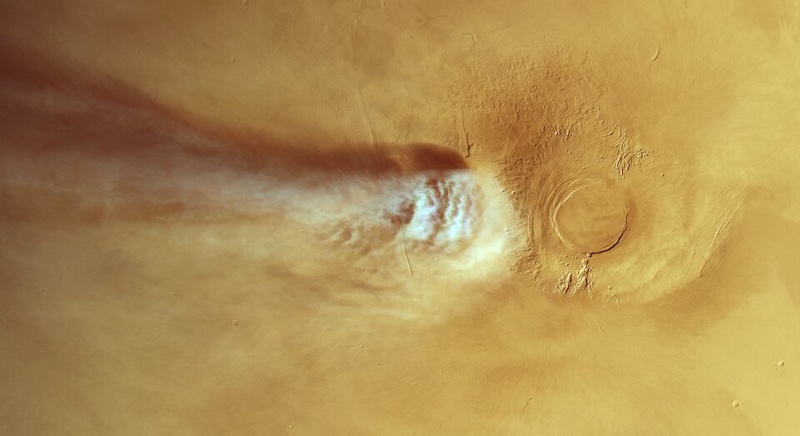
- Clouds are fairly common on Mars, despite the thin atmosphere. And some of them can be a bit more unusual than others.
- The Arsia Mons Elongated Cloud (AMEC), extending from the volcano Arsia Mons, is one such cloud. It reappears every spring and summer, forming downwind from the volcano. But how and why?
- ‘Exotic physics,’ not actually seen before, can explain the behavior of the weirdest cloud on Mars, a new study from France says.
The weirdest cloud on Mars
Mars’ atmosphere is extremely thin. But the red planet does have clouds. And some of them can be … well, unusual.
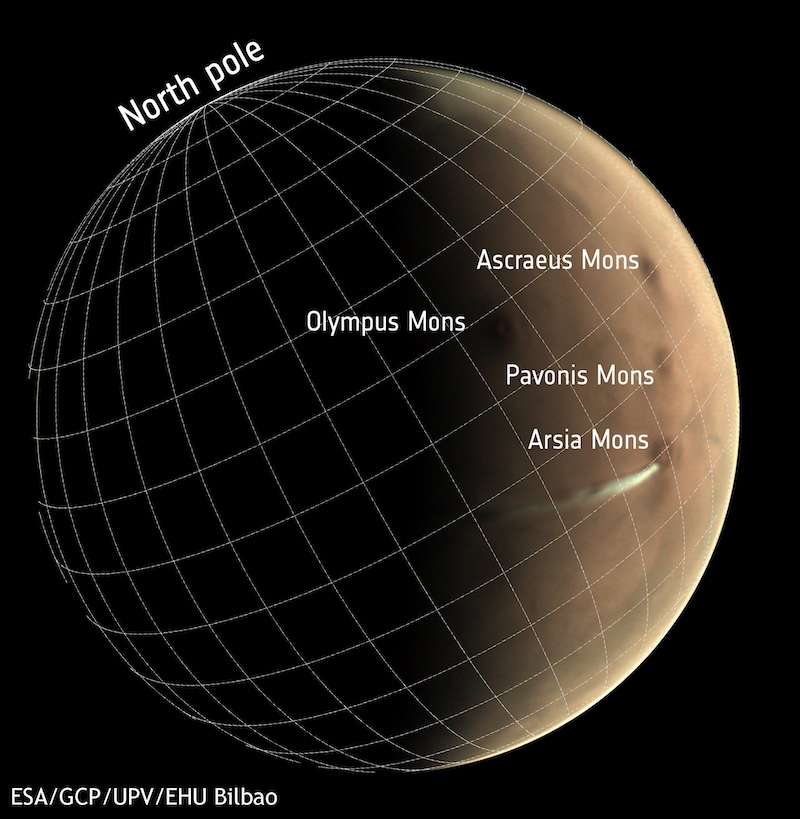
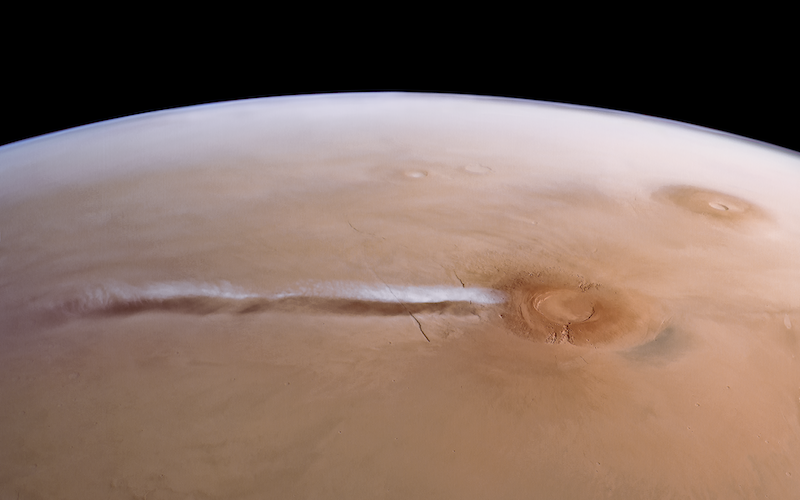
The weirdest cloud on Mars is a vast, elongated formation extending from an ancient volcano on Mars, called Arsia Mons. So scientists call this cloud the Arsia Mons Elongated Cloud (AMEC). It forms every spring and summer, downwind of the volcano. It grows and then fades away every day during this period. But why and how?
The cloud can stretch up to 920 miles (1,500 km) in length! The European Space Agency’s Mars Express orbiter first saw the cloud in 2018. And it has often observed it ever since. But despite years of observations, its extraordinary length and daily cycle have remained difficult to explain.
The researchers, from Sorbonne University in Paris, France, said on October 7, 2026, that new simulations suggest that “exotic physics” might be behind this weird cloud.
They published their peer-reviewed paper in Nature Geoscience on October 7, 2026.
‘Exotic physics’ needed to explain weirdest cloud on Mars
Previous simulations weren’t able to model how the cloud should form. But now, the new simulations do, and reveal something interesting. Lead author Jorge Hernández-Bernal at LMD/CNRS/Sorbonne University said:
To create the AMEC in our modeling, we found that we needed to include some exotic physics … physics that, while included in textbooks, is treated as theoretical and usually thought not to happen in nature. It certainly hasn’t been seen in action before. Once we included this physics in our simulations, the AMEC emerged just as we hoped.
An unexpected process
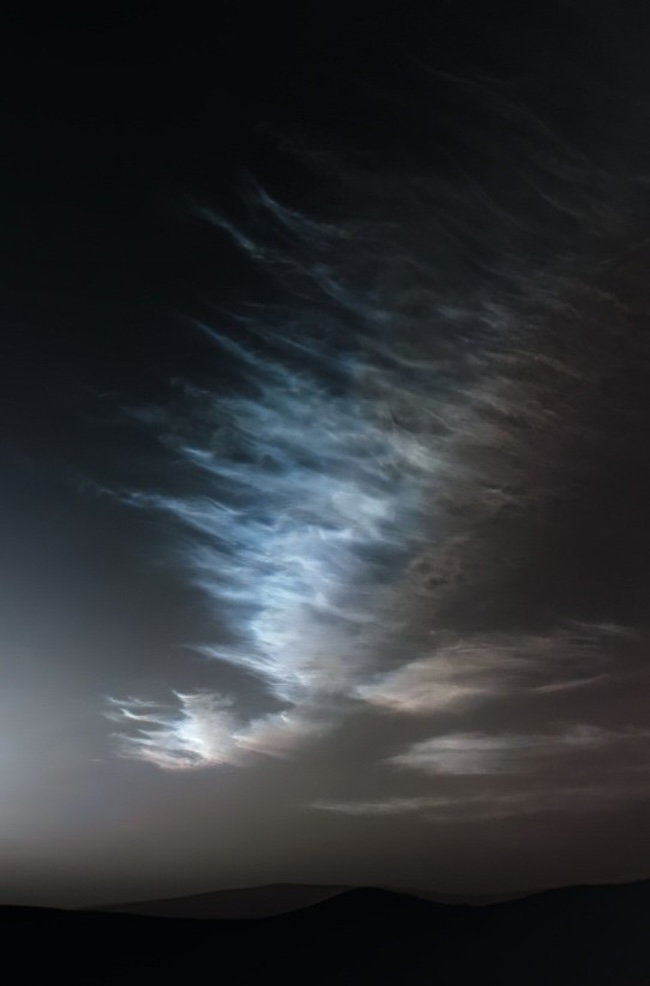
Most clouds — on both Mars and Earth — form in cool, moist air. The water vapor condenses onto particles floating in the atmosphere, such as salt, pollen, soot or dust.
But for the Arsia Mons Elongated Cloud, something is different. The icy particles or droplets don’t need a “seed” particle to form. Hernández-Bernal said:
For the AMEC, it seems that cloud formation takes place without needing any of this ‘stuff.’ Water vapor turns directly into icy cloud particles without any middle step. It’s akin to droplets of condensation appearing in the middle of a room, rather than on a window. We call this homogeneous nucleation, and we’ve never seen it before in a planetary atmosphere. It’s wholly unexpected.
Rare process never seen before
Until now, this process has been theoretical, never seen in any planetary atmosphere. But scientists thought that it could happen. Maybe in the upper atmospheres of Venus or Earth.
And now, for the first time, they’ve seen it in action, on Mars.
Scientists think it requires “exceptional circumstances” to occur. This would be in extreme relative humidity levels of over 100,000 times those that we experience on Earth. As Hernández-Bernal noted:
We’ve not seen these conditions on Mars before, but our finding now strongly suggests that the planet’s humidity can indeed reach these extreme levels.
And it’s not only the humidity, but the location. The towering volcano, plus thin atmosphere, create just the right conditions for this kind of cloud to form.
Winds flow past Arsia Mons, and the volcano triggers a powerful wave that lifts moist parcels of air several kilometers up into the air in just a few minutes. This causes the atmosphere to cool rapidly, with temperatures dropping by 30 degrees in just 10 minutes.
The relative humidity levels also spike. And the water vapor spontaneously freezes directly into cloud particles.
The new model isn’t a complete 100% match for the observations by Mars Express, but it is impressive nonetheless. Hernández-Bernal said that:
… the result is remarkable. We don’t have nearly as much information about Mars’ atmosphere as we do about Earth’s, so reproducing the AMEC to this degree is a big success for the model.

How Mars Express solved the mystery?
So how did Mars Express make these new findings about the cloud?
It used its three onboard cameras: the Visual Monitoring Camera, the High Resolution Stereo Camera and OMEGA. These cameras are able to image large swaths of the Martian surface at high resolution. Another advantage the orbiter has is that it can observe during morning hours. Only ESA’s ExoMars Trace Gas Orbiter can also do that.
Mars Express can also observe the cloud and track its changes over periods of only a few hours. According to Mars Express Project Scientist Colin Wilson:
Mars Express can also track how the cloud is changing on timescales of mere hours, which gives us an unrivaled view of short-lived phenomena on the planet. Overall, this finding is a true accomplishment for the mission and its scientists: Mars Express discovered the AMEC, has followed up and monitored it for years, and is now helping reveal the secrets of its formation.
Bottom line: A new study of the oddest cloud on Mars, which reappears every year at the Arsia Mons volcano, says that “exotic physics” is required to explain its behavior.
Source: Homogeneous ice nucleation from water vapor suggested by elongated clouds on Mars
Read more: New Cloud Atlas of Mars for cloudspotting on the red planet
Like what you read?
Subscribe and receive daily news delivered to your inbox.
More from
Paul Scott Anderson


Did formaldehyde on ancient Mars help kickstart life?

Black holes could have planets, new simulations suggest
Is this an alien radio signal from a super-Earth exoplanet?
Life on Enceladus? 2 new studies boost chances