



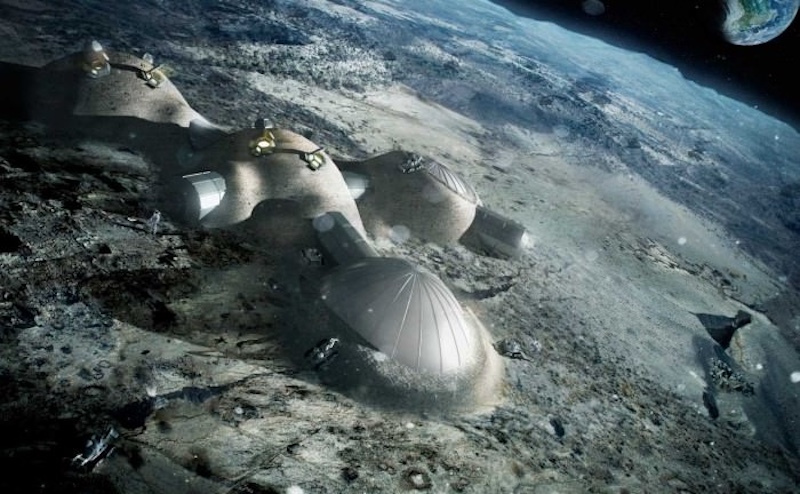
- Is there enough water on the moon to support future large cities?
- There might not be enough water for larger cities of up to a million people, a new study suggests.
- But smaller towns or villages could survive for several centuries.
Enough water on the moon for cities?
Scientists have found many deposits of water ice on the moon, particularly at its poles. But is there enough of it to sustain future humans living there in cities?
This is what Martin Elvis at the Center for Astrophysics | Harvard & Smithsonian in Cambridge, Massachusetts, questions in a new guest editorial article for Frontiers on September 14, 2026.
Elvis and fellow astronomer Jonathan McDowell did the math to try to answer this question. They found that lunar towns or even small cities might not run out of water for over 1,000 years … but moon cities of a million people would likely run out within a century.
The researchers published their peer-reviewed conclusions in Frontiers in Space Technologies on September 13, 2026.
Ice at the moon’s poles
Scientists had long thought the moon to be completely dry. No water, not even ice. But in recent years, probes orbiting the moon have found evidence for ice at the moon’s poles.
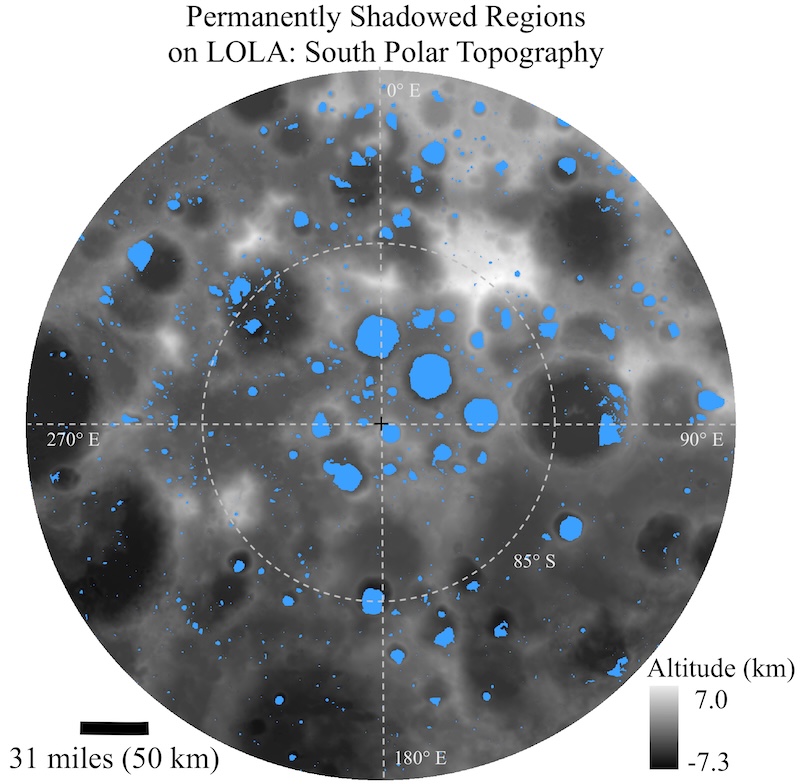
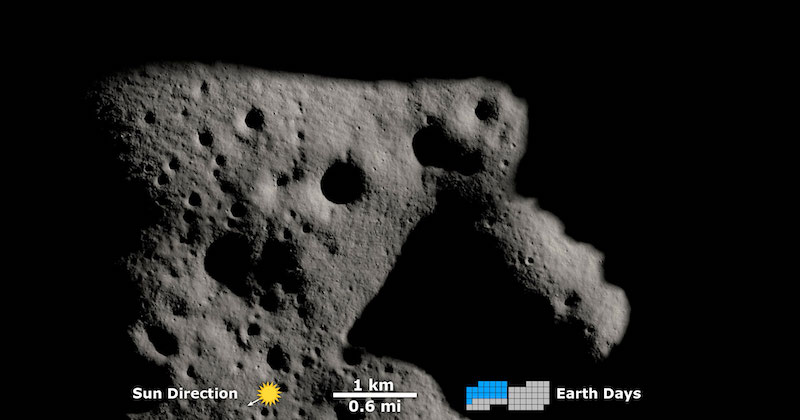
The ice is hiding in extremely frigid “cold traps,” which are deeply-shadowed craters that never see sunlight. This ice has not seen direct sunlight for about 4 billion years. And that ice doesn’t sublimate away (turn from solid to gas) more than a millimeter every billion years.
There might be as much as a billion tons of ice in these dark craters, although estimates vary. So that sounds like good news, right? Well, maybe … maybe not.
Is a city on the moon sustainable?
The researchers started by asking the question:
How sustainable is a city on the moon?
It turned out that power isn’t an issue. While the depths of the craters are always in darkness, the rims of the craters do see sunlight. The researchers found that it would be possible to generate three gigawatts of electricity using kilometer-tall towers covered with solar panels.
Not enough water on the moon
It’s the need for water that brings problems.
The study’s calculations showed that even if there was a billion tons of water locked up as ice, a large city of up to a million people might last only decades. Such a large permanent settlement would need water for drinking, hygiene, food production and life-support systems. And this is the crux of it all: the water is a finite resource.
And if the residents achieved 98% water recycling, as the paper postulates, the city would still run out of water in just over a century. That kind of water recycling has already been achieved on the International Space Station (ISS).
The paper states:
Permanently Shadowed Regions near the lunar poles are insufficient to support a population of one million using ISS-level (98%) recycling for more than about one century. Unless recycling can be improved by factors of about 10, or a similarly greater water supply is discovered, this result precludes large-scale long-term human habitation of the moon.
Note that this figure of a century is an estimate from two researchers, not an established barrier.
The paper’s estimates are based on a model of 1 million people at 500 tons of water/person/year of total water demand, with 98% recycling. That’s reasonable, but again doesn’t come from a standard scientific consensus.
Less water than previously thought
There’s still this one basic and important problem: we still don’t know exactly how much water there is on the moon. There is still a lot of uncertainty of the amount of water ice. And current remote sensing from orbit doesn’t adequately probe the deeper regolith. We need better surveys, reaching deeper underground, where some scientists think there is a good chance of finding more ice.
A study from earlier this year suggested there is much less water ice at the moon’s poles than previously thought. The study we’re discussing in this article used the figure of a billion tons, but other current estimates of the amount of water say it is likely about 30 times less than that. Another study from 2022 estimated only 34 million tons.
If so, a city of a million people might actually only have enough water for decades, rather than a century.
That said, a city of a million people on the moon seems like an extreme possibility. It will still be several years before Artemis astronauts can begin to establish a base camp on the moon. Maybe with a few buildings, but barely large enough to even be considered a village. Water running out would not be a concern for such a settlement.
In fact, the study notes that even a settlement of 100,000 people would have enough water for 1,000 years (with ISS-level recycling efficiency).
Any larger cities — if they ever happen — are likely hundreds of years away. And by that time, we should have a much better idea of exactly how much water there really is on the moon, and better water recycling abilities.

Possible solutions
So obviously, the smaller the better for being sustainable. Thinking far into the future … is there any way a much larger city could survive? There are some suggested solutions.
- Improve the efficiency of water recycling by a factor of five or more.
- Lower water usage from new techniques such as vertical farming.
- Import water from accessible asteroids.
- Find more water on the moon, potentially at greater depths.
As the study notes, simply finding more water would be the best possibility. There could be more cold traps with ice deeper in the lunar regolith (“soil”) that we just haven’t detected yet.
Only time will tell if large moon bases or cities ever become a reality. Aside from the obvious technical and political challenges, that will depend on how much ice there is that can be used for water, or how much water could be brought in from elsewhere.
Bottom line: Is there enough water on the moon for future cities? New estimates say there could be enough for smaller villages or towns, but not larger metropolises.
Source: No cities on the Moon: a billion tons of water is not enough for sustainability
Read more: There’s less ice in moon’s shadows than 1st thought
Like what you read?
Subscribe and receive daily news delivered to your inbox.
More from
Paul Scott Anderson


Baby exoplanet: Astronomers find the youngest world yet

6th batch of Pentagon UAP files: Air Force talk and more
The rings of Chariklo are unexpectedly dynamic and changing
Did Venus have a moon for nearly 2 billion years?



