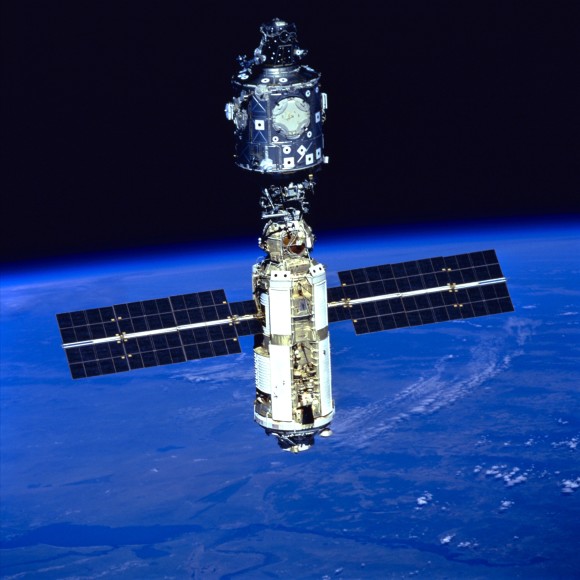
May 29, 1999. The space shuttle Discovery became the first in the shuttle fleet to dock with the with the International Space Station (ISS) on today’s date in 1999. The ISS – today described by American prime contractor Boeing as the “largest, most complex scientific project ever undertaken” – spanned the size of a football field when it was completed in 2011. In 1999, though, the station consisted of only two bare modules, called Zarya and Unity. One of major tasks of the shuttle Discovery’s crew was to transfer more than 1.5 tons of equipment to the inside of ISS.
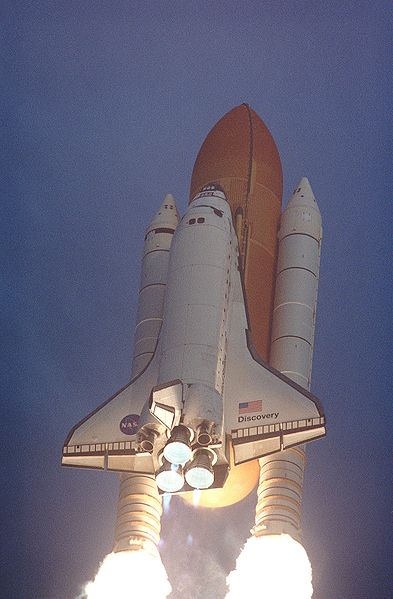
Space shuttle Discovery – mission STS-96 – at launch on May 27, 1999. This shuttle became the first to dock with ISS. Image via NASA.A snapshot of the International Space Station after the STS-96 crew left it in 1999. Image credit: NASA
Additionally, shuttle astronauts undertook what was then the second-longest spacewalk ever performed. While outside for seven hours and 55 minutes, Tamara E. Jernigan and Daniel T. Barry attached two cranes to the station and put out foot restraints for future astronauts to secure themselves during spacewalks.
Although shuttles docked routinely with ISS after that, NASA did not release a photo of a shuttle-ISS docking until 2011. In May of that year, space shuttle Endeavour was docked at the ISS, when the Soyuz TMA-20 left it. Crew member Paolo Nespoli snapped a shot from an altitude of approximately 200 miles (300 km) as he and Russian cosmonaut Dmitry Kondratyev and NASA astronaut Cady Coleman headed back to Earth. That image is below.
First-ever image of a space shuttle docked at the International Space Station. This is the shuttle Endeavour, and the year is 2011. Italian astronaut Paolo Nespoli snapped the image as he and others departed ISS. Image via NASA.
Bottom line: The space shuttle Discovery was the first shuttle to dock with the International Space Station, on May 29, 1999. The space shuttle Endeavour was the first to have its image captured in space while docked to ISS, in 2011.
Elizabeth Howell is an award-winning Canadian journalist who can't stop talking about space and science. As a teenager, she saw the movie Apollo 13 and wanted to be an astronaut. That hasn't happened - yet - but at least she gets to write about them. Elizabeth's favourite career moments so far include attending three shuttle launches, and legitimately writing the word "snot" into a Mars Curiosity story. Besides EarthSky, you can read Elizabeth's work in SPACE.com, Universe Today, SEN.com, All About Space and other fun places. Elizabeth's space obsession extends to her hobbies; she's a big fan of Battlestar: Galactica and has met all five TV Star Trek captains. She even visited Captain Kirk's future birthplace in small-town Iowa.
Deborah Byrd (asteroid 3505 Byrd) helps edit EarthSky.org and is a frequent host of EarthSky videos. Deborah created the EarthSky radio series in 1991 and founded EarthSky.org in 1994. Prior to that, she had worked for the University of Texas McDonald Observatory since 1976, and created and produced their Star Date radio series. She has won a galaxy of awards from the broadcasting and science communities, including having an asteroid named in her honor in 1990, a Public Service Award from the National Science Board in 2003, and the Education Prize from the American Astronomical Society in 2020. A science communicator and educator since 1976, Byrd believes in science as a force for good in the world and a vital tool for the 21st century. "Being an EarthSky editor is like hosting a big global party for cool nature-lovers," she says.
Like what you read? Subscribe and receive daily news delivered to your inbox.
Thank you! Your submission has been received!
Oops! Something went wrong while submitting the form.