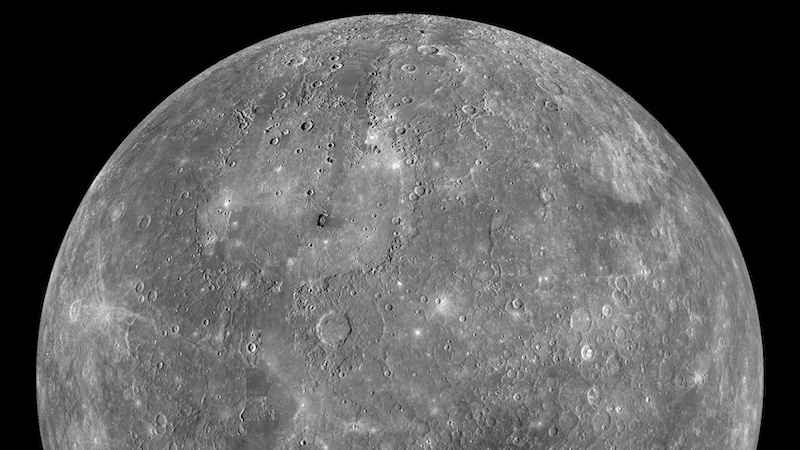
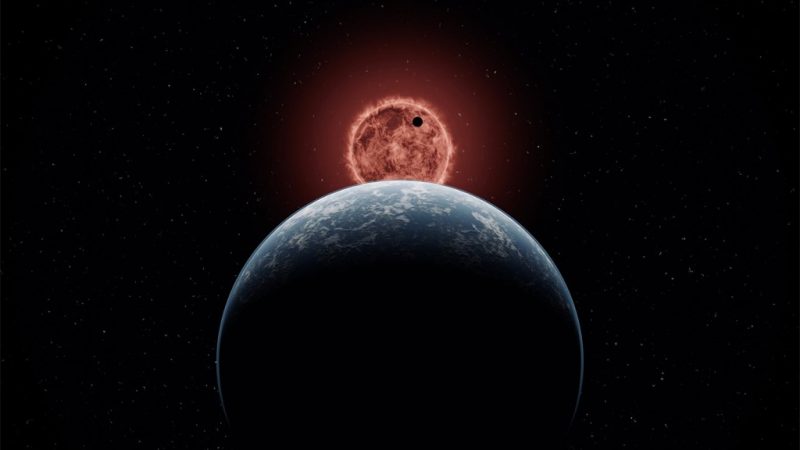
- LHS 3844 b is a super-Earth exoplanet 48.5 light-years from Earth. It’s about 30% larger than our own Earth.
- New observations by the James Webb Space Telescope show that LHS 3844 b is dark, scorching hot and has no atmosphere. Its year last less than half an Earth-day.
- Its composition is also unlike Earth’s, data shows. It likely resembles Mercury or the moon in composition and appearance.
Nearby super-Earth hot and airless
Using the James Webb Space Telescope, an international team of researchers has analyzed the surface of a nearby super-Earth type exoplanet, only 48.5 light-years away. They said on May 4, 2026, that this large, rocky world is dark on its surface, extremely hot and airless. The planet is called LHS 3844 b.
The study suggests LHS 3844 b probably looks a lot like a larger version of our sun’s innermost planet, Mercury, or Earth’s large moon.
But LHS 3844 b orbits much closer to its red dwarf star than Mercury does to our sun. It orbits just 0.006 AU from its star, in contrast to Mercury’s much larger distance of 0.387 AU (1 AU = 1 Earth-sun distance). LHS 3844 b is classified as an ultra-short period planet. So it “hugs” its star tightly, so tightly that its entire year lasts less than half an Earth-day. Meanwhile, Mercury’s year is 88 Earth-days long.
In other words, if you lived on LHS 3844 b, you’d celebrate your birthday twice every earthly day.
Could we live there? Definitely not. It’s too blazingly hot, with surface temps of about 1,340 degrees Fahrenheit or 725 degrees Celsius.
But LHS 3844 is a rocky world. So, assuming we could overcome the heat of its surface, we could stand on it. Its composition is largely basaltic instead of silicate. Silicate minerals are the most common and important class of rock-forming minerals on Earth, making up approximately 90% of the Earth’s crust.
Former PhD student Sebastian Zieba at Max Planck Institute for Astronomy (MPIA) in Heidelberg, Germany (now at the Center for Astrophysics | Harvard & Smithsonian in Cambridge) and Laura Kreidberg at MPIA led the new study.
The researchers published their peer-reviewed findings in Nature Astronomy on May 4, 2026. There is also a non-paywalled preprint version available on arXiv.
1/3 ? Exciting discoveries from the James Webb Space Telescope! Researchers from MPIA and CfA | Harvard & Smithsonian analysed the rocky exoplanet LHS 3844 b, revealing a dark, hot surface likely composed of basalt. We are beginning to do #exogeology. ? #Exoplanets #JWSTwww.mpia.de/news/science…
— Max-Planck-Institut für Astronomie (@mpi-astro.bsky.social) 2026-05-04T19:06:32.622Z
The dark and featureless surface of rocky exoplanet LHS 3844 b from JWST mid-infrared spectroscopy. Sebastian Zieba et. al. https://arxiv.org/abs/2605.00100
— AstroArxiv (@astroarxiv.bsky.social) 2026-05-08T03:31:19.873Z
A dark, scorched world
LHS 3844 b is what scientists call a super-Earth. So it’s about 30% larger than Earth. And it’s also tidally-locked. This means it keeps the same side facing its star, much as our moon keeps a single side toward Earth. Both Earth’s moon – and LHS 3844 b – take the same time to complete one orbit as to complete a single rotation. Voila. That’s why they keep a single face turned toward their parent objects.
But in LHS 3844 b’s case, that object is a star. So this little world is exceedingly hot, especially on its star-facing side. Its surface – basically a dark gray color – is about 1,340 degrees Fahrenheit or 725 degrees Celsius.
A larger version of Mercury or the moon
The researchers say this exoplanet likely resembles Mercury or our moon in appearance. The research team determined this by measuring the infrared radiation coming from the planet’s scorched surface.
Older data from the Spitzer Space Telescope a few years ago also supports this conclusion.
And just like Mercury and the moon, it is an airless world, despite being larger than Earth.
Composition of LHS 3844 b
So apart from its appearance, what’s the composition of LHS 3844 b? The analysis ruled out a composition similar to Earth. Unlike Earth’s silicate composition, this planet’s crust and/or mantle is likely composed of basalt, perhaps similar to the moon.
This also means the planet probably lacks plate tectonics. Zieba said:
Since LHS 3844 b lacks such a silicate crust, one may conclude that Earth-like plate tectonics does not apply to this planet, or it is ineffective. This planet likely only contains little water.
The researchers performed a more detailed statistical analysis. This supported the conclusion that solid areas of basalt or magmatic rock best match the observations. These areas can also contain magnesium, iron and olivine. Crushed rocks and gravel on the surface are thought to be more likely than smaller grains or powders. As Zieba noted:
It turns out, these processes not only slowly dissolve hard rocks into regolith, a layer of fine grains or powder as found on the moon. They also darken the layer by adding iron and carbon, making the regolith’s properties more consistent with the observations.

An active surface? Or not?
Basically, there are two main possible scenarios. The first is that the planet’s surface is mostly dark, solid basaltic or magmatic rock. It is subject to relatively quick alteration by space weather. There might be volcanism involved in this relatively “fresh” surface.
In the other scenario, the dark surface is even more like Mercury or the moon. But there are likely long periods of no geological activity, or maybe none at all.
So which scenario is correct? We don’t know for sure. But one clue is that Webb should have detected sulfur dioxide (SO2) if there was any volcanic activity. And it didn’t. So as of now, the researchers are favoring the second scenario.
The researchers now want additional observations by Webb. They want to examine differences in how solid slabs and powders emit or reflect light on the surface. That would help them further determine which of the two geological scenarios is the most likely. Kreidberg said:
We are confident the same technique will allow us to clarify the nature of LHS 3844 b’s crust and, in the future, other rocky exoplanets.
Bottom line: The Webb space telescope observed nearby super-Earth LHS 3844 b. It found it blazingly hot and airless, close to its star.
Via Max Planck Institute for Astronomy
Read more: Powerful magnetic fields on super-Earths could boost chances of life
Like what you read?
Subscribe and receive daily news delivered to your inbox.
More from
Paul Scott Anderson


Caves on the moon are target of new NASA mission

2nd-generation planet: Was this world born around a dead star?
Weirdest cloud on Mars formed via ‘exotic physics’
Did formaldehyde on ancient Mars help kickstart life?