Rubin finds retrograde object past Neptune
The new Rubin Observatory in Chile has found an object beyond Neptune that follows a retrograde orbit. Most other other planets, moons and asteroids orbit our sun in a more or less flat plane. They generally move in the same direction, counterclockwise as seen from earthly north.
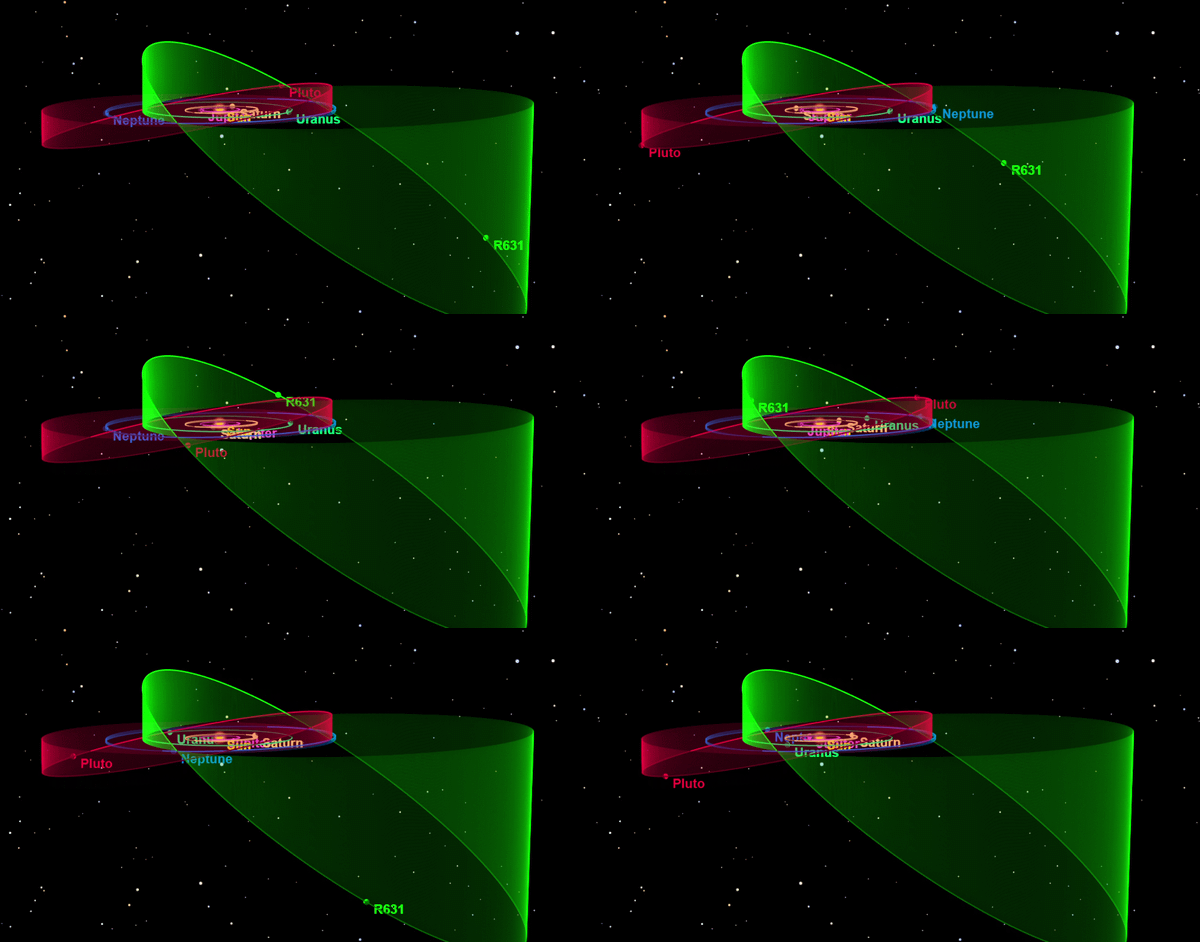
This object’s orbit is highly inclined, slicing through at a severe angle.
When we hear the word retrograde, we tend to think of an object moving backward in its orbit, against the direction of most planets, and many asteroids and moons. But in astronomy, retrograde has a more precise meaning. Any object whose orbit is tilted more than 90 degrees relative to the plane of the solar system is considered to be in retrograde motion.
This newly discovered object, currently designated R631 in the Rubin data, has an orbital inclination of 142 degrees. So its orbit is tilted beyond perpendicular, and it is moving in the opposite direction from most planets.
What sort of object is R631?
The designation R631 is only temporary. The object will soon get an official designation from the Minor Planet Center. Astronomers and citizens alike who monitor Rubin’s alert stream noticed this object, which has appeared over four months in the data. Rubin’s observations of the retrograde object are from December 2025 through March 2026.
R631 is located 32 astronomical units (AU) from our sun. That’s 30 times the Earth-sun distance. And it would place the object just beyond the orbit of Neptune, which is 30 AU from the sun. The object R631 will reach its closest point to the sun, or perihelion, on October 31, 2047, at a distance of 24 AU.
If this orbit is correct, it will take object R631 some 547.84 Earth-years to make one full orbit of the sun.
Physicist and astronomer Marshall Eubanks said on Minor Planet Mailing List that the object could be 62 miles (100 km) in diameter. He said it might be akin to giant Comet Bernardinelli–Bernstein (comet C/2014 UN271), the largest known Oort cloud comet.
If R631 is cometary in nature, it might show some activity (such as outgassing) around the time of its 2047 perihelion. In June 2025, we reported that Comet Bernardinelli–Bernstein has been belching jets from a distance of 16.6 AU from our sun.
Why does R631 orbit in retrograde motion?
Why do objects in our solar system tend to orbit the sun in the same direction? And why might this object be orbiting differently from other objects?
Our solar system is thought to have been formed from a spinning cloud of gas and dust in space. The central concentration of mass pulled itself inward through gravity to form the sun. The rest of the dust and gas went on to clump together and eventually form planets, with crumbs left over as objects such as asteroids, moons and comets.
So there are several ways R631 might have developed a retrograde orbit. It might have been born in another solar system — flung out of its that system, perhaps when the system brushed too close to ours — and ultimately was pulled into the sun’s gravity well.
Alternatively, it might have begun life in our solar system, in an ordinary prograde orbit, like Earth’s. It might then have passed too close to a large object, say Jupiter or a passing star, which flung it into a retrograde path.
Sam Deen, an amateur astronomer who finds lost objects such as asteroids and comets in archival data, said the retrograde object is likely from the Kuiper belt and became destabilized when it passed too close to Neptune sometime in the past billion years.
Is R631 related to the Kreutz sungrazers?
This is not the first object discovered with a retrograde orbit. In fact, there was another famous object that had a 142-degree inclination: the Great Comet of 1882.
This comet was bright. It might have been the brightest natural object in the sky in recorded history. It was visible in daylight, reaching what some say was a magnitude of -17. That’s in contrast to our sun, which has a magnitude of -26. The Great Comet of 1882 came so close to our sun that it broke into fragments. Its highly inclined orbit matched that of the Kreutz sungrazer family of comets, a group of comets that follow remarkably similar orbits, bringing them extremely close to the sun at their nearest approach.
Comet Ikeya-Seki was another Kreutz sungrazer that had an inclination of about 142 degrees. It had a spectacular encounter with the sun in October 1965. Although it survived its extremely close passage, its nucleus broke apart into several pieces. Those fragments gradually faded as they traveled away from the sun.
Scientists think the Kreutz sungrazer comets are all remnants of a single, massive ancient comet that fragmented hundreds or thousands of years ago.
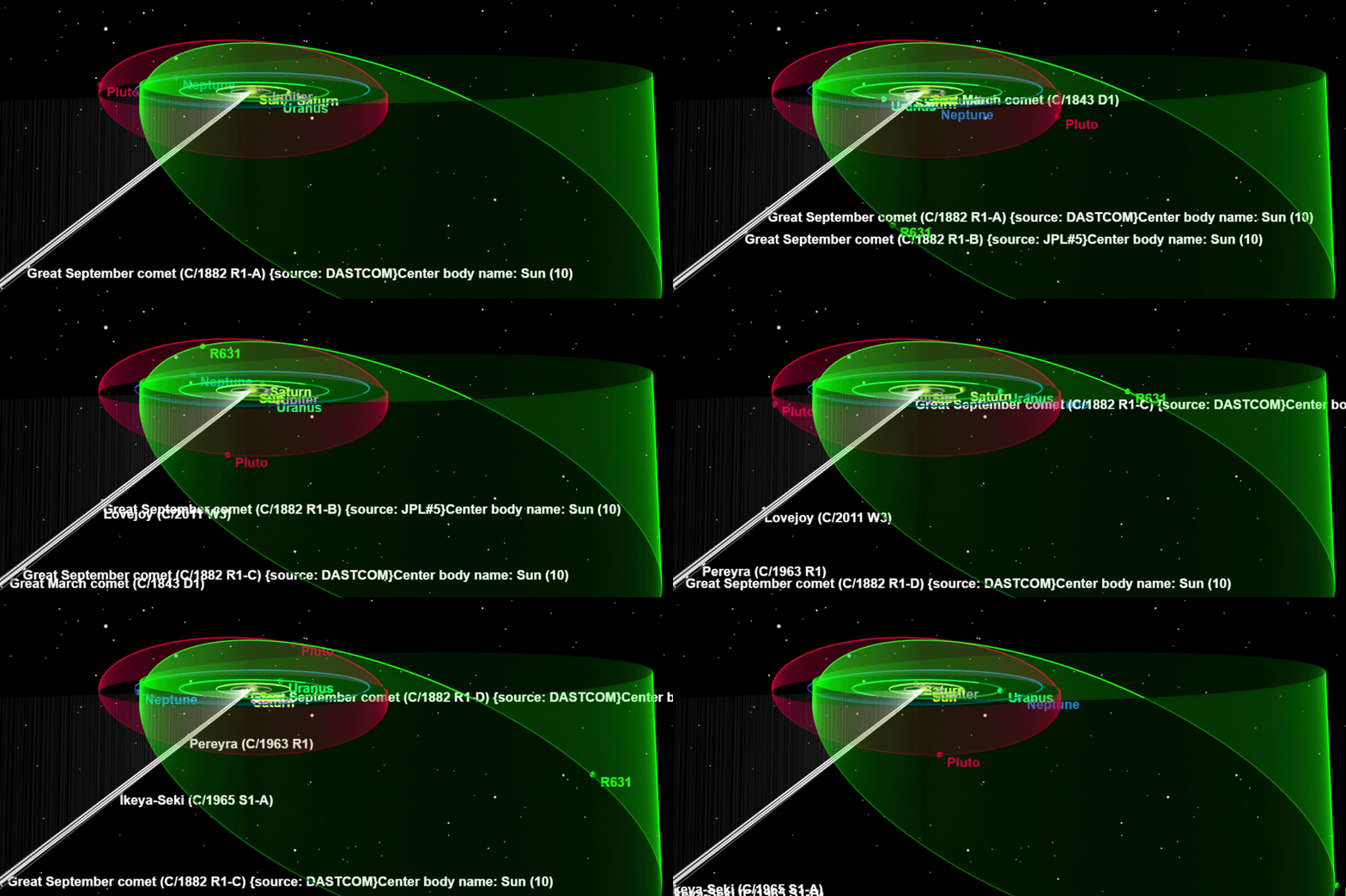
If you’re curious — like I was — if R631 could be from that same object, Tony Dunn ran a simulation of the Kreutz sungrazers versus R631 and the rest of the solar system. His simulation makes it clear that R631 is unrelated.
Bottom line: The Rubin Observatory in Chile has discovered a retrograde object in our solar system. It circles the sun in a highly inclined orbit beyond Neptune.
Like what you read?
Subscribe and receive daily news delivered to your inbox.
More from
Kelly Kizer Whitt


Visible planets and night sky guide for November

The constellation Andromeda the Chained Lady
Swift spacecraft fell back to Earth in a fiery blaze