



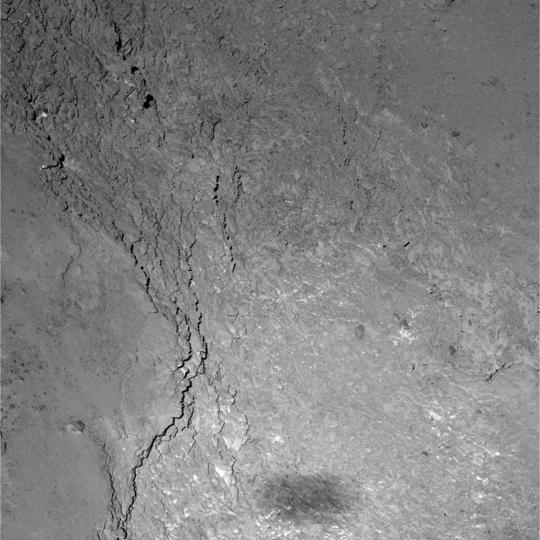
On February 14, 2015, the Rosetta spacecraft made a close flyby of Comet 67P/Churyumov-Gerasimenko. The spacecraft not only passed closer to a comet than any spacecraft had before, but it also became part of a unique space geometry. For a short time during the maneuver – as the spacecraft swept in closest to 67P – the sun, the spacecraft and the comet were almost perfectly aligned. Thus – although the resulting images are of high scientific value – they don’t appear as dramatic as some earlier Rosetta images of the comet, because few shadows can be seen. But there is one exception: as a side-effect of this exceptional geometry, we can see Rosetta’s shadow on the surface of the comet, surrounded by a bright halo-like region.
The images were acquired by OSIRIS, the scientific imaging system on board the Rosetta spacecraft. They have a resolution of 11 centimeters per pixel.
Cool, yes?
Read more about Rosetta’s shadow from the Max Planck Institute for Solar System Research
Enjoying EarthSky so far? Sign up for our free daily newsletter today!
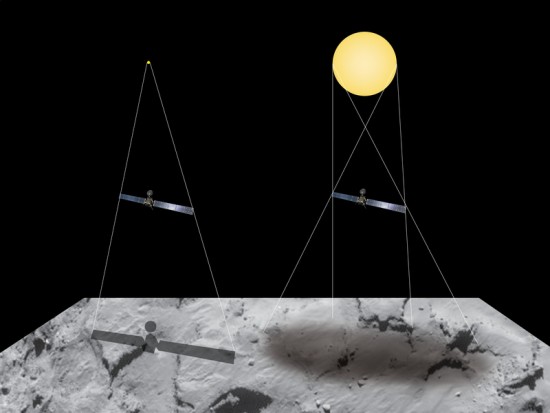
Bottom line: The Rosetta spacecrft caught its own shadow encircled in a wreath of light, on the icy surface of Comet 67P/Churyumov-Gerasimenko, on February 14, 2015.
Like what you read?
Subscribe and receive daily news delivered to your inbox.
More from
Deborah Byrd


Visible planets and night sky guide for October

Cassiopeia and Perseus on October evenings
Orionid meteor shower 2026: All you need to know
See brightest star, Sirius, in your morning sky



